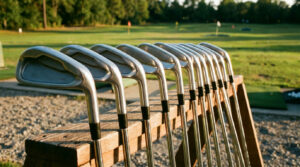

Many golfers spend years working on their swing mechanics. However, they overlook one powerful factor: equipment fit. Custom-Fit Golf Clubs match your swing, body type, and playing style to maximize performance.
Off-the-rack clubs are designed for average specifications. Unfortunately, very few golfers are truly “average.” As a result, mismatched equipment can limit distance, accuracy, and consistency.
When you switch to Custom-Fit Golf Clubs, your equipment begins working with your swing instead of against it. That alignment can lead to immediate and measurable improvement.
Why Standard Clubs Hold Many Golfers Back
Most retail clubs come in standard length, lie angle, and shaft flex. While convenient, these specifications rarely match individual swing characteristics.
For example, a shaft that is too stiff reduces launch and distance. Meanwhile, a shaft that is too flexible increases dispersion. In both cases, performance suffers.
Similarly, incorrect lie angles cause directional misses. If the club sits too upright or too flat at impact, shots consistently drift left or right.
Because small mismatches create big errors, many golfers benefit greatly from Custom-Fit Golf Clubs.
The Science Behind Custom Fitting
Professional club fitting relies on data. During a fitting session, launch monitors measure ball speed, launch angle, spin rate, and dispersion.
Fitters also analyze swing speed, tempo, and attack angle. Using this information, they adjust shaft type, clubhead design, and loft settings.
As adjustments are made, you hit additional shots. Because each change produces measurable data, decisions become objective rather than guesswork.
This data-driven process ensures Custom-Fit Golf Clubs align precisely with your swing dynamics.
Key Areas Where Custom Fitting Makes a Difference
Shaft Flex and Weight
Shaft selection plays a major role in ball flight. A properly fitted shaft optimizes energy transfer and timing.
If the shaft matches your swing speed, launch conditions improve naturally. As a result, distance increases without extra effort.
Club Length
Proper length ensures consistent contact. Clubs that are too long promote inconsistent strikes. Conversely, clubs that are too short affect posture and balance.
Correct club length enhances comfort and control. Therefore, it becomes a foundational part of Custom-Fit Golf Clubs.
Lie Angle Adjustment
Lie angle influences shot direction significantly. A small adjustment can eliminate consistent directional misses.
By ensuring the clubface sits square at impact, accuracy improves dramatically.
Grip Size
Grip size affects hand tension and control. Grips that are too small increase wrist action. Larger grips reduce excess movement.
Because comfort influences consistency, grip fitting contributes to overall performance gains.
Distance Gains From Proper Fit
Many golfers assume only swing changes create distance improvements. However, optimized launch and spin conditions can add significant yardage.
For example, adjusting loft by one degree may increase carry distance noticeably. Likewise, pairing the correct shaft with your swing speed enhances ball speed.
With Custom-Fit Golf Clubs, distance gains often occur without altering technique.
Improved Accuracy and Consistency
Consistency defines lower scores. When clubs match your swing, dispersion patterns tighten.
Because lie angle and shaft flex affect directional control, custom adjustments reduce side spin. Consequently, fairways and greens become easier to hit.
Accuracy improvements also build confidence. When shots start flying predictably, decision-making improves on the course.
For many players, the accuracy benefits of Custom-Fit Golf Clubs outweigh even distance gains.
Do Beginners Benefit From Custom Fitting?
Some golfers believe fitting only helps advanced players. In reality, beginners often see immediate benefits.
Properly fitted clubs reduce frustration. Instead of fighting mismatched equipment, beginners learn with clubs suited to their swing.
While beginners may not need premium shafts, basic fitting adjustments still improve comfort and consistency.
Therefore, Custom-Fit Golf Clubs can support development at every skill level.
When Should You Get Fitted?
Timing depends on your playing goals.
If you struggle with consistent misses, equipment may be the cause. Likewise, if you have improved your swing recently, your current clubs may no longer match your mechanics.
Many experts recommend reassessing equipment every three to five years. As swing speed and strength change, adjustments become necessary.
Scheduling a fitting ensures your Custom-Fit Golf Clubs evolve alongside your game.
Common Myths About Custom Fitting
One common myth is that fitting guarantees perfection. While it improves performance, practice remains essential.
Another misconception suggests fitting always requires expensive upgrades. In many cases, small loft or lie adjustments make a significant difference.
Additionally, some golfers think fittings are time-consuming. Most sessions last between 60 and 120 minutes, making the process manageable.
Understanding these myths helps you approach Custom-Fit Golf Clubs realistically.
Cost vs. Long-Term Value
Custom fitting involves additional expense. However, long-term value often outweighs the cost.
Properly fitted clubs last longer because they remain relevant as your skills improve. Instead of upgrading frequently, you refine performance through minor adjustments.
Moreover, confidence gained from consistent ball flight enhances enjoyment. Lower scores and better rounds justify the investment.
When viewed long term, Custom-Fit Golf Clubs often prove financially wise.
How to Find a Qualified Club Fitter
Look for certified professionals who use advanced launch monitors. Technology such as TrackMan or Foresight ensures accurate data.
Read reviews and ask fellow golfers for recommendations. Experience and brand knowledge also matter.
Because quality fitting determines results, choosing the right specialist is essential for successful Custom-Fit Golf Clubs.
Final Thoughts
Improving your golf game requires attention to detail. While practice and lessons build skill, equipment fit unlocks potential.
Custom-Fit Golf Clubs align shaft, loft, lie, and grip specifications with your unique swing. As a result, distance increases, accuracy improves, and consistency grows.
Rather than adapting your swing to standard clubs, allow professionals to tailor clubs to you. With properly fitted equipment, every swing becomes more efficient and predictable.
Take the step toward customization, and experience how the right fit can transform your performance on the course.
FAQ
- How long does a club fitting session take?
Most sessions last between one and two hours, depending on how many clubs are evaluated. - Can I adjust my current clubs instead of buying new ones?
In many cases, loft, lie, and grips can be adjusted without replacing the entire set. - Do high handicappers need fitted equipment?
Yes, golfers of all skill levels benefit from clubs that match their swing characteristics. - How often should I get refitted?
Every three to five years or after major swing changes is a good guideline. - Are custom clubs more expensive than standard clubs?
They may cost slightly more, but the long-term performance benefits often justify the investment.