
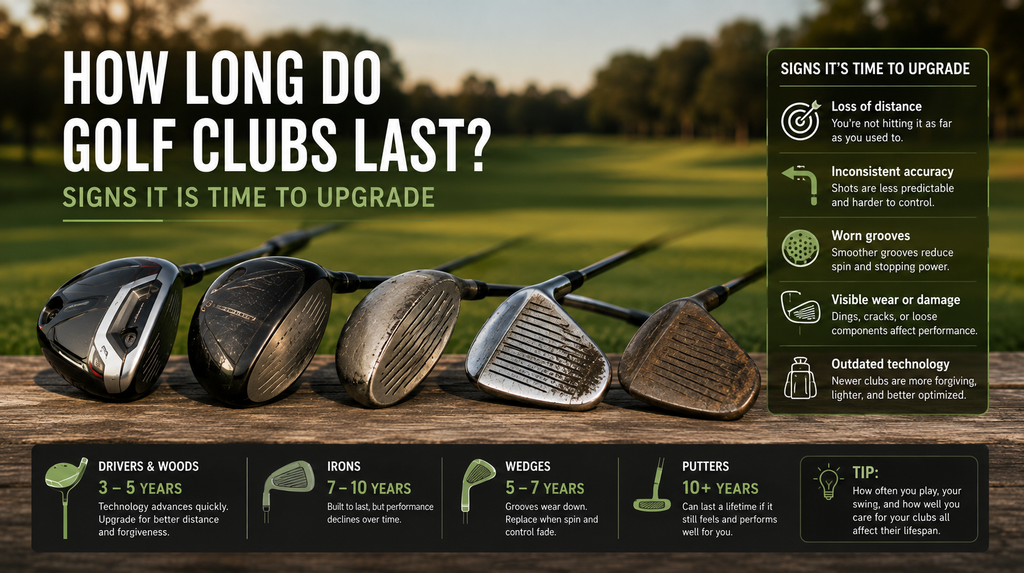
Many golfers wonder how long golf clubs last, especially after using the same set for several seasons. Quality clubs can remain playable for years, but every part of the bag ages differently. Wedges may lose useful groove performance sooner than putters. Meanwhile, drivers can remain functional even after newer technology reaches stores. How often you play, where you practice, and how well you maintain your equipment all affect its lifespan. Therefore, age alone should not determine when you upgrade. Instead, look for changes in condition, consistency, distance, and fit before replacing trusted equipment.
Do Golf Clubs Actually Wear Out?
Golf clubs are designed to handle thousands of impacts. Therefore, normal use does not usually destroy a club quickly. A recreational golfer may use an iron set for many years without experiencing serious structural problems.
However, performance can gradually change. Clubfaces and grooves experience repeated contact with golf balls, turf, sand, dirt, and moisture. Over time, that contact can create wear.
Different parts also age at different rates. Grips may become slick within a season or two. Shafts can remain usable for much longer unless they suffer damage. Meanwhile, clubheads may last for many years with proper care.
How long golf clubs last also depends on playing frequency. Someone who plays twice a month creates far less wear than a golfer who practices daily and plays several rounds each week.
Course conditions matter too. Sandy soil can increase face and groove wear. Similarly, leaving dirt on clubs can hold moisture against metal surfaces.
Age is therefore only one clue. Physical condition and actual performance provide better evidence when deciding whether equipment still belongs in your bag.
How Long Drivers Typically Remain Useful
A driver can remain structurally sound for many years. However, golfers often replace drivers sooner because this category receives frequent technology updates.
For a recreational player, a well-maintained driver can easily remain useful for several seasons. The face does not suddenly lose performance because a newer model arrives.
Frequent players create more impact cycles, though. Eventually, repeated high-speed strikes can place stress on the face, crown, hosel, and shaft connection.
Listen for unusual sounds after impact. A new rattle, crack, or dramatically different sound can indicate damage. In addition, inspect the face and crown for visible cracks.
Distance loss deserves attention as well. However, do not blame the club after one poor round. Swing changes, weather, golf balls, and strike quality can all alter distance.
When evaluating how long golf clubs last, drivers should be judged by consistent results. Compare your current driver against newer options under similar conditions.
If a new model produces only a tiny improvement, replacement may not be worthwhile. On the other hand, a fitting may reveal meaningful gains if your current driver no longer matches your swing.
How Long Should You Keep Your Irons?
Irons are among the longest-lasting clubs in a golfer’s bag. A quality set can provide reliable service for many years, especially for recreational players.
Forged irons may show cosmetic wear sooner because their metal is generally softer. Bag chatter, small dents, and finish marks are common. However, these marks do not always affect performance.
Cast irons can also remain playable for a long time. More importantly, check the grooves and impact area rather than focusing only on appearance.
Players who hit thousands of range balls each year may create visible wear spots on frequently used irons. Short and mid-irons often experience more wear because golfers use them more often.
How long golf clubs last in an iron set therefore varies from club to club. Your 7-iron may show significant face wear while your 4-iron still looks relatively fresh.
Before replacing the entire set, evaluate performance. If carry distances remain predictable and the clubs still fit your swing, there may be little reason to change.
However, a major swing change can make an older set less suitable. Different shaft weight, flex, lie angles, or head designs may better support your current game.
Why Wedges Often Wear Out Faster
Wedges usually experience some of the hardest use in the bag. Golfers hit them from fairways, rough, bunkers, practice areas, and many other surfaces.
Their grooves also play an important role in controlling launch and spin. As those grooves wear, performance can become less predictable, particularly on partial shots and shots where moisture or rough sits between the face and ball.
A golfer who practices wedge shots frequently may notice wear much sooner than a casual player. Sand is especially abrasive. Therefore, regular bunker practice can accelerate surface wear.
Look closely at the face. Rounded groove edges, a smooth impact area, and visible face wear can indicate that performance has changed.
For wedges, how long golf clubs last depends heavily on usage rather than calendar age. A lightly used wedge may stay effective for years. A heavily practiced wedge could require attention much sooner.
Do not assume every old wedge needs replacement, though. Compare launch, carry, stopping behavior, and consistency with a newer wedge.
If your short-game results have become unpredictable despite solid contact, worn grooves may be part of the problem.
Putters Can Stay in the Bag for Decades
Putters experience much less impact stress than drivers, irons, and wedges. They also avoid full-speed contact with turf. As a result, they can remain usable for decades.
Many golfers keep the same putter for years because familiarity creates confidence. If the length, weight, alignment, and feel continue to suit your stroke, there is no automatic reason to replace it.
Check the face insert if your putter has one. Some inserts can become damaged, loose, or worn. Also, inspect the shaft for rust and make sure the head remains securely attached.
The grip will usually need attention much sooner than the putter itself. A worn grip can change how securely and comfortably you hold the club.
When considering how long golf clubs last, putters are often the clear winners. Their lifespan can extend far beyond most other equipment.
An upgrade becomes useful when your setup or stroke changes. For example, a different head shape or alignment system may suit your current putting motion better.
Still, new does not always mean better. If an older putter consistently starts the ball on your intended line, replacing it simply because of age may hurt more than help.
Do Golf Shafts Wear Out Over Time?
Golf shafts generally do not lose their flex simply because they become several years old. A shaft that remains undamaged can continue performing reliably for a long time.
However, physical damage changes the situation. Graphite shafts can suffer cracks, splintering, or impact damage. Pay special attention to areas near the hosel and places where the shaft repeatedly contacts your golf bag.
Steel shafts can develop rust, especially when exposed to moisture. Surface rust may be manageable, but significant corrosion can weaken the shaft.
Never continue using a shaft that appears structurally damaged. A failure during a full swing can create a safety risk.
Your swing may also outgrow a shaft even when the shaft itself remains perfectly usable. Changes in speed, tempo, strength, or technique can alter the weight and flex that suit you.
Therefore, judging how long golf clubs last involves more than checking the clubhead. Shafts, grips, ferrules, and connection points deserve inspection too.
A club fitter can help determine whether an older shaft still matches your delivery. Sometimes a shaft or grip change can refresh a club without requiring a completely new purchase.
Signs Your Golf Clubs May Need Replacing
Visible damage is the clearest reason to consider replacement. Cracks in a driver face, serious shaft damage, loose clubheads, or deep corrosion should never be ignored.
Performance changes can be more subtle. Perhaps your iron distances have become less predictable even though your strike quality remains stable. Alternatively, wedge shots may release more than expected.
Watch for these patterns across several rounds. One bad day does not prove that equipment has worn out.
Another sign is poor fit. Your swing can change substantially over several years. Lessons, fitness, injuries, age, or technique adjustments may alter your speed and delivery.
As a result, equipment that once fit perfectly may become less effective.
The question of how long golf clubs last should therefore include both physical lifespan and useful lifespan. A club can remain intact while no longer fitting the golfer who owns it.
You may also discover large performance gains during a professional fitting. If newer equipment produces clearly better dispersion, launch, or carry, an upgrade could make sense even when your current clubs remain functional.
When Cosmetic Wear Does Not Matter
Golf clubs rarely stay perfect for long. Iron heads develop scratches. Driver soles collect marks. Wedges lose their original finish, while putters can develop small dings.
Fortunately, cosmetic wear does not automatically reduce performance.
Bag chatter on an iron may look significant while having almost no effect on ball flight. Likewise, scratches on the sole generally matter little because that surface does not strike the ball.
Focus on functional areas. The face, grooves, shaft, hosel, and structural connections deserve more attention than superficial marks.
Rust also requires context. Some raw wedges are designed to develop surface rust. However, corrosion on a steel shaft can be more concerning.
Cleaning your equipment makes inspection easier. Once dirt is removed, you can distinguish ordinary marks from cracks or deeper damage.
Before replacing a club because it looks old, test it. If performance remains predictable, appearance alone is a weak reason to spend money.
Understanding why golf clubs last for different periods can help you avoid unnecessary upgrades. Equipment should earn its place through performance, not showroom appearance.
How Maintenance Extends Club Life
Good maintenance does not require complicated products. Simple habits can keep your equipment in better condition for years.
Clean clubfaces and grooves regularly. Use water, a soft brush, and a towel to remove dirt. However, avoid leaving clubheads submerged for long periods because water can reach areas around the ferrule or hosel.
Dry clubs before storing them. Moisture can encourage rust on steel components. This is especially important after playing in rain.
Check your grips too. Dirt, sunscreen, sweat, and skin oils can reduce traction. Cleaning them can restore some grip before replacement becomes necessary.
Store clubs in a dry location with moderate temperatures. A hot car trunk is not an ideal permanent storage area. Extreme conditions can affect grips, adhesives, and other materials.
Headcovers can protect drivers, fairway woods, hybrids, and putters from unnecessary impact damage.
With sensible care, golf clubs last longer and remain easier to inspect. Maintenance also helps you spot small problems before they become expensive ones.
Should You Upgrade Because Technology Has Improved?
Golf manufacturers regularly release new equipment with updated materials, weighting, shapes, and fitting options. Some changes can produce real performance improvements.
However, improvement does not mean every golfer needs every new generation.
If your current driver is several years old, newer designs may offer better forgiveness or more suitable fitting options. Yet the size of that improvement depends on your current equipment and swing.
Iron technology has also developed. Modern game-improvement designs can provide strong ball speed and forgiveness. Still, a properly fitted older iron set may remain highly effective.
Instead of focusing on release dates, compare actual results. Bring your current equipment to a fitting or demo session.
Look at average carry, dispersion, launch, spin, and strike consistency. Most importantly, decide whether the improvement is large enough to justify the cost.
New technology can be valuable, but it should solve a real problem. Marketing alone should not decide when you upgrade.
Replace Grips Before Replacing Good Clubs
Sometimes golfers assume their clubs feel old when the real problem is the grips. Fortunately, grips are far cheaper to replace than an entire set.
A worn grip may feel smooth, hard, shiny, or slippery. Consequently, you might increase grip pressure to prevent the club from moving in your hands.
Extra tension can affect your swing. Therefore, fresh grips can make older equipment feel noticeably more secure.
How quickly grips wear depends on playing frequency, climate, storage, and maintenance. Golfers who play often may need replacements more frequently than occasional players.
Inspect every grip because wear may not occur evenly across the set. Your most frequently used clubs often deteriorate sooner.
Fresh grips can help golf clubs last as useful parts of your bag because they restore an important contact point without requiring a major equipment change.
Grip size matters as well. If your current grips never felt comfortable, regripping offers an opportunity to test a size or texture that better suits your hands.
How to Decide Whether an Upgrade Is Worth It
Start by identifying the problem you want new equipment to solve. Avoid shopping first and searching for a reason afterward.
Perhaps you need more driver forgiveness. Maybe your wedge grooves have become worn. Alternatively, your irons may no longer match your swing after significant technique changes.
Next, inspect your current clubs. Clean them thoroughly and look for structural damage, groove wear, rust, loose components, and worn grips.
Then test your current equipment against potential replacements. Use the same golf ball and similar conditions whenever possible.
Do not judge the comparison by one perfect shot. Instead, examine averages and misses. A worthwhile upgrade should improve an area that matters on the course.
Also consider cost. Regripping, adjusting loft and lie, or replacing a damaged shaft may solve the problem for less money.
Ultimately, golf clubs last longest when they remain physically sound and continue matching your needs. Replace equipment because there is a clear benefit, not because a product launch makes your current set feel outdated.
Conclusion
There is no universal expiration date for golf equipment. Drivers, irons, wedges, putters, shafts, and grips all experience different types of wear.
Wedges often require closer attention because their grooves work through demanding conditions. Meanwhile, irons can remain dependable for many years. Putters may stay useful for decades, while drivers should be evaluated through both physical condition and performance.
Regular cleaning, dry storage, fresh grips, and routine inspections can extend equipment life. More importantly, they help you recognize real problems before they affect your game.
Remember that age alone does not determine how long golf clubs last. Your playing frequency, practice habits, maintenance, swing changes, and equipment condition matter far more. Upgrade when a club becomes damaged, loses useful performance, no longer fits your swing, or when a replacement delivers a meaningful improvement. Until then, a trusted club can keep earning its place in your bag.
FAQ
1. How many years should a set of golf irons last?
A quality iron set can remain useful for many years. Recreational golfers may keep irons for a decade or longer when the grooves, shafts, and clubheads remain in good condition.
2. How do I know when my wedges are worn out?
Look for a smooth impact area, rounded groove edges, and less predictable control. If shots consistently launch or release differently despite good contact, compare your wedges with newer ones.
3. Do golf drivers lose distance as they get older?
Age alone does not automatically cause major distance loss. However, structural damage or heavy use can affect performance. Compare your driver under controlled conditions before deciding it has deteriorated.
4. Should I replace old clubs even if I still hit them well?
No. If your clubs remain safe, fit your swing, and produce predictable results, you do not need to replace them simply because newer models exist.
5. Is it better to regrip old clubs or buy new ones?
If the clubheads and shafts still perform well, regripping is often the smarter and less expensive choice. New grips can restore traction, comfort, and confidence without replacing good equipment.