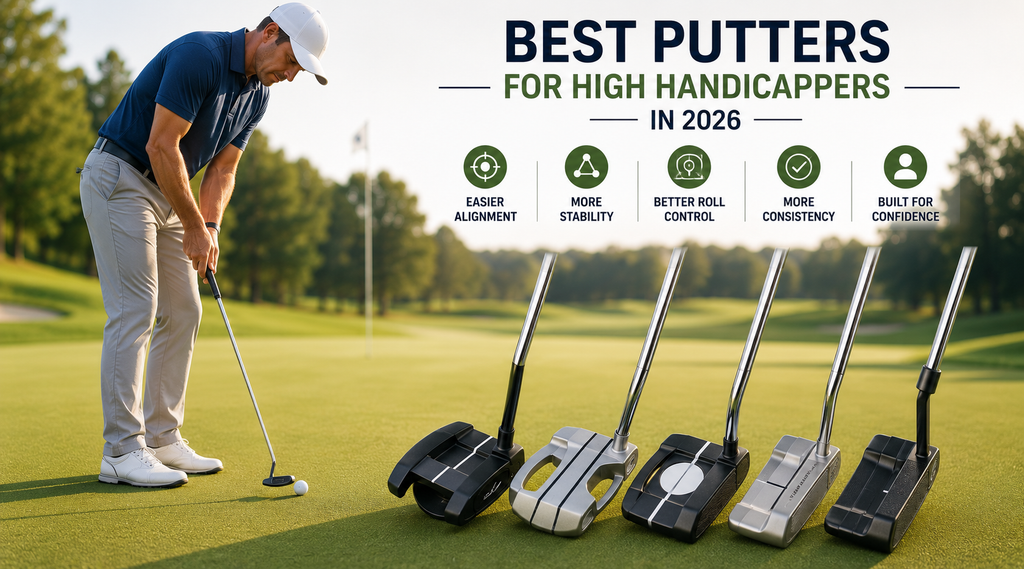
Finding the best putters for high handicappers is less about buying the most expensive model and more about choosing a design that makes putting simpler. High-handicap golfers often lose strokes through inconsistent contact, poor alignment, and unreliable distance control. Fortunately, a suitable putter can make these areas easier to manage. Modern designs offer larger heads, high stability, clear alignment systems, different neck styles, and several grip options. The right combination depends on your stroke and preferences. This guide explains the features worth comparing in 2026 so you can choose a putter that inspires confidence rather than creating another problem to solve.
What High-Handicap Golfers Need From a Putter
Consistency should be the main goal.
You need a putter that makes it easier to aim, return the face predictably, and produce dependable speed. Forgiveness on small mishits can also help.
Many high-handicap golfers benefit from a stable head. A putter that resists excessive twisting can maintain more predictable performance when contact misses the exact center.
Alignment matters just as much. Clear lines or contrasting shapes can help you understand where the face points at address.
However, more alignment features are not always better. Some golfers prefer a simple line, while others feel more comfortable with a larger visual system.
The best putters for high handicappers combine forgiveness with a shape that looks natural behind the ball.
Your goal is to remove uncertainty. When you feel comfortable with setup and alignment, you can focus more attention on distance and target.
Mallet vs Blade Putters
Blade putters have a traditional, compact shape. They can provide excellent feedback and may suit golfers who prefer a simple appearance.
Mallet putters are larger and can move more weight toward the perimeter of the head. This often creates greater stability.
For that reason, many high-handicap players find mallets easier to use.
The larger head also provides more space for alignment aids. Long lines, contrasting sections, and geometric shapes can help golfers visualize their intended start line.
Still, you should not automatically reject a blade.
Some golfers simply aim smaller heads better. Others prefer the way a blade moves during their natural stroke.
When comparing the best putters for high handicappers, test both styles. Pay attention to starting direction, strike location, distance control, and confidence.
The shape that produces the most repeatable results should win, regardless of whether it fits a common recommendation.
Why Forgiveness Matters on the Green
Forgiveness is often discussed with drivers and irons, but it also matters in putting.
Not every putt strikes the exact center of the face. When contact moves toward the heel or toe, the head can respond differently.
A stable putter can reduce the performance loss from these small misses.
This does not mean every off-center putt will roll perfectly. However, greater stability may help preserve speed and direction.
That can be especially valuable on longer putts. A small loss of energy can leave the ball several feet shorter than expected.
The best putters for high handicappers generally make average strikes more predictable rather than rewarding only perfect contact.
During testing, deliberately hit a few putts slightly toward the heel and toe. Compare how the ball reacts.
A forgiving design should help keep those imperfect strikes reasonably close to the intended result.
Alignment Features Can Simplify Aiming
A golfer can make a good stroke and still miss if the putter face starts in the wrong direction.
Therefore, alignment deserves serious attention.
Modern putters offer many visual systems. Some use a single line. Others use multiple lines, contrasting sections, dots, or shapes that frame the golf ball.
The best system depends on how your eyes interpret the target.
Set several putters behind a ball without hitting it. Aim each one toward a target, then check whether the face actually points where you intended.
You may discover that one design looks square much more naturally.
For many players, the best putters for high handicappers are those that reduce the amount of adjustment needed at address.
You should not have to fight the appearance of the putter.
Once you find an alignment style you trust, build a repeatable setup around it.
Face Design and Feel Matter
Putter faces can use milled surfaces, inserts, grooves, or other textures. These designs can influence sound and feel.
Some golfers prefer a soft sensation. Others want firmer feedback at impact.
Neither option is universally superior.
Feel matters because it can influence distance control. If you understand how impact relates to ball speed, judging longer putts may become easier.
The golf ball you use also affects sensation. A softer ball paired with a soft insert can feel very different from a firmer ball on a milled metal face.
Therefore, test putters with your normal ball whenever possible.
While searching for the best putters for high handicappers, do not choose solely from descriptions such as “soft” or “responsive.”
Hit putts from several distances. Look for a face that provides understandable feedback without making you uncomfortable.
Confidence in impact can support better speed control.
Choose the Right Putter Length
Putter length influences posture, eye position, arm position, and how freely the club can move.
A putter that is too long may force you into an awkward setup. You may grip down excessively or stand farther from the ball than you prefer.
A putter that is too short can create the opposite problem. You might bend too much or feel cramped.
Standard retail lengths work for many golfers, but height alone should not determine your choice.
Arm length, posture, setup preference, and stroke style also matter.
When evaluating the best putters for high handicappers, test different lengths while paying attention to comfort and alignment.
Your eyes do not necessarily need to sit perfectly over the ball. However, your setup should feel repeatable.
A professional fitting can help determine a suitable length rather than forcing your body to adapt to whatever putter happens to be available.
Do Not Ignore Putter Lie Angle
Lie angle affects how the putter sits on the ground at address.
If the toe or heel sits excessively off the surface, the setup may become less comfortable and could influence how the face is presented.
Your natural posture and hand position affect the lie angle you need.
This is another reason why copying another golfer’s putter specifications may not work.
During testing, set up naturally rather than manipulating your hands to make the sole look perfect.
If a putter consistently sits awkwardly, ask whether an adjustment or different specification would suit you better.
The best putters for high handicappers should encourage a comfortable setup rather than forcing unnecessary compensations.
A fitter can evaluate both length and lie together. These specifications interact, so changing one may influence the other.
Understanding Toe Hang and Face Balance
Different putters behave differently as they move during the stroke.
Toe hang describes how the head rests when the shaft is balanced in a certain position. Different neck designs and weighting arrangements create different amounts.
Traditionally, golfers with more face rotation have often been matched with more toe hang, while straighter-looking strokes may be paired with designs that resist rotation.
However, putting strokes are more complex than a simple straight-versus-arc label.
Your face angle at impact and strike consistency matter more than matching yourself to a broad category.
When testing the best putters for high handicappers, compare several neck and head configurations.
Do not worry about creating a technically perfect stroke. Instead, identify which putter makes it easiest to start the ball on your intended line.
Actual results should guide your choice.
A Larger Grip May Improve Control
Putter grips come in many shapes and sizes.
Traditional grips are relatively narrow. Larger grips have become common because they can change how the hands feel during the stroke.
Some golfers find that a larger grip reduces excessive hand action and encourages the arms and shoulders to work together.
However, oversized grips are not automatically better.
A grip that feels too large may reduce your sense of the clubhead. Meanwhile, a very small grip can feel uncomfortable for golfers with larger hands.
The best putters for high handicappers should have a grip that feels secure without creating unnecessary tension.
Test several sizes if possible.
Remember that changing the grip can also affect the overall balance and feel of the putter. Therefore, evaluate the complete club after making a significant grip change.
Distance Control Should Be a Priority
Many golfers focus heavily on short putts when testing equipment. However, long-range distance control deserves equal attention.
Three-putts often begin with a poor first putt that finishes too far from the hole.
Test putters from 20, 30, and 40 feet. Instead of trying to hole every attempt, focus on finishing inside a comfortable circle around the target.
Notice whether one putter consistently produces better speed.
Head weight, overall balance, face feel, and strike consistency can all influence your ability to judge distance.
The best putters for high handicappers should help turn long putts into manageable second putts.
Do not choose a putter simply because you made several six-footers during a short test.
A complete evaluation should include short, medium, and long distances because every part of putting contributes to your score.
Stability Can Help With Off-Center Contact
High-stability designs have become increasingly common.
These putters distribute weight in ways intended to resist twisting when impact occurs away from the center.
For golfers with inconsistent strike locations, this can provide useful forgiveness.
Larger mallets often perform well in this area because their shapes allow designers to position mass farther from the center.
However, stability must still work with your stroke.
A highly stable head that feels difficult to aim or control may not be the best choice.
As you compare the best putters for high handicappers, use impact feedback during testing.
Place a small mark or use suitable impact tape to understand where you strike the face. Then compare how different heads perform on similar mishits.
Your goal is not to eliminate every poor strike. Instead, choose equipment that makes ordinary mistakes less costly.
Should High Handicappers Get a Putter Fitting?
A fitting can be valuable even if you are not an advanced golfer.
In fact, high-handicap players may benefit significantly because they often buy putters based on appearance alone.
A fitter can evaluate your setup, stroke, face angle, strike location, launch, and speed control.
They can also compare different lengths, lie angles, head shapes, grips, and neck styles.
This process can reveal problems that are difficult to notice by yourself.
For example, you may consistently aim one type of alignment system left of the target while another naturally points square.
A fitting can narrow down the best putters for high handicappers based on measurable tendencies rather than guesswork.
However, do not ignore comfort. Putting contains a strong visual and feel component. The final choice should produce good data while also giving you confidence over the ball.
How Much Should You Spend on a Putter?
Golfers can find usable putters across a wide range of prices.
A higher price does not guarantee fewer putts.
Premium models may use specialized materials, detailed milling, complex weighting, or high-end finishes. These features can be valuable, but only when they suit your needs.
Budget-friendly models can still provide useful alignment and forgiveness.
Therefore, establish a spending limit before shopping.
Try several options within and slightly around your budget. If an affordable model performs as well as a premium alternative, there is little reason to spend more purely for status.
The best putters for high handicappers deliver value through performance and confidence.
Also consider used putters. Because putters experience less high-speed impact than many other clubs, well-maintained older models can remain excellent options.
Inspect the face, shaft, grip, and overall condition before buying.
New vs Used Putters for High Handicappers
Buying used can stretch your budget significantly.
A previous-generation mallet with a proven design may cost much less than a current model while offering similar practical benefits.
Check the face carefully, especially if the putter uses an insert. Make sure there are no major dents, loose components, or serious damage.
Inspect the shaft for rust or bending. Also, confirm the actual length because previous owners may have modified it.
A worn grip is usually less concerning because replacement is relatively straightforward.
When searching for the best putters for high handicappers, do not assume the newest release is automatically the strongest choice.
A well-fitted older model can outperform a poorly suited new putter.
Used equipment becomes particularly attractive when it allows you to test a higher-quality design without exceeding your budget.
How to Test a Putter Before Buying
Start with alignment rather than immediately hitting putts.
Place the putter behind the ball and aim toward a target. Notice how easily you can square the face.
Next, hit several short putts from three to six feet. Track starting direction rather than simply counting makes.
Then move to medium distances. Pay attention to both line and speed.
Finally, hit several long putts. Your goal is to leave the ball near the hole consistently.
Repeat the process with each candidate.
The best putters for high handicappers should perform well across different distances rather than dominating one specific test.
Avoid hitting dozens of putts with one model before switching. Fatigue and adaptation can influence results.
Alternate between two or three finalists instead. This creates a more useful comparison and can reveal which putter feels naturally comfortable.
Practice Still Matters After Buying a Better Putter
A forgiving putter cannot replace practice.
Once you choose a model, spend time developing a repeatable setup and stroke.
Start with distance control. Place balls at several distances and try to roll them into a target zone rather than aiming at a hole.
Next, practice starting direction. A putting gate or simple straight-line drill can provide immediate feedback.
Short putts deserve regular attention as well. Build confidence by practicing manageable distances with a consistent routine.
Avoid changing your technique every time you miss.
Even the best putters for high handicappers need time to become familiar. You must learn how the face feels, how quickly the ball comes off it, and how the head responds during your stroke.
Consistent practice turns suitable equipment into something you can trust under pressure.
Common Putter-Buying Mistakes to Avoid
One mistake is choosing a putter because a professional golfer uses it. Their stroke, setup, preferences, and specifications may be completely different from yours.
Another is selecting solely by appearance.
Looks matter because confidence is important, but performance should confirm the choice.
Do not test only short putts. A model that feels excellent from five feet may provide poor distance control from 40 feet.
Ignoring length and lie is another common problem. These specifications influence setup and how naturally the putter sits behind the ball.
Golfers also assume that expensive automatically means better.
When comparing the best putters for high handicappers, focus on alignment, forgiveness, feel, fit, and distance control.
Finally, avoid replacing your putter after a few bad rounds. Poor putting can result from technique, green reading, speed control, or confidence rather than equipment alone.
Build a Simple Putting Routine
Consistency begins before the stroke.
First, read the putt from behind the ball and identify the expected break.
Next, choose a starting line and estimate the speed required.
Take one or two practice strokes if they help you feel the distance. Avoid adding unnecessary movements that make the routine difficult to repeat.
Set the putter behind the ball and align the face.
Then settle into your posture and make the stroke.
Try to keep the routine similar whether the putt is for par, birdie, or double bogey.
The best putters for high handicappers work even better when paired with a dependable routine.
A consistent process reduces indecision. Instead of changing thoughts over the ball, you can focus on your chosen line and speed.
Conclusion
High-handicap golfers do not need complicated putting equipment. They need a putter that simplifies alignment, contact, and distance control.
Mallet designs can offer excellent stability and clear visual guidance, although some golfers will perform better with blades. Test both rather than choosing by reputation.
Pay attention to length, lie angle, head shape, neck design, grip size, and face feel. Each feature influences how naturally you set up and deliver the putter.
Forgiveness also deserves attention. A stable design can make small off-center strikes less damaging.
Whenever possible, test putters from several distances or complete a professional fitting. Most importantly, choose performance over price or popularity.
The best putters for high handicappers are those that make your normal stroke more predictable. Find a design you can aim confidently, control from long range, and trust on short putts. Pair it with focused practice, and you can create a simpler path toward fewer three-putts and lower scores.
FAQ
1. Are mallet putters better for high-handicap golfers?
They can be. Mallets often provide high stability and larger alignment features. However, golfers who aim or control a blade better should not switch simply because mallets are commonly recommended.
2. What putter length should a beginner use?
The right length depends on height, arm length, posture, and setup preference. Test different lengths and choose one that allows a comfortable, repeatable address position.
3. Does a bigger putter grip make putting easier?
A larger grip may reduce excessive hand action for some golfers. However, it can also change feel and balance, so compare different sizes before deciding.
4. Should I buy an expensive putter to improve my scores?
Not necessarily. Fit, alignment, distance control, and confidence matter more than price. An affordable model that suits your stroke can outperform a costly one that does not.
5. How often should a golfer replace a putter?
There is no fixed replacement schedule. Putters can remain useful for many years. Replace yours when damage, poor fit, or a clearly better-performing option provides a valid reason to change.