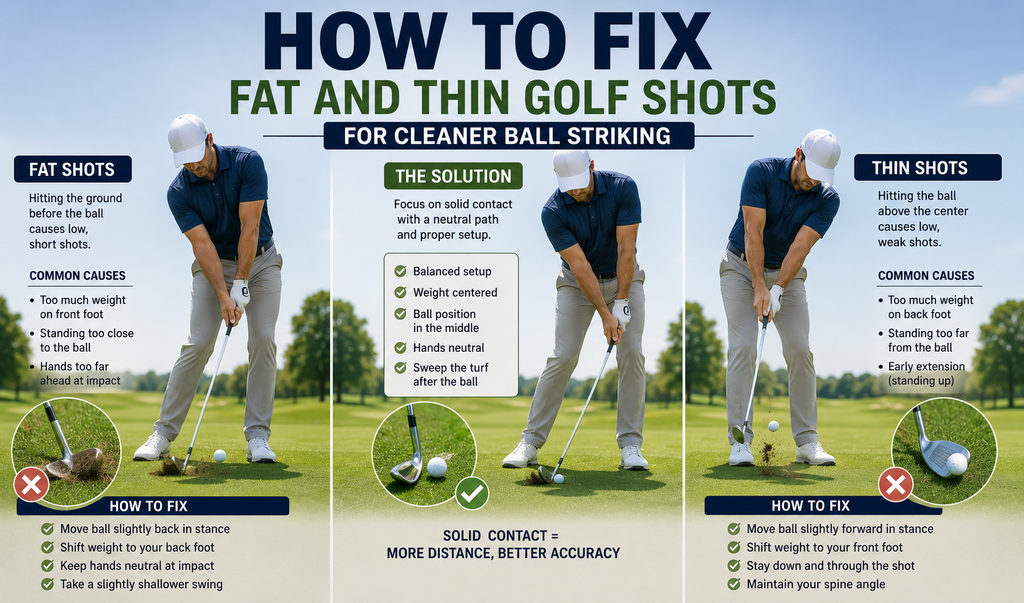
Few mistakes frustrate golfers more than hitting the ground before the ball or catching an iron shot too thin. Learning to fix fat and thin shots starts with recognizing that both misses often come from the same basic problem: inconsistent control of the bottom of your swing. A fat shot reaches the ground too early. A thin shot usually occurs when the club reaches its lowest point in the wrong place or rises before making solid contact. Fortunately, you do not need to rebuild your entire swing. Better ball position, balance, pressure movement, and focused practice can help you strike the ball more cleanly.
Understand What Causes Fat and Thin Golf Shots
A fat shot occurs when the club contacts the ground before reaching the ball. The turf absorbs energy, so the shot usually travels shorter than expected.
A thin shot happens when the clubface contacts the ball too high relative to the face’s ideal strike area. The ball may fly low and fast, and severe misses can feel uncomfortable in your hands.
Although the results look different, both problems often relate to low-point control.
With a normal iron shot, the club should generally contact the ball before reaching the lowest part of its path. The club can then continue downward and interact with the turf after impact.
Therefore, learning to fix fat and thin shots is largely about creating a predictable strike location.
Instead of trying to scoop the ball into the air, focus on producing a balanced motion that allows the clubhead to reach the ball before the turf.
Check Your Ball Position First
Ball position is one of the simplest variables to inspect.
If the ball sits too far forward, some golfers reach the bottom of the swing before impact. The club may hit the turf first or begin moving upward before reaching the ball.
A ball positioned too far back can create different problems. It may encourage an excessively steep strike or force you to make compensations.
For a standard mid-iron, start with the ball around the middle portion of your stance, adjusted slightly according to the club and your swing.
Longer clubs generally move somewhat forward. Shorter clubs typically sit closer to the center.
However, avoid changing ball position after every poor shot.
Place an alignment stick along your stance during practice. This makes it easier to see where the ball actually sits.
A repeatable setup gives you a stronger foundation to fix fat and thin shots without relying on constant swing adjustments.
Maintain a Stable Setup
Your posture influences where the club returns at impact.
Begin with an athletic stance. Allow your knees to flex naturally while tilting forward from the hips.
Avoid sitting too far back or reaching excessively toward the ball.
Your arms should hang comfortably. From there, establish enough distance from the ball that you can swing without feeling crowded or stretched.
Posture should remain relatively stable during the motion.
If your body rises dramatically through impact, the club can move away from the ground and create thin contact. Meanwhile, excessive lowering or collapsing can move the club toward the turf too early.
You do not need to remain perfectly still. A golf swing naturally involves movement.
However, controlling unnecessary vertical changes can help you fix fat and thin shots.
Record your swing from face-on and down-the-line views. Video can reveal posture changes that are difficult to feel while swinging.
Improve Your Pressure Movement
Poor pressure movement can contribute to inconsistent contact.
Some golfers move heavily onto the trail side during the backswing but fail to move forward effectively during the downswing.
As a result, the bottom of the swing can remain too far behind the ball.
For a right-handed golfer, pressure should move naturally into the right side during the backswing and then begin shifting toward the left side as the downswing develops. Reverse these directions for a left-handed golfer.
Do not exaggerate the movement by sliding your entire body toward the target.
Instead, think about finishing in balance with most of your pressure supported by the lead side.
When trying to fix fat and thin shots, pay attention to where your body finishes.
If you regularly end with significant weight on your trail foot, improving your pressure shift may help move the strike forward and create cleaner contact.
Do Not Try to Lift the Golf Ball
Golf irons are designed with loft. You do not need to help the ball into the air.
Yet many golfers instinctively lean backward or scoop with their hands because they want to see a high shot.
This movement can shift the swing’s low point behind the ball.
Sometimes the club hits the ground first. On another swing, the golfer senses the ground approaching and pulls upward, producing thin contact.
The solution is not to force your hands aggressively forward.
Instead, trust the loft of the club and allow the swing to move naturally through impact.
To fix fat and thin shots, think about striking through the ball rather than underneath it.
A useful practice goal is to contact the ball first and brush the turf afterward. You do not need to create a huge divot. Clean contact is more important than how much grass you remove.
Control Your Low Point
Low-point control is one of the most useful concepts in iron striking.
Imagine the clubhead traveling along an arc. That arc eventually reaches its lowest position before beginning to rise.
For many standard iron shots, you want that lowest point to occur slightly ahead of the ball.
If it occurs behind the ball, fat contact becomes more likely. If your body makes a sudden adjustment to avoid the ground, thin contact can follow.
A simple drill can improve awareness.
Draw a line on a practice mat or use a safe line in a suitable grass practice area. Set up with the ball just behind the line from the target’s perspective.
Try to strike the ball and then contact the ground on the target side of the line.
This drill helps you fix fat and thin shots by giving you immediate feedback about where the club reaches the turf.
Keep Your Head Movement Natural
Golfers often hear, “Keep your head down.”
Unfortunately, taking that instruction too literally can create tension and restrict movement.
Your head does not need to remain completely motionless. Instead, focus on maintaining reasonable posture and balance.
Excessive movement away from the target can make it difficult to return the club to the same location. Likewise, standing up rapidly before impact may lead to thin shots.
Rather than forcing your head downward, allow your body to rotate while maintaining your basic inclination toward the ball.
After impact, your head and eyes can follow the shot naturally.
To fix fat and thin shots, prioritize stable body movement rather than a rigid head position.
A relaxed, athletic motion is easier to repeat than one built around trying to freeze a single body part throughout the swing.
Use a Smooth Tempo
Swinging harder does not guarantee better contact.
In fact, excessive effort often makes strike problems worse.
When golfers rush the transition from backswing to downswing, their sequence can become inconsistent. Balance may suffer, and the club’s low point can move unpredictably.
Practice at a comfortable speed.
Start with half swings using a short or mid-iron. Focus on balance and clean contact rather than distance.
Once you can strike several shots consistently, gradually increase the length of your swing.
This approach helps you fix fat and thin shots without adding unnecessary speed before your movement becomes reliable.
A smooth tempo also makes it easier to identify what caused a miss.
If every swing happens at maximum effort, small setup and balance problems become harder to recognize.
Distance can return later. First, build a strike you can repeat.
Avoid Excessive Trail-Side Lean
At address, some golfers create too much upper-body tilt away from the target when hitting irons.
A small amount of natural tilt can exist. However, excessive trail-side lean can encourage the bottom of the swing to remain behind the ball.
This problem may become worse if you continue leaning backward during impact.
Check your setup in a mirror or on video.
With a standard iron, your body should look balanced rather than dramatically tilted away from the target.
During the downswing, allow pressure to move forward while your body continues rotating.
You should not feel as though your chest is falling backward while your hands try to rescue the shot.
Correcting this pattern can help fix fat and thin shots because it improves your ability to control where the club reaches the bottom of its arc.
Practice With Shorter Swings
Full swings introduce more speed and movement. Therefore, they can make it harder to diagnose contact problems.
Short swings provide a better starting point.
Take a pitching wedge or short iron and make waist-high-to-waist-high swings. Your goal is simply to strike the ball before brushing the turf.
Do not worry about how far the shot travels.
After several solid strikes, increase the swing gradually.
You can also place two tees or markers on the ground to create a small contact zone. Try to enter the turf within that area consistently.
Short-swing practice is particularly effective when trying to fix fat and thin shots because it removes unnecessary complexity.
If you cannot control contact with a small swing, adding speed is unlikely to solve the problem.
Master the simpler motion first, then build toward normal shots.
Check Your Distance From the Golf Ball
Standing too close or too far away can create compensations.
If you stand extremely close, your arms may have limited space through impact. You might stand up or pull the club inward to avoid feeling crowded.
If you stand too far away, you may reach toward the ball and struggle to maintain balance.
Either pattern can affect strike quality.
At address, let your arms hang naturally from your shoulders. Then position yourself so the grip sits comfortably in your hands without excessive reaching.
Different clubs require slightly different distances because their lengths vary.
Once you find a comfortable setup, make it repeatable.
Many golfers trying to fix fat and thin shots immediately change their swing mechanics while ignoring address position.
Before making complicated adjustments, confirm that your setup allows your body and arms enough room to move naturally.
Use Divots as Feedback
Your divot can tell you useful information about impact.
For a solid iron strike, the divot generally begins around or after the ball’s original position rather than several inches behind it.
If the turf disturbance consistently starts behind the ball, your low point is too far back.
However, do not become obsessed with creating large divots.
Some golfers naturally produce shallow turf interaction, while others take deeper divots. Both can hit excellent shots.
Direction matters too. A divot that points dramatically left or right can provide clues about swing path, although divot direction alone does not tell the complete story.
When working to fix fat and thin shots, use turf interaction as feedback rather than as a goal.
Focus on ball-first contact and predictable strike location.
On mats, where divots are unavailable, use contact-line drills or other safe feedback methods to monitor where the club reaches the surface.
Learn From Your Strike Pattern
Do not judge your iron game from one shot.
Instead, examine patterns across several swings.
If eight out of ten shots are fat, you likely have a repeatable low-point problem. If misses alternate between fat and thin, your body may be making compensations from swing to swing.
Strike location on the clubface matters too.
Use suitable impact spray or face tape during practice to see where the ball contacts the face.
You may discover that your “thin” shots also occur toward the heel or toe.
This information makes practice more focused.
Rather than trying random tips, you can identify your most common miss and work on the likely cause.
A pattern-based approach makes it easier to fix fat and thin shots because you are solving a repeated problem instead of reacting emotionally to every poor swing.
Do Not Change Too Many Things at Once
Golfers often respond to poor contact by changing their grip, stance, backswing, downswing, and follow-through during the same practice session.
That makes improvement difficult to measure.
Choose one variable first.
Ball position is a sensible starting point because it is easy to check. Next, evaluate balance and pressure movement.
Then work on low-point drills if needed.
Hit enough shots after each adjustment to see whether the strike pattern changes.
If you make five changes simultaneously and suddenly hit a good shot, you will not know which adjustment helped.
A simpler approach can fix fat and thin shots more efficiently.
Keep notes during practice if necessary. Record what you changed and whether contact improved.
Golf improvement becomes easier when you treat practice as a process rather than searching for an instant fix after every miss.
Take Your Improved Contact to the Course
Range improvement does not always transfer immediately to real golf.
On the course, every shot presents a different lie, target, and level of pressure.
Start by choosing conservative targets.
You do not need to attack every flag while rebuilding your contact. Aim toward larger areas of the green and use a club that allows a comfortable swing.
Pay attention to lie conditions as well.
A ball sitting on a slope requires adjustments that a flat range mat does not teach.
Before each shot, make one clear decision about your target and club. Then trust the swing you practiced.
Do not carry several technical thoughts into impact.
To fix fat and thin shots during actual rounds, focus on a repeatable setup and balanced finish.
Save detailed mechanical work for practice sessions. On the course, your priority should be committing to the shot.
When Equipment Could Be Part of the Problem
Technique usually plays a major role in poor contact, but equipment can influence how easily you deliver the club.
Clubs that are dramatically too long or too short may affect posture and strike consistency.
Shaft weight can also influence timing. If a club feels extremely heavy or unusually light, you may struggle to sense its position during the swing.
Lie angle and overall club design can influence performance too.
However, avoid blaming equipment for every poor shot.
If you regularly hit both fat and thin shots with several clubs, technique and setup deserve attention first.
A professional fitting can help if your equipment feels uncomfortable or clearly unsuitable.
Properly fitted clubs will not automatically fix fat and thin shots, but they can remove unnecessary obstacles.
The goal is to use equipment that allows you to establish a comfortable setup and make your natural swing without extreme compensations.
Build a Simple Practice Routine
Effective practice does not need to involve hundreds of balls.
Begin with ten short swings using a wedge. Focus only on ball-first contact and balance.
Next, hit ten shots with a mid-iron while monitoring your low point.
Use a line or another suitable ground reference if your practice facility allows it.
Then hit several normal shots to different targets. This adds a realistic decision-making element.
Finish by changing clubs after every swing. On the course, you rarely hit the same iron repeatedly, so random practice can improve adaptability.
Track the number of clean strikes rather than only judging distance.
Over time, increase your target. For example, aim to produce seven clean contacts out of ten, then work toward eight.
A structured routine can help fix fat and thin shots while giving you a clear way to measure progress.
Common Ball-Striking Mistakes to Avoid
Trying to scoop the ball is one of the biggest mistakes. The club already has loft, so let it do the work.
Another problem is swinging too hard. More effort can reduce balance and make low-point control less predictable.
Do not force your head to remain completely still either. Natural rotation is necessary for a functional golf swing.
Constantly moving the ball around your stance can also create confusion.
Likewise, avoid searching for a new swing tip after every poor strike.
Instead, focus on setup, balance, pressure movement, and predictable turf contact.
If your practice remains inconsistent despite focused work, consider getting help from a qualified golf instructor.
Professional feedback can identify movement patterns that are difficult to diagnose alone.
Learning to fix fat and thin shots becomes much easier when your practice addresses the real cause rather than the appearance of each individual miss.
Conclusion
Fat and thin iron shots may look like opposite mistakes, but they often share a common cause: inconsistent control of the bottom of your swing.
Start with the simplest factors. Check ball position, posture, distance from the ball, and balance. Then work on moving pressure toward the lead side while allowing the club to strike the ball before the turf.
Avoid trying to lift the ball. Instead, trust the club’s loft and focus on clean contact.
Short swings and low-point drills can provide useful feedback without overwhelming you with technical thoughts. As your strike improves, gradually add speed and longer swings.
Most importantly, learning to fix fat and thin shots takes repetition. Judge your progress by patterns rather than individual swings. A predictable setup, balanced motion, and consistent low point can turn frustrating iron contact into cleaner, more reliable ball striking.
FAQ
1. Why do I hit some iron shots fat and others thin?
Both misses can result from inconsistent low-point control. Your body may also compensate differently from one swing to another, causing the club to strike either the turf or ball incorrectly.
2. Where should the divot start on a good iron shot?
For a typical iron strike, turf interaction generally begins around or just after the ball’s original position. However, divot depth varies between golfers.
3. Can standing up during the downswing cause thin shots?
Yes. Excessive changes in posture can move the club away from the ground and contribute to thin contact. Focus on maintaining a balanced, athletic motion.
4. Should I keep my head down to improve iron contact?
Avoid forcing your head into a rigid position. Maintaining reasonable posture and balance is more useful than trying to keep your head completely still.
5. What is the easiest drill for improving ball-first contact?
A simple contact-line drill can help. Use a safe ground reference and practice striking the ball before contacting the surface on the target side of the line.