
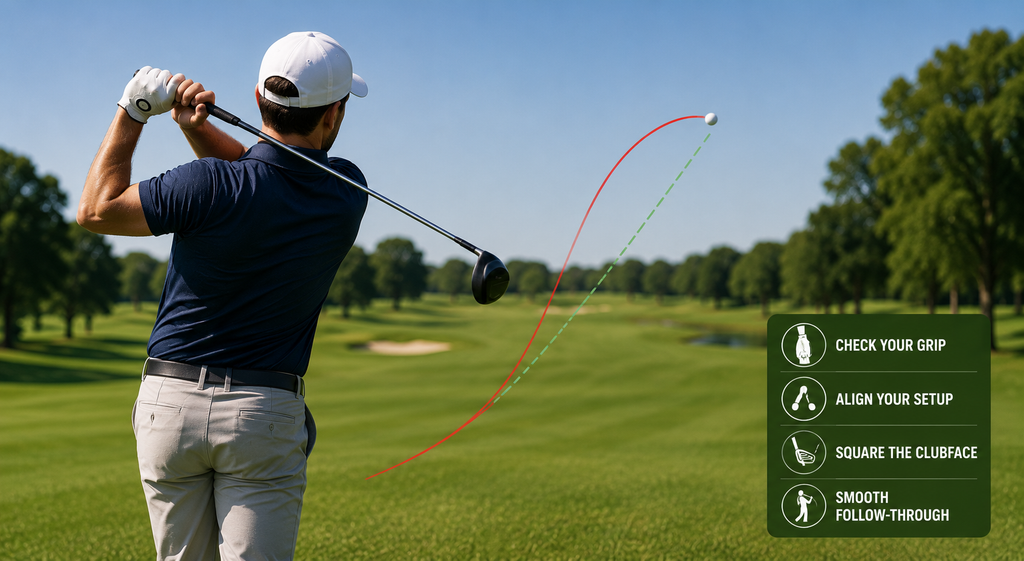
Learning to stop hooking the golf ball can quickly make your game more predictable. For a right-handed golfer, a hook starts right or near the target before curving strongly left. For a left-handed player, the direction is reversed. A small draw can be useful, but a severe hook often leads to missed fairways, blocked approaches, and penalty trouble. Fortunately, you do not need to rebuild your entire swing. Start by understanding the relationship between your clubface and swing path. Then check your grip, alignment, ball position, rotation, and release. With focused practice, you can turn a destructive hook into a straighter and more controlled ball flight.
Understand Why a Golf Ball Hooks
Ball flight gives you valuable information about what happened at impact.
A hook develops when the clubface is too closed relative to the path of the club. For a right-handed player, that relationship creates the spin axis that makes the ball curve left.
Therefore, fixing a hook requires more than simply aiming farther right.
You need to improve the relationship between face angle and swing direction.
If you want to stop hooking the golf ball, begin by watching two things: where the shot starts and how it curves.
The starting direction provides clues about the clubface. The amount and direction of curve provide additional information about the relationship between the face and path.
You do not need complex equipment to begin noticing these patterns. Simply paying closer attention to ball flight can make practice more productive.
Know the Difference Between a Hook and a Pull
A hook and a pull can both finish left of the target for a right-handed golfer, but they are not the same shot.
A pull generally starts left and stays relatively straight.
A hook curves significantly left during flight.
You can also hit a pull-hook, which starts left and curves even farther left.
This distinction matters because different impact conditions can create each result.
If you incorrectly diagnose every left miss as a hook, you may work on the wrong part of your swing.
To stop hooking the golf ball, identify your normal pattern first.
Place an alignment target downrange and observe where your shots begin.
Do not judge only where the ball finishes.
That simple habit gives you better feedback and helps you select the right correction.
Check Your Grip First
Your grip strongly influences clubface control.
A grip that is too strong for your swing can make it easier for the clubface to close excessively through impact.
For a right-handed golfer, a strong grip often means both hands are rotated too far toward the right side of the handle.
However, grip appearance varies between players.
Do not force your hands into an uncomfortable position simply because a picture says they must look a certain way.
Instead, make small adjustments.
If you are trying to stop hooking the golf ball, slightly neutralizing an excessively strong grip may help.
Start with your lead hand. Then place the trail hand naturally so both hands work together.
Hit several controlled shots before making another change.
Large grip adjustments can feel strange and may create a new miss.
Avoid Excessive Grip Pressure
A strong grip position and strong grip pressure are different things.
You can place your hands neutrally on the club and still squeeze too tightly.
Excessive tension can reduce rhythm and make it difficult for your arms, wrists, and body to work together.
On the other hand, holding the club too loosely can also reduce control.
Aim for secure but comfortable pressure.
You should feel that the club will not move in your hands, yet your forearms should remain relatively relaxed.
When working to stop hooking the golf ball, notice whether tension increases before difficult tee shots.
Many golfers unknowingly squeeze harder when they fear a hook.
That tension can disrupt tempo and make the swing less coordinated.
Take one practice swing with relaxed arms before addressing the ball.
Check Your Alignment
Poor alignment can encourage compensations.
For example, a right-handed golfer who aims too far right may instinctively swing or release the club in a way that sends the ball back toward the target.
Over time, that compensation can contribute to a hook pattern.
Use an alignment stick or club on the ground during practice.
Set it parallel to your target line and check your feet, knees, hips, and shoulders.
Your body does not need to feel perfectly square in every situation, but you should know where you are aimed.
If you want to stop hooking the golf ball, remove accidental alignment errors before changing your swing.
Otherwise, you may be correcting a movement that developed only because your setup was pointed in the wrong direction.
Review Your Ball Position
Ball position can influence your delivery.
If the ball moves too far forward for your swing, the club may have more time to close before impact.
That can make a left miss more likely for some right-handed golfers.
However, moving the ball dramatically backward is not a reliable long-term solution.
It can create different contact and path problems.
Instead, establish a consistent reference point for each club.
With a driver, the ball is generally played forward in the stance. Irons gradually move closer toward the center as the clubs become shorter.
To stop hooking the golf ball, experiment only with small ball-position adjustments.
Use alignment sticks during practice so you can see whether the ball has gradually moved away from your intended position.
Watch for an Excessively In-to-Out Path
Many golfers learn that an in-to-out swing can help eliminate a slice.
That advice can work, but exaggerating the movement creates another problem.
If the club travels dramatically from inside to outside while the face is closed relative to that path, the ball can hook strongly.
Therefore, do not chase the biggest possible in-to-out number.
A functional swing path should work with your desired ball flight.
When trying to stop hooking the golf ball, feel as though the club travels more toward the target after impact rather than dramatically out to the right for a right-handed golfer.
This is a practice feel, not a requirement to force the club perfectly straight.
Use ball flight as your guide.
If the curve becomes smaller, you are moving in a useful direction.
Do Not Try to Hold the Clubface Open
Golfers who fear a hook sometimes try to prevent the clubface from closing at all.
They may stiffen their wrists, stop their release, or guide the club through impact.
That approach can create weak blocks, poor contact, and inconsistent speed.
The goal is not to freeze the face.
Instead, improve how the face and path work together.
A functional release allows the club to move naturally while your body continues rotating.
To stop hooking the golf ball, focus on producing a more neutral impact rather than fighting the clubhead with your hands.
A controlled swing at 70% or 80% effort is a good place to practice this feeling.
Once the ball flight becomes more predictable, gradually increase speed.
Keep Your Body Rotating Through Impact
A stalled body can force the hands to become overly active.
For some golfers, the lower body begins the downswing but then stops rotating. The arms and hands continue moving, and the clubface can close rapidly.
Improving rotation may reduce the need for that last-second hand action.
From the top of the backswing, feel your chest continuing to turn through the shot.
Your finish should feel balanced rather than trapped behind the ball.
If you struggle to stop hooking the golf ball, hit short shots while focusing on chest rotation.
Start with half swings.
Do not chase maximum distance.
The objective is to feel your torso, arms, and club moving together through impact.
As coordination improves, gradually lengthen the swing.
Check Whether You Are Getting Stuck
Some golfers drop the club too far behind their body during the downswing.
From there, they may need aggressive hand action to square the face.
This can create a two-way miss. One shot blocks right, while the next hooks left.
If that pattern sounds familiar, your issue may involve more than simply closing the face.
Video can help.
Record your swing from behind the target line and compare several shots.
You do not need to diagnose every technical detail yourself.
However, if you repeatedly feel trapped and cannot stop hooking the golf ball, a qualified golf instructor can help identify the underlying movement.
Trying random fixes from different sources can make the pattern more confusing.
Control Your Tempo
Hooks often become worse when golfers swing harder.
A rushed transition can disrupt sequencing and make face control more difficult.
Instead of immediately changing mechanics, hit several shots at reduced speed.
Use a smooth backswing and allow the downswing to build naturally.
You may discover that your hook becomes much smaller.
If so, tempo is probably contributing to the problem.
A useful drill is to hit five balls at roughly 70% effort.
Then hit five at 80%.
Continue only if your balance and ball flight remain controlled.
Learning to stop hooking the golf ball does not require swinging slowly forever.
Reduced-speed practice simply gives you more time to feel the movements that create a better impact position.
Make Sure Your Setup Is Balanced
Balance begins before the club moves.
If too much weight sits on your heels or toes, your body may compensate during the swing.
Stand athletically with pressure distributed through your feet.
Allow your knees to flex naturally and tilt forward from the hips.
Your arms should hang comfortably rather than reaching excessively for the ball.
A balanced setup gives your body more freedom to rotate.
That can support the changes needed to stop hooking the golf ball.
Check your distance from the ball as well.
Standing too close or too far away can affect how your arms and club move.
Instead of making dramatic adjustments, use video or professional feedback to establish a repeatable address position.
Use a Start-Line Drill
A start-line drill can improve awareness of clubface control.
Choose a target on the range.
Then place two objects several feet in front of the ball to create a wide gate.
Your goal is to start shots through that gate.
Begin with a short iron and make controlled swings.
Do not worry about hitting the ball far.
Watch both the starting direction and the curve.
As you improve, gradually narrow the gate.
This drill can help you stop hooking the golf ball because it separates the starting line from the final result.
You begin noticing whether the face is sending the ball too far left or right before the curve even develops.
Once you become consistent with short irons, repeat the exercise with longer clubs.
Try the Feet-Together Drill
The feet-together drill encourages balance and rhythm.
Address the ball with your feet close together and use a short or mid-iron.
Make smooth half or three-quarter swings.
Because your base is narrow, an aggressive or poorly balanced motion becomes easier to notice.
Focus on clean contact and a controlled finish.
This drill is not designed for maximum distance.
Instead, it can help synchronize your arms and body.
Golfers working to stop hooking the golf ball may find it useful when excessive hand action or poor tempo contributes to the miss.
Hit several shots this way, then return to your normal stance.
Try to keep the same balanced rhythm as your swing becomes longer.
Practice With Shorter Swings
Full-speed driver swings can hide the cause of a hook.
Shorter swings make face and path control easier to feel.
Start with a wedge or 9-iron.
Swing from roughly hip height to hip height and observe the ball flight.
Once you can produce relatively straight shots, move to a three-quarter motion.
Then progress to longer clubs.
This approach helps you build the correction gradually.
If the hook returns only when the swing becomes longer, you have identified where control begins to disappear.
To stop hooking the golf ball, remain at the swing length where you can succeed before adding more speed.
Practice should reinforce good patterns rather than repeat the same large miss at maximum effort.
Check Your Strike Location
Not every hook is caused only by face and path.
Strike location can influence ball flight, especially with drivers and other woods.
Impact toward the toe can add gear-effect curvature that sends the ball farther left for a right-handed player.
Use impact tape, foot spray designed for practice, or another safe strike-location method.
Hit several normal shots and look for a pattern.
If most strikes appear near the toe, address that contact issue as part of your correction.
You may need to review your setup, distance from the ball, or swing movement.
When attempting to stop hooking the golf ball, better strike information prevents you from blaming every miss on your grip.
Impact location is another piece of the puzzle.
Fix the Driver Hook Without Changing Everything
A driver hook can feel especially damaging because the ball travels farther.
However, do not make five swing changes at once.
Start with your grip and alignment.
Then check ball position and strike location.
Next, reduce swing effort and observe whether the curve improves.
If the ball still hooks, work on your path and body rotation.
This step-by-step approach helps identify which change actually works.
Many golfers trying to stop hooking the golf ball make the mistake of changing grip, stance, backswing, downswing, and equipment during one range session.
That creates too many variables.
Change one element, hit enough shots to see a pattern, and then decide whether another adjustment is necessary.
Do Not Aim Farther Right to Compensate
Aiming right may seem logical for a right-handed golfer whose ball keeps curving left.
Unfortunately, this can make the pattern worse.
Your body may respond to the new alignment by swinging even farther from inside to outside.
If the face remains closed relative to that path, the hook can become stronger.
Instead, practice with a clear target line.
Set your alignment first and then improve the ball flight.
When you stop hooking the golf ball through better impact conditions, you will no longer need to rely on extreme compensation.
On the course, a small adjustment may occasionally be practical. However, building your entire swing around a severe hook usually limits consistency.
Equipment Can Influence Your Miss
Swing mechanics are usually the first place to investigate, but equipment can affect ball flight.
An adjustable driver set in a strongly draw-biased configuration may not suit a golfer who already fights a hook.
Shaft characteristics, club length, lie angle, and other fitting variables can also influence delivery and strike.
That does not mean equipment causes every hook.
Before buying anything, establish a consistent swing pattern.
Then consider a professional fitting.
If you still cannot stop hooking the golf ball despite reasonable mechanics, a fitter can evaluate whether your current setup exaggerates the miss.
Equipment should complement your swing rather than force you to compensate for it.
Take Your Range Fix to the Course
A correction that works on the range must eventually survive real pressure.
Start by choosing a conservative target.
Do not immediately attempt your hardest tee shot.
Use your normal pre-shot routine and make a controlled swing.
Focus on one simple cue, such as balanced tempo or continued chest rotation.
Avoid carrying several technical thoughts onto the course.
If you are working to stop hooking the golf ball, judge progress over multiple rounds rather than one shot.
You may still hit an occasional hook.
The real goal is to reduce its frequency and severity.
A playable draw or small left miss is a major improvement over a ball that curves into trouble.
Common Hook-Fixing Mistakes
The first mistake is making too many changes at once.
Another is weakening the grip dramatically without confirming that grip position caused the problem.
Some golfers also try to hold the clubface open through impact. That often creates tension and a new miss.
Others aim farther right, which can exaggerate an in-to-out path.
Swinging harder to force the ball straight rarely works either.
To stop hooking the golf ball, use a structured process.
Check setup first. Observe ball flight and strike location. Then work on face control, path, rotation, and tempo as needed.
If the problem remains severe, professional instruction can save time.
A knowledgeable coach can identify the main cause instead of asking you to experiment with endless tips.
Build a Simple Anti-Hook Practice Routine
Begin with ten short iron shots at reduced speed.
Focus on centered contact and a relatively straight starting line.
Next, hit ten three-quarter shots while maintaining balanced rotation.
Move to a mid-iron and repeat.
Then hit a hybrid, fairway wood, or driver at about 75% effort.
Only increase speed when the curve remains manageable.
Finish by imagining several real holes.
Choose a specific target and go through your full routine before each shot.
This practice structure can help you stop hooking the golf ball because it builds control before speed.
Keep track of your pattern over several sessions.
Progress may appear as a smaller hook before the ball becomes consistently straight.
That is still meaningful improvement.
Conclusion
A hook becomes easier to fix once you understand what creates the curve.
For a right-handed golfer, the clubface is too closed relative to the swing path when the ball hooks left. The direction reverses for a left-handed golfer.
Begin with simple checks.
Review your grip, alignment, ball position, balance, and strike location. Then examine whether your swing path travels excessively from the inside or whether your hands become too active as your body stops rotating.
Practice at reduced speed and use shorter swings before returning to full driver shots.
Most importantly, change one factor at a time.
Learning to stop hooking the golf ball is not about eliminating every left-curving shot. Your goal is to develop predictable face and path control so your misses become smaller and your good shots start closer to the intended target. Build that control gradually, and straighter shots can become far more repeatable.
FAQ
1. What causes a golf ball to hook?
A hook occurs when the clubface is closed relative to the swing path at impact. Strike location can also influence curvature, particularly with woods.
2. Can a strong golf grip cause a hook?
An excessively strong grip can contribute to a closed clubface for some golfers. However, grip is only one possible cause, so check your overall ball-flight pattern.
3. Why do I hook my driver but not my irons?
Driver length, lower loft, strike location, setup, and swing path can make curvature more noticeable. Compare your driver setup and impact pattern with your irons.
4. Should I weaken my grip to fix a hook?
A small move toward a more neutral grip may help if your grip is excessively strong. Avoid making a dramatic change without testing the results.
5. Can a golf club fitting help with a persistent hook?
Yes. Once your swing is reasonably consistent, a fitting can identify whether club settings, shaft characteristics, length, or other specifications are contributing to your typical miss.