
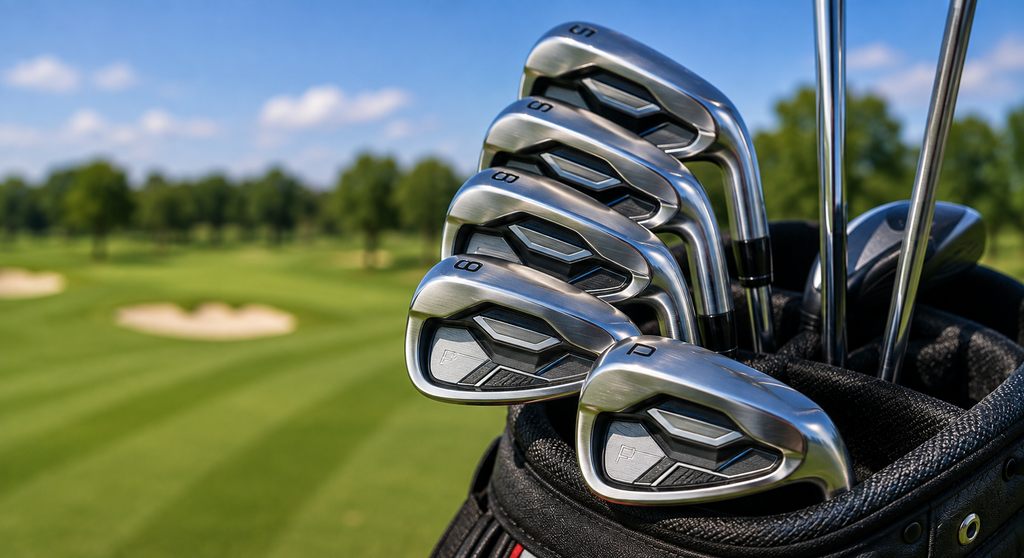
The best game improvement irons can make iron play easier without requiring a perfect swing on every shot. These clubs generally use forgiving head designs, helpful weighting, wider soles, and technology designed to maintain useful performance when contact misses the center. That makes them attractive to beginners, mid-handicap golfers, and anyone who values consistency over maximum workability. However, not every forgiving iron will suit every player. Loft, sole width, head size, shaft, feel, launch, and distance gapping all matter. Before buying a new set in 2026, focus on finding irons that make your normal shots more predictable rather than simply choosing whichever model produces the longest single shot.
What Is a Game Improvement Iron?
Game improvement irons are designed to make common iron shots easier.
They usually have larger clubheads than compact players irons. Many also use cavity-back or hollow-body construction to position weight strategically around the head.
That design can improve stability when you strike the ball away from the center.
Manufacturers may also use flexible face structures and low center-of-gravity placement to support ball speed and launch.
However, there is no single specification that defines every game improvement model.
The best game improvement irons combine several helpful characteristics while still fitting your swing.
Some models focus heavily on forgiveness and launch. Others provide a slightly smaller appearance while retaining considerable assistance.
Therefore, test the complete club rather than judging it by its category label.
Who Should Play Game Improvement Irons?
These irons are commonly associated with mid- and high-handicap golfers, but handicap should not be your only guide.
A golfer who regularly misses the center of the face can benefit from added forgiveness regardless of handicap.
Likewise, players with moderate swing speeds may appreciate an iron that helps create launch and useful carry.
Older golfers, newer players, and golfers returning after a long break may also find this category comfortable.
Even skilled players sometimes prefer more forgiving equipment.
The best game improvement irons are for golfers who value predictable results and confidence.
You do not need to earn the right to play a smaller iron head.
Choose equipment that helps you produce the shots you want.
If a forgiving model gives you tighter dispersion and better distance control, it deserves consideration.
Forgiveness Should Be Your First Priority
Forgiveness describes how well a club maintains useful performance when impact is imperfect.
No iron can completely rescue a severe mishit.
However, a forgiving design may reduce distance loss and help keep smaller misses closer to the intended target.
This matters because recreational golfers rarely strike every iron shot from the exact center.
During testing, pay attention to ordinary swings rather than only perfect contact.
Compare what happens when impact moves slightly toward the heel or toe.
The best game improvement irons should make those common misses less damaging.
Look at carry consistency and dispersion.
A club that produces one exceptionally long shot but loses substantial distance on the next three may be less useful than an iron with a tighter overall pattern.
Look for Helpful Weight Distribution
Weight placement can have a significant effect on how an iron performs.
Many forgiving designs position mass around the perimeter or use other construction techniques to increase stability.
Manufacturers may also position weight lower to help golfers launch the ball.
Some models use tungsten or multiple materials to fine-tune these characteristics.
You do not need to select irons based solely on technical terms.
Instead, understand what the technology is supposed to accomplish and then verify the result.
When testing the best game improvement irons, ask whether the club launches easily and maintains reasonable distance when your strike is imperfect.
If the answer is yes, the design is doing something useful for your game.
A Wider Sole Can Make Contact Easier
Many game improvement irons use wider soles.
A wider sole can influence turf interaction and may help the club move through the ground more effectively when contact is slightly heavy.
This can be useful for golfers who occasionally strike the turf before the ball.
However, wider is not automatically better.
Golfers with shallow swings or those who play on very firm turf may prefer a different sole shape.
Bounce and sole geometry also matter.
The best game improvement irons should interact comfortably with the courses and conditions you normally play.
If possible, test irons from real grass rather than only hitting from a mat.
Mats can hide certain contact problems and do not always show how the sole behaves through natural turf.
Easy Launch Can Improve Long-Iron Performance
Long irons become more difficult to launch as loft decreases.
Some golfers reach a point where their 5-iron and 6-iron carry almost the same distance because the longer club does not launch efficiently.
Game improvement designs can help by using weight placement and head construction intended to produce easier launch.
Still, equipment has limits.
If your longest irons continue to fly too low, hybrids or higher-lofted fairway woods may be better choices.
The best game improvement irons should create useful distance separation throughout the portion of the set you actually carry.
Do not insist on buying a 4-iron simply because it is available.
Your set should be built around performance rather than tradition.
Distance Is Useful, but Consistency Matters More
Modern irons can produce impressive ball speed.
That extra distance can help, particularly if you have lost speed or want shorter clubs into greens.
However, distance becomes less valuable when it is unpredictable.
Imagine one 7-iron carries 150 yards repeatedly while another varies between 145 and 165.
The second club may produce the longer maximum shot, but the first could be much easier to score with.
When comparing the best game improvement irons, study average carry and front-to-back dispersion.
Ask how consistently the ball travels your expected distance.
Approach golf becomes easier when you can trust your numbers.
Do not choose irons based only on the longest shot from a fitting session.
Understand Stronger Loft Structures
Many modern game improvement irons use relatively strong lofts.
For example, the loft of one model’s 7-iron may resemble the loft of another model’s 6-iron.
That does not automatically make the design misleading or poor.
Modern head construction can help stronger-lofted clubs launch effectively.
However, you should understand what you are buying.
Check the loft specifications throughout the set.
The best game improvement irons should produce appropriate launch and distance gaps for your swing rather than simply making each club travel farther.
Pay particular attention to the pitching wedge.
A strongly lofted pitching wedge can create a large gap to your existing sand or gap wedge.
You may need to adjust the bottom of your bag after changing iron sets.
Distance Gapping Is Essential
A good iron set should provide useful progression from one club to the next.
Measure average carry with every iron.
Then compare those numbers with your hybrids, fairway woods, and wedges.
Large gaps can make club selection difficult.
Excessive overlap can waste space in your bag.
The best game improvement irons should fit into your complete set rather than operating as an isolated group.
Suppose your new 5-iron carries almost as far as your hybrid. You may no longer need both.
Similarly, if your pitching wedge travels much farther than your next wedge, another scoring club may become necessary.
Evaluate the entire bag before finalizing your setup.
Head Size Can Build Confidence
Game improvement irons usually look larger at address than traditional blades.
For many golfers, that larger appearance inspires confidence.
A longer blade length, thicker topline, or additional offset can make the hitting area appear more generous.
Other golfers prefer a cleaner, more compact look.
Fortunately, the category now includes many different shapes.
You can often find substantial forgiveness without choosing the largest possible head.
When testing the best game improvement irons, pay attention to your reaction at address.
Does the club make the shot look manageable?
Can you align it comfortably?
Visual confidence is subjective, but it matters because hesitation can affect how freely you swing.
Offset Can Help Some Golfers
Offset describes how the leading edge of the clubface sits relative to the shaft.
Many forgiving irons use noticeable offset.
This design can influence how the club looks at address and how it behaves during the swing.
Some golfers appreciate it because it can support their preferred ball flight.
Others dislike the appearance or find that excessive offset does not suit their typical miss.
Do not assume more offset automatically means more forgiveness for you.
The best game improvement irons should complement your impact pattern.
If you already struggle with shots that curve strongly left as a right-handed golfer, test different designs carefully.
Ball-flight data is more useful than relying on general equipment claims.
Shaft Choice Is Just as Important
A forgiving clubhead paired with an unsuitable shaft may still perform poorly.
Shaft weight, length, flex, and overall profile influence timing, speed, launch, and feel.
Lighter shafts can help some golfers create speed, but they may feel difficult to control for others.
Heavier shafts can provide stability, yet they may become tiring if they do not match your strength and tempo.
Therefore, test multiple options when possible.
The best game improvement irons should feel manageable throughout an entire round, not merely during five swings in a fitting bay.
Do not rely entirely on labels such as regular or stiff because those classifications can vary.
Judge the complete combination through actual shots.
Steel vs Graphite Shafts
Both steel and graphite can work well in game improvement irons.
Steel remains popular because it offers many weight and profile options.
Graphite can provide lighter configurations and may feel more comfortable for some golfers.
Modern graphite iron shafts also offer a wide range of performance characteristics.
Therefore, the choice should not be based on outdated assumptions that one material is only for certain types of players.
When comparing the best game improvement irons, try both if appropriate.
Focus on strike quality, launch, dispersion, speed, feel, and physical comfort.
The shaft that helps you repeat your swing more easily is often the stronger choice.
Feel Still Matters in Forgiving Irons
Forgiveness does not mean you have to ignore feel.
Modern construction techniques allow many larger irons to provide a satisfying impact sensation.
Still, feel is highly personal.
One golfer may prefer a softer response, while another enjoys a firmer sensation.
Sound also influences perceived feel.
During testing, notice whether good strikes provide clear feedback.
You should also be able to recognize a mishit without feeling excessively punished.
The best game improvement irons balance feedback with comfort.
Performance data should guide the decision, but you are more likely to trust a club that feels good when you strike it.
Do Not Ignore Dispersion
Golfers often become excited when a new iron adds several yards.
Yet approach shots are about hitting targets.
A slightly shorter iron that produces a tighter dispersion pattern may help you score better.
Track left-to-right spread during testing.
Also consider front-to-back variation.
A club that regularly finishes near the expected distance gives you more confidence when choosing a target.
The best game improvement irons should reduce the severity of your normal misses rather than simply increase maximum ball speed.
Ask the fitter to show you the full group of shots instead of highlighting only your best swing.
That broader picture reveals how the club performs when your swing is normal.
Consider Your Typical Miss
Every golfer has tendencies.
You might miss toward the toe, strike the ball low on the face, hit slightly heavy shots, or struggle with directional consistency.
Your ideal iron should help make that normal miss more manageable.
During a fitting, do not hide mishits.
They provide useful information.
If one club loses significantly less carry on your typical toe strike, that may matter more than a small advantage on perfect contact.
Finding the best game improvement irons means finding forgiveness that matches your actual pattern.
A design that helps another golfer’s miss may not help yours in exactly the same way.
Game Improvement vs Super Game Improvement Irons
Super game improvement irons generally take forgiveness even further.
They may use larger heads, wider soles, more offset, and designs focused heavily on easy launch.
These clubs can work well for beginners, high handicappers, slower swingers, and players who simply want maximum assistance.
Standard game improvement models may provide a slightly more compact appearance while retaining substantial forgiveness.
Neither category is automatically superior.
The best game improvement irons sit at the point where assistance, appearance, feel, and control match your needs.
Test across categories if you are uncertain.
Your handicap does not force you into one specific design.
Game Improvement vs Players Irons
Players irons typically prioritize compact shaping, precise feedback, and control.
They may appeal to golfers with consistent contact who value trajectory manipulation.
Game improvement models generally offer a larger margin for error.
However, modern categories increasingly overlap.
Some forgiving irons now have relatively compact appearances, while some players-style models include considerable technology.
Therefore, avoid choosing based solely on labels.
Compare the best game improvement irons directly against any players-style options that interest you.
If the smaller club performs equally well and gives you more confidence, it could be appropriate.
If forgiveness clearly improves your results, take the assistance.
Golf does not award extra points for using difficult equipment.
Should Beginners Buy a Full Iron Set?
Beginners do not necessarily need every iron from 4-iron through pitching wedge.
Long irons can be difficult to launch.
A beginner may perform better with hybrids at the top of the set.
For example, you might begin your irons at the 6-iron and use hybrids for longer distances.
That approach can simplify the bag while improving confidence.
When shopping for the best game improvement irons, check which set configurations are available.
Some retailers offer different combinations.
Do not pay for long irons you are unlikely to use if another setup suits you better.
You can always add or change clubs as your game develops.
Mid-Handicap Golfers Should Look Beyond Labels
Mid-handicap players often have enough consistency to appreciate feel and control while still benefiting from forgiveness.
That makes game improvement irons particularly attractive.
However, not every mid-handicap golfer has the same needs.
One player may generate plenty of speed but struggle with toe strikes. Another may need more launch.
A third might want a compact appearance without giving up stability.
The best game improvement irons for this group should balance those priorities.
Testing becomes especially valuable because several categories may work.
Do not assume your handicap means you need a specific amount of offset, sole width, or head size.
Your ball flight tells a more useful story.
Consider How the Irons Perform From Rough
Most fitting sessions happen from perfect lies.
Golf courses do not.
You will hit irons from rough, uneven lies, fairway bunkers, and imperfect turf.
A larger head or wider sole may behave differently from those situations than a compact iron.
If possible, test clubs outdoors.
Pay attention to how easily the head moves through grass and whether you can control the face.
The best game improvement irons should provide confidence beyond a practice mat.
Of course, no iron will turn deep rough into an easy shot.
Sometimes the correct decision is simply to take more loft and return the ball to safety.
Try Before You Buy
Specifications and reviews can narrow your choices, but they cannot tell you exactly how a club will perform for your swing.
Testing is essential.
Warm up first, then establish baseline numbers with your current irons.
Try several new models using the same golf ball when possible.
Compare average carry, launch, dispersion, strike pattern, and feel.
Do not hit only 7-irons if you can avoid it.
The best game improvement irons should work throughout the set.
Test at least one longer iron and one shorter iron to understand how the design changes across the range.
A Professional Fitting Can Save Money
A fitting may seem like an extra expense, but it can prevent an expensive purchasing mistake.
A fitter can evaluate clubhead options alongside shaft weight, length, lie angle, and other specifications.
More importantly, you can compare new equipment directly with your current set.
You may discover that a small adjustment improves your existing clubs.
Alternatively, the data may show a clear advantage from a new design.
When searching for the best game improvement irons, use fitting data to separate genuine improvement from marketing.
A new set should solve a measurable problem.
Common Buying Mistakes to Avoid
One mistake is buying the iron that produces the longest single shot.
Another is choosing a set entirely because of its appearance.
Golfers also overlook shaft fit, wedge gapping, and the difficulty of long irons.
Some players buy irons that are too demanding because they expect to “grow into” them.
Others choose the largest possible heads despite feeling uncomfortable at address.
When comparing the best game improvement irons, balance current ability with realistic goals.
Equipment should help you play now.
You can always change later if your swing develops significantly.
Finally, avoid assuming higher price guarantees better results.
Fit and performance matter more than prestige.
A Smart 2026 Buying Checklist
Begin by identifying your biggest iron-play problem.
Do you need more launch, forgiveness, distance consistency, or confidence?
Next, determine which iron numbers you actually need.
Then compare head size, sole design, offset, loft structure, and available shafts.
Test multiple models and record average results.
Check how the new irons fit with your hybrids and wedges.
A strong candidate among the best game improvement irons should provide useful distance gaps and manageable misses throughout the set.
Finally, compare price and long-term value.
Do not pay for technology that produces no meaningful improvement in your hands.
Conclusion
Game improvement irons can make golf more enjoyable by reducing the penalty from ordinary mishits and helping players create dependable launch and distance.
However, forgiveness should not be judged by head size alone.
Look at weight distribution, sole design, loft structure, shaft fit, dispersion, strike consistency, and how the clubs interact with your typical swing.
Pay particular attention to long-iron launch and wedge gapping.
Most importantly, test several options rather than choosing solely from reviews or manufacturer claims.
The best game improvement irons in 2026 are the ones that make your normal shots more predictable. They should give you confidence at address, useful carry distances, and enough assistance when contact is less than perfect. Choose the set that improves your average result, and you will have equipment that supports your game instead of demanding perfection from it.
FAQ
1. What handicap should use game improvement irons?
There is no strict handicap requirement. Beginners, mid-handicappers, and even skilled golfers can benefit if they prefer additional forgiveness and easier launch.
2. Are forgiving irons harder to control?
Not necessarily. Some golfers may prefer the feedback and shaping of compact irons, but modern forgiving designs can still provide reliable distance and directional control.
3. Should I choose graphite or steel shafts in forgiving irons?
Choose based on fit rather than category. Weight, profile, comfort, speed, and dispersion are more important than assuming one shaft material is universally better.
4. Can hybrids replace long irons in a game improvement set?
Yes. If your long irons fly too low or produce overlapping distances, hybrids can provide easier launch and more useful gapping.
5. Are stronger-lofted irons always longer?
Not for every golfer. Stronger loft can increase distance potential, but launch, speed, strike quality, and head design determine whether that distance is actually useful.