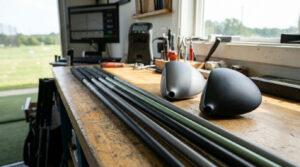
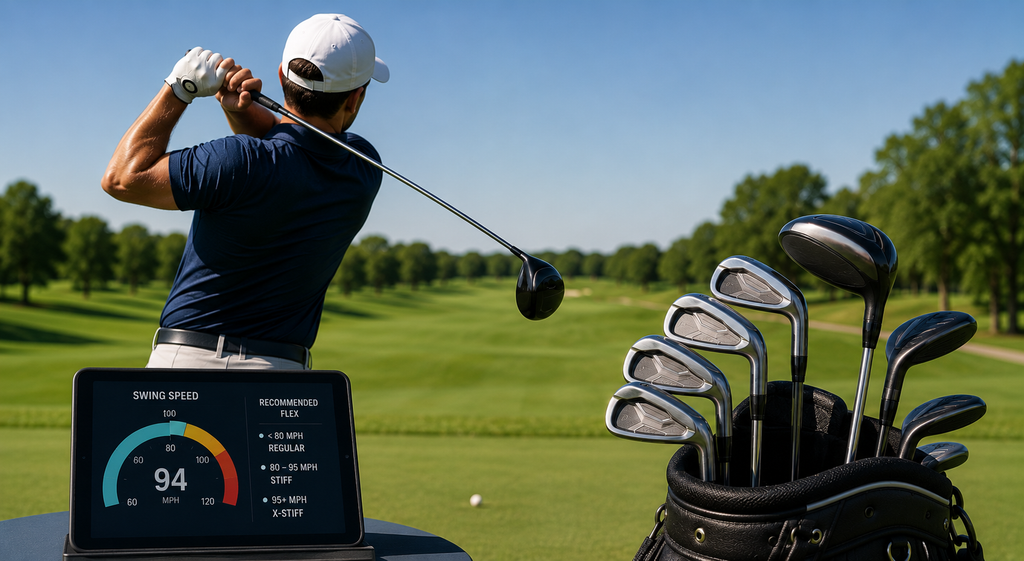
Choosing golf clubs for swing speed can make equipment shopping much easier. Your speed influences how you load the shaft, launch the ball, generate distance, and control different clubs. However, speed should never be the only number behind a buying decision. Tempo, strike quality, launch conditions, strength, and personal feel also matter. Two golfers with similar driver speeds may perform better with completely different shafts or clubhead designs. Therefore, the smartest approach is to use swing speed as a starting point and then confirm your choices through testing. This guide explains how to match drivers, irons, woods, hybrids, shafts, and lofts to the way you actually swing.
Why Swing Speed Matters When Buying Clubs
Swing speed describes how quickly the clubhead is moving during the swing, usually measured near impact.
Higher speed creates more potential for ball speed and distance. However, the golfer still needs efficient contact and suitable launch conditions to turn that speed into useful performance.
Slower swingers often benefit from equipment that makes launch easier. Faster players may need different shaft characteristics, lofts, or head designs to manage trajectory and dispersion.
That is why comparing golf clubs for swing speed can be useful.
Still, avoid assuming that one speed automatically requires one exact specification. Equipment categories overlap, and individual swings differ.
Use speed to narrow your options. Then evaluate how those options perform with your normal swing.
How to Measure Your Swing Speed
The easiest method is to use a launch monitor or swing-speed measuring device.
Many professional club fitters, golf retailers, teaching facilities, and indoor golf centers have this technology.
Measure several normal swings rather than trying to produce your fastest possible number.
Your goal is to understand your typical playing speed.
If you normally swing your driver smoothly on the course, hitting ten maximum-effort drives during a fitting gives you less useful information.
When selecting golf clubs for swing speed, average performance matters more than a personal speed record.
Warm up before testing. Hit enough shots to establish a pattern, but stop if fatigue changes your swing.
You should also measure different clubs when possible because driver speed does not tell the complete story of how you deliver an iron.
Do Not Confuse Swing Speed With Ball Speed
Swing speed and ball speed measure different things.
Swing speed refers to the clubhead. Ball speed measures how quickly the golf ball leaves the face after impact.
A golfer can swing quickly but produce disappointing ball speed because of poor contact.
Meanwhile, another golfer with less clubhead speed may transfer energy more efficiently.
This distinction matters when shopping for golf clubs for swing speed.
You should not chase a shaft or clubhead simply because it appears designed for faster players.
Look at strike quality and ball speed as well.
If a new club improves centered contact, it may produce more useful distance even when your swing speed stays nearly identical.
Efficiency is often more valuable than simply swinging harder.
Start With Shaft Flex
Shaft flex is one of the first specifications golfers associate with speed.
Common labels include ladies, senior or amateur, regular, stiff, and extra stiff. However, these labels are not standardized perfectly across every manufacturer.
A regular-flex shaft from one company may feel different from another.
Therefore, flex labels should be treated as general categories rather than universal measurements.
When comparing golf clubs for swing speed, use shaft flex as a starting point.
A slower swing may perform well with a more flexible option, while a faster swing may benefit from additional stability.
Yet tempo and transition matter too.
A smooth player and an aggressive player with similar speeds may prefer different shaft profiles.
Actual testing remains the best way to decide.
Understand Shaft Weight
Flex receives plenty of attention, but shaft weight can be just as important.
A lighter shaft may help some golfers move the club more comfortably and potentially create additional speed.
However, going too light can make the club difficult to control for certain players.
A heavier shaft may improve awareness and stability, but excessive weight can reduce speed or cause fatigue.
The ideal golf clubs for swing speed should feel manageable throughout an entire round.
Do not judge shaft weight from three swings.
Hit enough shots to see whether your contact and dispersion remain consistent.
Golfers who walk frequently or experience fatigue late in a round should also consider how the overall club weight feels over time.
Tempo Changes the Equation
Swing speed tells you how fast the club moves, but tempo describes how that movement develops.
Some golfers have smooth transitions from backswing to downswing. Others change direction aggressively.
That difference can influence how a shaft feels and performs.
For example, two players may generate similar driver speed. The smoother player might prefer one shaft profile, while the more aggressive player feels better with another.
This is why buying golf clubs for swing speed from a simple chart can be limiting.
A chart cannot fully measure how you load the shaft.
Pay attention to whether the club feels stable without becoming difficult to swing.
Your best option should support your natural rhythm rather than forcing you to create a completely different motion.
Choose Driver Loft Carefully
Golfers sometimes assume faster swing speed always requires less driver loft.
The relationship is not that simple.
Your attack angle, dynamic loft, strike location, spin, and clubhead design all affect launch conditions.
A slower swinger may benefit from additional loft if it helps produce more carry. However, some slower players already launch the ball high enough.
Likewise, a faster player may need more or less loft depending on delivery.
When evaluating golf clubs for swing speed, driver loft should be tested rather than guessed.
Adjustable drivers make this easier because a fitter can compare multiple settings.
Focus on useful carry, total distance, dispersion, and trajectory instead of choosing the lowest loft you believe you can handle.
Forgiveness Matters at Every Speed
Fast golfers miss the center of the face too.
Therefore, forgiveness is not only a feature for beginners or slower players.
A stable clubhead can reduce the penalty when impact moves toward the heel or toe.
For golfers with moderate or slower speeds, forgiveness can be especially valuable because losing additional ball speed on a mishit may create a significant distance loss.
The right golf clubs for swing speed should protect your normal misses.
During testing, pay attention to imperfect shots.
If one driver maintains more useful distance and direction when you miss the center, that may matter more than a few extra yards from your best strike.
Slower Swing Speeds Need Useful Launch
Golfers with slower speeds often need enough launch to keep the ball in the air and maximize carry.
This can affect driver loft, fairway wood selection, hybrid setup, iron design, and shaft choice.
A low-lofted long iron may look appealing, but it provides little value if it launches too low and carries almost the same distance as the next iron.
Therefore, golfers comparing golf clubs for swing speed should examine peak height and carry gaps.
Easy-launching hybrids and higher-lofted fairway woods can sometimes outperform difficult long irons.
Similarly, game improvement irons may provide more useful launch than compact designs.
The objective is not to make every shot fly extremely high. Instead, you want a trajectory that creates predictable distance.
Faster Golfers Should Prioritize Control Too
More clubhead speed creates greater distance potential, but it can also make poor directional control more costly.
A fast player does not automatically need the lowest loft, stiffest shaft, or smallest clubhead available.
Equipment should still provide predictable launch and dispersion.
If you swing quickly, compare several shaft weights and profiles.
Look for a combination that allows you to make your normal swing without feeling that the club is unstable.
When choosing golf clubs for swing speed, faster golfers should evaluate their worst shots as carefully as their best ones.
A setup that produces slightly less maximum distance but much tighter dispersion may be more useful on the course.
Iron Design Should Match Your Delivery
Swing speed can influence which iron designs work well, particularly in the longer clubs.
Players with plenty of speed may be able to launch stronger-lofted or more compact irons effectively.
Golfers with moderate or slower speeds may benefit from a lower center of gravity, wider sole, or more forgiving head.
However, these are not strict rules.
A golfer with plenty of speed may still prefer game improvement irons. Likewise, a slower player with consistent contact may perform well with a compact model.
The best golf clubs for swing speed should produce appropriate launch, carry, and stopping ability.
Do not choose irons based solely on appearance.
Measure how they perform throughout the set.
Pay Attention to Long-Iron Gapping
Long irons reveal problems that shorter irons can hide.
As loft decreases, golfers need enough speed and quality of contact to create useful launch.
Eventually, you may reach a point where two consecutive irons carry nearly the same distance.
For example, your 5-iron might carry only a few yards farther than your 6-iron.
At that point, carrying both may not make sense.
When building golf clubs for swing speed, test the longest irons individually.
If distance gaps begin disappearing, consider a hybrid or fairway wood.
The replacement should be chosen according to carry distance rather than simply matching the number printed on the iron.
Hybrids Can Help Moderate and Slower Swings
Hybrids combine characteristics of woods and irons.
Their design often makes them easier to launch than traditional long irons.
That can be particularly useful for golfers who struggle to generate enough height with a 4-iron or 5-iron.
However, hybrids are not only for slow swingers.
Players across many speed ranges use them because they can perform well from fairways, rough, and other lies.
When comparing golf clubs for swing speed, test hybrids against the long irons they could replace.
Look at average carry, peak height, dispersion, and confidence.
If the hybrid consistently produces a more useful shot, it deserves a place in your bag.
Higher-Lofted Fairway Woods Can Be Valuable
Many golfers automatically buy a 3-wood because it seems like a standard part of a golf set.
Yet a low-lofted 3-wood can be challenging to launch from the ground.
For some players, a 5-wood or 7-wood creates more carry because the additional loft helps produce a better trajectory.
That can be especially valuable at moderate swing speeds.
When testing golf clubs for swing speed, compare actual distance rather than assuming less loft means longer shots.
You may discover that a higher-lofted wood carries farther and lands more softly.
It can also provide a useful option for long approaches.
Wedge Selection Depends Less on Maximum Speed
Your wedge setup should focus heavily on distance control and versatility.
Full-swing speed still matters, but wedge buying should not become a search for maximum ball speed.
Instead, identify the lofts needed to create practical yardage gaps below your pitching wedge.
Then consider bounce and sole design based on your delivery and typical course conditions.
A complete set of golf clubs for swing speed should become more control-focused as you move into scoring clubs.
Measure full and partial wedge distances.
You may find that three well-spaced wedges provide better coverage than four clubs with overlapping yardages.
The correct setup depends on the shots you regularly face.
Club Length Can Influence Speed and Control
Longer clubs can create more potential clubhead speed because of the larger swing radius.
However, additional length can make centered contact more difficult.
This tradeoff is especially noticeable with drivers.
A golfer may swing a longer driver faster yet produce less useful distance because contact becomes inconsistent.
When selecting golf clubs for swing speed, do not assume longer automatically means better.
Test different lengths when fitting options allow.
A slightly shorter club that consistently finds the center of the face may produce better average ball speed, tighter dispersion, and greater confidence.
Golf rewards effective distance, not theoretical speed.
Total Club Weight Matters
Shaft weight is only one part of the club’s overall feel.
The head, grip, shaft, and club length all contribute to total weight and balance.
A club that feels too heavy may reduce speed or become difficult to swing late in the round.
A club that feels excessively light can make timing harder for some players.
The ideal golf clubs for swing speed should feel easy enough to move while remaining stable.
During a fitting, compare more than launch-monitor numbers.
Notice how much effort each club requires.
Your equipment should help you repeat your normal motion rather than encourage you to swing harder than usual.
Do Not Buy Based on Age Alone
Golf equipment is sometimes marketed toward seniors, women, juniors, or other groups.
Those categories can help narrow choices, but they do not determine your ideal specifications.
Two golfers of the same age may have very different speeds, strength levels, swing tempos, and ball flights.
Therefore, age alone should never determine shaft flex or clubhead design.
Choose golf clubs for swing speed and actual performance instead of relying entirely on demographic labels.
A senior golfer with plenty of speed may perform better with a heavier or firmer shaft than expected.
Meanwhile, a younger golfer with a smooth, moderate-speed swing might benefit from a lighter configuration.
Fit the player, not the stereotype.
Your Typical Strike Matters
Swing speed cannot compensate for consistently poor contact.
Strike location affects ball speed, launch, spin, and direction.
Before buying new clubs, learn where you normally contact the face.
Impact tape or other appropriate strike-location tools can help during practice or fitting.
If your miss frequently occurs toward the toe, look at how different clubheads perform from that area.
The right golf clubs for swing speed should provide useful results from your typical strike pattern.
Do not evaluate equipment only from your three perfect shots.
The club that handles ordinary contact well may help your scores more than the one that produces the highest number from a rare center strike.
Use Carry Distance Instead of Ego
Golfers sometimes choose equipment because they want to say they use a stiff shaft, low-lofted driver, or traditional long iron.
Those labels do not lower scores.
Carry distance, dispersion, launch, and consistency are much more useful.
If a lighter shaft helps you hit more fairways, use it.
If a 7-wood produces better long approaches than a 4-iron, carry the 7-wood.
When building golf clubs for swing speed, let performance make the decision.
Your equipment does not need to resemble another golfer’s bag.
It needs to cover your distances and support the shots you can produce reliably.
Test With the Golf Ball You Normally Use
Golf balls can produce different launch, spin, feel, and speed characteristics.
Therefore, a fitting becomes more useful when you test with the ball you normally play or something comparable.
This is especially important when comparing drivers and irons.
If possible, avoid changing both the golf ball and club repeatedly during the same comparison.
Keep variables consistent.
When evaluating golf clubs for swing speed, you want to know whether the equipment improves performance rather than wondering whether the ball caused the difference.
A consistent testing environment produces more useful information.
Do Not Chase Maximum Swing Speed During a Fitting
A fitting is not a long-drive contest.
Swinging harder than normal can lead you toward equipment that performs well only when you make an unusually aggressive motion.
Start with your normal tempo.
Hit enough shots to establish a reliable baseline.
If you want to test higher speed later, you can.
However, your final choice should perform during the swing you expect to use on the course.
Choosing golf clubs for swing speed means matching equipment to sustainable speed.
A club that works beautifully for your hardest swing but poorly at your normal effort is unlikely to provide consistent results over 18 holes.
How Often Should You Recheck Your Speed?
Swing speed can change.
Fitness, age, injuries, lessons, technique changes, and training can all influence how quickly you move the club.
You do not need a new fitting every few months.
However, consider rechecking your numbers when you notice a meaningful change in distance or ball flight.
Golfers who complete a structured speed-training program may also benefit from another evaluation.
Your existing golf clubs for swing speed may continue to work perfectly well.
On the other hand, a substantial change could make a different shaft weight, flex, loft, or club configuration worth testing.
Measure first rather than assuming you need new equipment.
A Professional Fitting Is Worth Considering
A qualified fitting can combine swing speed with information that simple buying charts cannot provide.
A fitter may evaluate ball speed, launch angle, spin, strike location, dispersion, club path, and other useful measurements.
They can then test different heads and shafts under similar conditions.
When choosing golf clubs for swing speed, this process helps separate assumptions from actual performance.
Bring your current clubs to establish a baseline.
A new club should demonstrate a meaningful advantage before you spend money.
Sometimes the fitting may show that your existing equipment already suits you.
That is useful information too.
Common Buying Mistakes
One common mistake is choosing shaft flex from swing speed alone.
Another is assuming slower golfers always need the lightest possible clubs.
Faster players sometimes make the opposite mistake by choosing equipment that is too heavy or demanding.
Golfers also buy low-lofted drivers or long irons because they believe less loft guarantees more distance.
It does not.
When comparing golf clubs for swing speed, avoid changing several specifications based on a single number.
Consider your launch, strike, tempo, dispersion, carry distance, and physical comfort.
Another mistake is buying from your fastest swing instead of your normal speed.
Choose equipment for the golfer who actually plays 18 holes.
Simple Swing-Speed Buying Checklist
Start by measuring your normal swing speed with reliable equipment.
Next, establish baseline numbers using your current clubs.
Test different shaft flexes and weights rather than trusting labels.
For the driver, compare loft and head settings.
With irons, check launch, forgiveness, carry gaps, and strike consistency.
Test hybrids or fairway woods if your long irons do not create enough separation.
When selecting golf clubs for swing speed, review your complete bag rather than purchasing each club independently.
Finally, judge average performance.
A good setup should make your normal swing more effective without requiring extra effort.
Conclusion
Swing speed is a valuable piece of information when buying golf equipment, but it should never become the only factor.
Use it to narrow your options for shaft flex, shaft weight, driver loft, iron design, and the top end of your set. Then test those options with your normal swing.
Pay attention to ball speed, launch, carry distance, strike location, dispersion, and comfort.
Slower golfers may benefit from easier-launching designs, while faster golfers may need additional stability and control. However, individual delivery always matters more than broad labels.
The smartest golf clubs for swing speed are not necessarily the lightest, stiffest, longest, or most expensive clubs. They are the ones that help you create predictable shots at a speed you can repeat throughout a round. Measure your swing, test several combinations, and choose equipment based on real performance rather than assumptions.
FAQ
1. What shaft flex should I use for my swing speed?
Swing speed can provide a starting point, but flex labels vary between manufacturers. Tempo, transition, shaft weight, launch, and dispersion should also influence the decision.
2. Do slower golfers always need lighter shafts?
No. A lighter shaft can help some players create speed, but others lose control or timing when the club becomes too light. Testing is the best approach.
3. Does a faster driver swing require less loft?
Not automatically. Attack angle, dynamic loft, strike location, spin, and clubhead design all influence the ideal driver loft.
4. Should slower swingers replace long irons with hybrids?
They should consider testing them. If a hybrid launches more easily and creates better carry separation, it may be more useful than a difficult long iron.
5. Can my ideal golf equipment change if my swing gets faster?
Yes. A significant speed change may affect shaft, loft, and club-selection preferences. However, retest your current equipment before assuming replacement is necessary.