Choosing the right golf club shaft flex can make your equipment feel more comfortable and predictable throughout the swing. However, many golfers select flex based only on swing speed, age, strength, or labels such as regular and stiff. Those factors can provide a starting point, but they do not tell the whole story. Your tempo, transition, shaft weight, club length, release pattern, and personal feel can all influence which shaft performs best. In addition, flex labels are not perfectly standardized across manufacturers. Therefore, a regular shaft from one company may not behave exactly like another. Instead of buying from the label alone, use this guide to understand what flex means and how to test the right option for your game.
What Does Shaft Flex Mean?
Shaft flex describes how much a golf shaft bends when forces act on it during the swing.
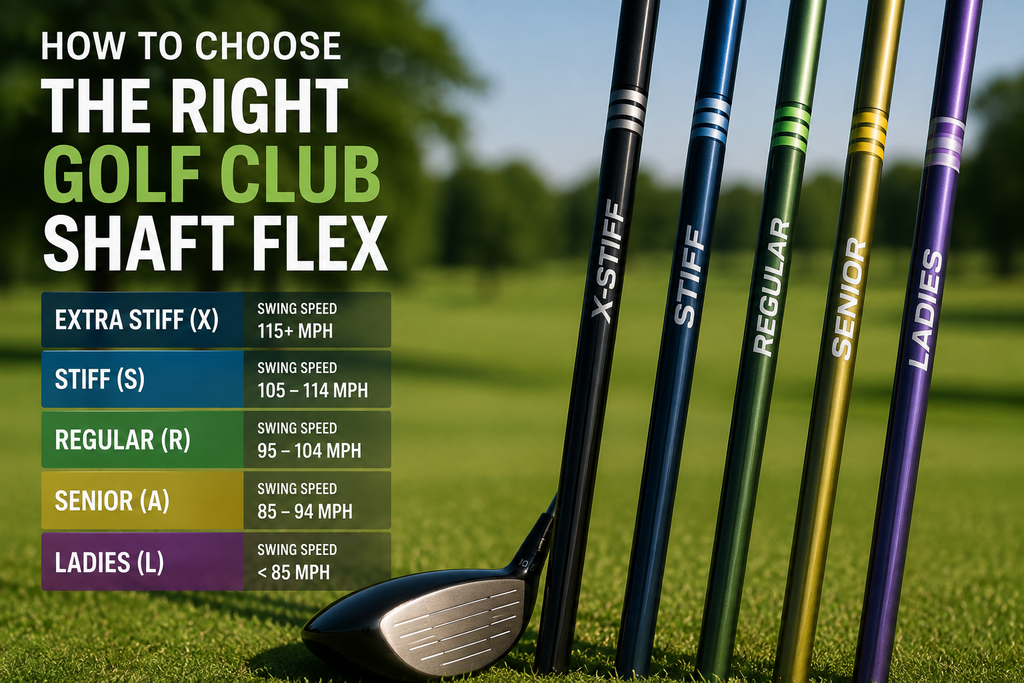
Common labels include ladies, senior, regular, stiff, and extra stiff. Some manufacturers use different naming systems.
These categories make shopping easier. However, they should be treated as general references rather than universal measurements.
Two shafts carrying the same flex label can feel and perform differently because their construction, weight, torque, bend profile, and materials may differ.
Therefore, choosing golf club shaft flex requires more than reading one letter printed on the shaft.
You need to consider how the entire shaft works with your swing and clubhead.
Why Shaft Flex Matters
A shaft is an important part of the club’s overall design.
During the swing, it bends and responds to the forces created by your movement. The way it feels can influence your timing and delivery.
A suitable shaft can make it easier to swing naturally and repeatedly.
On the other hand, a poorly matched option may feel difficult to load, unstable, excessively firm, or too soft.
However, there is no simple rule saying a particular golf club shaft flex automatically produces a specific shot.
Ball flight depends on the entire impact condition.
Clubface angle, swing path, strike location, speed, loft, and other variables all contribute to the result.
Start With Swing Speed
Swing speed is one useful starting point when comparing shaft options.
In general, faster golfers often fit into firmer shafts, while slower golfers may prefer softer options.
However, speed alone should not make the final decision.
Two golfers can produce nearly identical driver speeds but have very different transitions.
One may change direction aggressively at the top. Another may use a smooth, gradual motion.
Those players may prefer different shafts despite similar speed.
Use swing speed to narrow the available golf club shaft flex options. Then test those choices using actual ball flight, contact, dispersion, and feel.
Tempo Changes How a Shaft Feels
Tempo describes the overall pace and rhythm of your swing.
Some golfers have quick backswings and aggressive transitions. Others move more smoothly from address through impact.
A golfer with a strong transition may prefer a shaft that feels more stable during the change of direction.
Meanwhile, another player may feel more comfortable with a shaft that responds differently.
Neither approach is automatically correct.
When testing golf club shaft flex, make normal swings instead of changing your tempo to suit the equipment.
The club should complement the swing you can repeat on the course.
If you must manipulate your motion to make a shaft work, another option may fit better.
Understand Your Transition
The transition occurs as the club changes direction from backswing to downswing.
This part of the swing can place significant load on the shaft.
An aggressive transition can make some shafts feel softer than expected. Conversely, a smoother transition may allow a golfer to use a different profile comfortably.
This is another reason simple swing-speed charts have limitations.
They cannot fully describe how a player applies force throughout the motion.
When selecting golf club shaft flex, tell your fitter how different shafts feel during transition.
Words such as stable, loose, firm, heavy, light, smooth, or difficult to control can provide useful feedback alongside launch-monitor data.
Do Not Choose Flex Based on Ego
Some golfers believe stiff or extra-stiff shafts indicate greater skill.
They do not.
Flex is an equipment specification, not a handicap rating.
A golfer should use whatever produces the most suitable combination of feel and performance.
Choosing an excessively firm shaft because of pride may make the club less comfortable to swing.
Likewise, deliberately choosing a very soft shaft because it sounds more forgiving does not guarantee better results.
The correct golf club shaft flex is the one that works with your delivery.
Ignore what your playing partners use.
Their swings have little to do with your fitting requirements.
Flex Labels Are Not Universal
This point is particularly important when comparing brands.
There is no single universal standard that forces every manufacturer to make all regular, stiff, or senior shafts behave identically.
As a result, two shafts marked “R” may have different characteristics.
Their weights may differ. Their bend profiles can also vary.
One may feel noticeably firmer in a particular section than another.
Therefore, do not assume your current golf club shaft flex label must transfer directly to every new club.
If you play a stiff driver shaft successfully, that does not mean every stiff shaft on the market will suit you.
Test the actual shaft and club combination whenever possible.
Shaft Weight Matters Too
Flex receives plenty of attention, but shaft weight can be equally important.
A lighter shaft may help some golfers create speed and swing more comfortably.
However, going too light can make the club difficult to control for certain players.
A heavier option may provide a more stable sensation, but excessive weight can reduce speed or create fatigue.
When comparing golf club shaft flex, keep weight in mind.
If you test a 50-gram regular shaft against a much heavier stiff shaft, you are changing more than flex.
A good fitting controls variables carefully so you can understand which characteristics are actually improving performance.
Material Makes a Difference
Golf shafts are commonly made from steel or graphite, although designs and material combinations continue to evolve.
Graphite dominates modern driver and fairway wood shafts because it allows manufacturers to create a wide range of weights and profiles.
Irons may use either steel or graphite.
Modern graphite iron shafts can suit many types of golfers, including stronger and faster players.
Do not assume material automatically determines golf club shaft flex or player ability.
Instead, compare weight, feel, consistency, and performance.
Some golfers prefer the sensation of steel in irons. Others benefit from graphite’s available weight options or different feel.
Torque Is Different From Flex
Torque describes a shaft’s resistance to twisting.
It is commonly expressed as a measurement in degrees.
Although torque can influence how a shaft feels, it should not be confused with flex.
A shaft can be stiff in its overall flex category while still having different torque characteristics from another stiff shaft.
Golfers do not need to chase a particular torque number without context.
Instead, consider it one part of the overall design.
When choosing golf club shaft flex, evaluate the complete shaft rather than isolating one specification.
Manufacturers design flex, torque, weight, materials, and bend characteristics to work together.
Bend Profile Adds Another Layer
Two shafts with the same flex can bend differently along their length.
One may feel firmer near the tip. Another may feel different through the middle or handle section.
These characteristics contribute to what golfers often describe as the shaft’s profile.
The profile can influence feel and potentially affect delivery for a particular player.
However, golfers should avoid assuming a specific profile will always create a guaranteed ball flight.
Your response to the shaft matters.
Testing different profiles within a suitable golf club shaft flex range can reveal which design helps you produce consistent contact and dispersion.
Driver Flex Requires Careful Testing
The driver creates some of the highest swing speeds in the bag.
Therefore, shaft selection receives significant attention.
Start by establishing your normal driver speed and ball flight.
Then compare suitable shaft options using the same driver head when possible.
Look at average carry, total distance, launch, spin, strike location, and dispersion.
Most importantly, make normal swings.
The correct golf club shaft flex should perform across several shots rather than producing one impressive drive.
A single perfect result is not enough evidence.
Your driver needs to work on ordinary swings when you are playing under real course pressure.
Iron Shaft Flex Can Feel Different
Do not assume your driver shaft determines your iron shaft automatically.
Drivers and irons have different lengths, weights, head designs, and performance requirements.
Many golfers also swing irons with a different intention than the driver.
Therefore, iron fitting should receive its own evaluation.
With irons, consider distance consistency, trajectory, dispersion, strike quality, and stopping power alongside feel.
A suitable golf club shaft flex in your irons should help create predictable distance gaps and reliable contact.
Again, the printed flex label is only part of the equation.
Weight and overall shaft design may have a major influence on how the club performs.
What About Wedge Shafts?
Wedges create another interesting fitting decision.
Some golfers use shafts that closely match their irons. Others choose different wedge shafts based on feel, weight, trajectory, or the types of shots they play.
Full wedge swings and delicate greenside shots place different demands on the club.
Therefore, there is no universal rule requiring every wedge shaft to match your iron golf club shaft flex exactly.
Consistency may be useful, especially for full swings.
However, fitting should consider how you actually use each wedge.
If most of your wedge shots are partial swings, feel and control may become particularly important.
Does a Softer Shaft Automatically Hit Higher?
You may hear that softer shafts always launch higher.
Reality is more complicated.
Shaft design can influence delivery, but golfers react differently to equipment.
Changing flex can also change timing, strike location, dynamic loft, and clubface delivery.
Those changes affect ball flight.
As a result, you should not buy a softer golf club shaft flex solely because you want additional height.
If trajectory is too low, investigate loft, strike, clubhead design, ball choice, and swing delivery as well.
Use launch-monitor data to determine what actually changes when you test another shaft.
Does a Stiffer Shaft Always Improve Accuracy?
No.
A firmer shaft is not automatically straighter.
Accuracy depends on your ability to deliver the clubface and strike the ball consistently.
If a stiffer option feels difficult to load or disrupts your timing, dispersion may become worse.
For another golfer, a firmer shaft may feel more stable and produce tighter patterns.
That is why testing matters.
When evaluating golf club shaft flex, compare the full dispersion area instead of only your best shot.
Look at left and right misses, average distance, and strike quality.
The goal is repeatable performance.
Watch Your Strike Pattern
Impact location provides valuable fitting information.
Use impact tape or another suitable method to identify where the ball contacts the face.
If one shaft produces a noticeably tighter strike pattern, investigate further.
Perhaps its weight or feel helps you return the club more consistently.
However, do not immediately assume flex alone caused the improvement.
Several shaft characteristics may have changed at once.
A proper golf club shaft flex comparison works best when the fitter controls as many variables as possible.
Consistent contact can improve both distance and accuracy, so strike location deserves as much attention as launch-monitor numbers.
Look at Dispersion
Golfers naturally focus on distance.
However, a shaft that produces one extremely long shot may not be the best option.
Look at the complete group.
How wide is the dispersion?
Do misses consistently finish on one side?
Does one shaft reduce severe misses?
Also consider distance dispersion with irons.
A suitable golf club shaft flex should support predictable results rather than occasional spectacular numbers.
If two shafts create similar average distance, the option with better control and tighter dispersion may provide more value on the course.
Pay Attention to Feel
Feel is subjective, but that does not make it irrelevant.
You need to swing the club confidently.
One shaft may feel smooth and easy to time, while another feels harsh or difficult to control.
Describe those sensations to your fitter.
However, combine feel with measurable results.
A shaft that feels wonderful but produces poor contact and wide dispersion may not be the ideal choice.
Similarly, impressive numbers do not help much if you dislike the sensation and struggle to swing naturally.
The right golf club shaft flex should provide a useful balance of comfort, confidence, and performance.
Avoid Testing While Tired
Fatigue can change your swing speed, tempo, balance, and contact.
If you hit dozens of drivers before testing shafts, the results may not represent your normal swing.
Take breaks during a fitting.
Drink water and avoid rushing through every option.
If possible, start with your current club to establish a baseline.
Then test a manageable number of alternatives.
Choosing golf club shaft flex from tired swings can lead to misleading conclusions.
A quality fitting values reliable information over the number of shafts tested.
Bring Your Current Clubs
Your existing clubs provide useful reference points.
A fitter can measure their specifications and observe how you perform with them.
You may discover that your current setup already works well.
Alternatively, testing may reveal that another shaft produces a meaningful improvement.
Without a baseline, almost any new club can feel exciting.
When evaluating golf club shaft flex, compare new options directly against equipment you know.
Look for measurable benefits rather than assuming newer means better.
Be Careful With Online Flex Charts
Online charts can help narrow your search.
Many recommend flex categories based on driver swing speed or typical distance.
However, these charts cannot see your tempo, transition, strike pattern, or personal response to a shaft.
Use them as starting points rather than fitting prescriptions.
If a chart suggests stiff flex, test stiff alongside nearby alternatives when possible.
Your ideal golf club shaft flex may differ from a simple recommendation.
Actual shots provide better evidence than a generalized chart.
Do Not Fit Yourself Using Carry Distance Alone
Your normal driving distance can provide clues about speed, but it includes many variables.
Launch, spin, strike quality, weather, altitude, ground conditions, and golf ball choice can affect distance.
Someone who carries the ball shorter than expected may simply make inconsistent contact.
Therefore, avoid selecting flex from distance alone.
A launch monitor can provide direct speed and ball-flight measurements.
Even then, choosing golf club shaft flex requires looking beyond one number.
Combine data with strike patterns, dispersion, feel, and your normal swing.
What If You Are Between Two Flexes?
Many golfers fall between traditional flex recommendations.
That is completely normal.
If both regular and stiff appear reasonable, test them.
Compare how easily you can swing each one and how consistently the ball behaves.
You may perform better with the softer option. Another golfer with similar speed may prefer the firmer shaft.
There is no prize for choosing one category over another.
Your golf club shaft flex should support the shots you need to hit.
When performance is extremely close, comfort and confidence can help make the final decision.
Should Seniors Automatically Use Senior Flex?
No.
Age alone does not determine shaft requirements.
Some older golfers maintain significant swing speed and aggressive transitions. Others may benefit from lighter or softer equipment.
The same principle applies to younger players.
A young golfer with moderate speed should not automatically use stiff shafts because of age.
Choose golf club shaft flex based on how the player actually swings.
Strength, speed, tempo, physical comfort, and performance all matter.
Equipment labels should describe the product, not define the golfer.
Should Beginners Use Regular Flex?
Regular flex is common, but it is not automatically correct for every beginner.
A new golfer may have high swing speed because of athletic experience.
Another beginner may swing much more slowly.
Their technique may be developing, but their equipment needs can still differ significantly.
Beginners should use swing speed as a starting point and test appropriate options.
A well-matched golf club shaft flex can make learning more comfortable because the golfer is not fighting an obviously unsuitable club.
However, lessons and basic fundamentals remain more important than chasing perfect specifications during the earliest stages.
Get Professionally Fitted When Possible
A professional fitting is the most reliable way to compare shafts under controlled conditions.
A fitter can measure swing speed, ball speed, launch, spin, carry, dispersion, and strike location.
They can also observe tempo and transition while gathering your feedback.
Most importantly, they can compare several combinations rather than relying on assumptions.
When selecting golf club shaft flex, ask why a particular option performs better.
Understanding the reason behind the recommendation can make the buying decision easier.
A good fitting should help you find equipment that supports your normal swing instead of forcing you to create a new one.
A Simple Shaft Flex Testing Process
Begin with your current club and hit several normal shots.
Record average performance.
Next, test a shaft near your expected flex range while keeping the clubhead and other specifications as consistent as possible.
Hit enough shots to establish a pattern.
Then test the next suitable option.
Compare speed, launch, spin, carry, strike location, and dispersion.
Also record how each shaft feels.
When choosing golf club shaft flex, remove obvious mishits only when there is a clear reason. Do not eliminate every bad shot just because it hurts the averages.
Your normal misses are part of your real performance.
Common Shaft Flex Buying Mistakes
The first mistake is choosing flex based entirely on ego.
Another is assuming every manufacturer’s flex labels mean exactly the same thing.
Golfers also overlook shaft weight, torque, profile, and overall club length.
Some buy from swing-speed charts without testing.
Others choose the shaft that produced their single longest drive.
These approaches can lead to poorly matched equipment.
Instead, compare realistic swings and complete shot patterns.
A suitable golf club shaft flex should help you produce consistent results while feeling comfortable throughout the swing.
Conclusion
Choosing shaft flex becomes easier once you stop treating the label as the entire answer.
Swing speed provides a useful starting point, but tempo and transition also matter. Shaft weight, material, torque, bend profile, club length, and head design can influence how the complete club feels and performs.
Most importantly, remember that flex categories are not perfectly standardized between manufacturers. A regular shaft in one model may feel different from another regular shaft.
Test several realistic options using your normal swing. Compare strike location, dispersion, launch, carry, and overall consistency. Then consider how confidently you can swing each club.
A professional fitting can make this process much easier because it combines measurable data with your personal feedback.
Ultimately, the right golf club shaft flex is not the firmest or softest option you can use. It is the one that helps you deliver the club consistently, produces useful ball flight, and feels comfortable enough to trust throughout an entire round.
FAQ
1. How do I know if my golf shaft is too stiff?
There is no single symptom that proves a shaft is too stiff. Compare your current setup with softer alternatives and evaluate feel, strike quality, launch, distance, and dispersion.
2. How do I know if my shaft is too flexible?
A shaft may feel unstable or difficult to time for some players, but ball flight alone cannot confirm the problem. Testing against firmer options provides better evidence.
3. Is swing speed the most important factor when choosing shaft flex?
Swing speed is an excellent starting point, but tempo, transition, shaft weight, strike consistency, feel, and overall performance should also influence your decision.
4. Should my driver and irons use the same flex?
Not necessarily. Driver and iron shafts have different designs, weights, and playing characteristics. Each part of your set should be evaluated according to its performance requirements.
5. Can the wrong shaft flex cause a slice?
An unsuitable shaft may influence how you deliver the club, but a slice usually involves several impact and swing factors. Flex alone should not be treated as the sole cause.