The best golf irons for seniors can make it easier to launch shots, maintain useful distance, and produce consistent contact throughout a round. As swing speed or mobility changes, an iron set that once worked perfectly may begin to feel demanding. However, losing some speed does not mean you need to accept poor iron play. Modern game-improvement designs can provide larger hitting areas, lower centers of gravity, lighter components, and stronger forgiveness on off-center strikes. The right choice depends on your speed, strike pattern, preferred ball flight, physical comfort, and budget. Instead of buying based only on age labels, compare clubs according to how they perform for your individual swing.
What Makes an Iron Senior-Friendly?
Senior-friendly irons usually focus on making common golf shots easier.
For many players, that means helping the ball launch without requiring excessive effort. Forgiveness is also valuable because strike consistency can vary during a round.
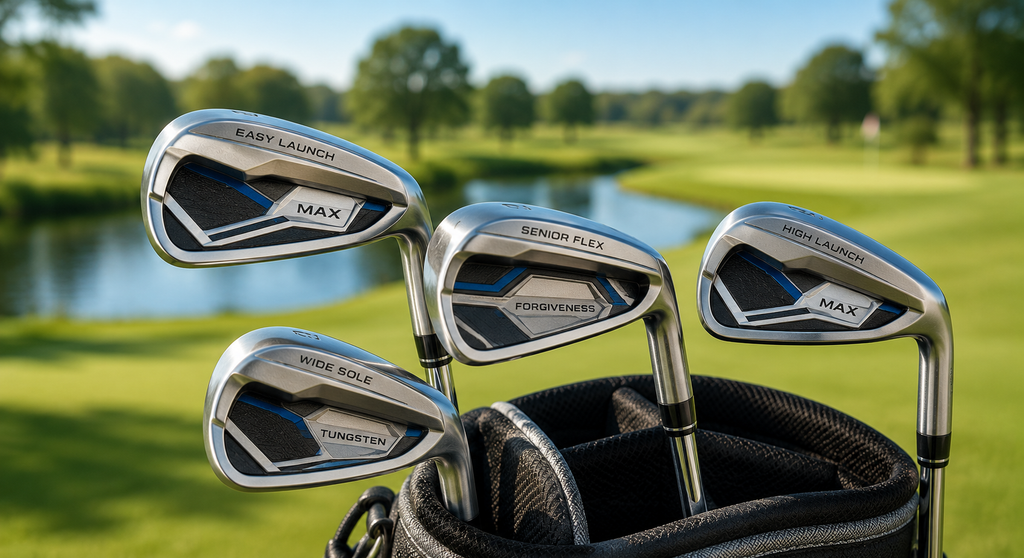
A larger clubface, wider sole, perimeter weighting, and cavity-back construction can all contribute to easier performance.
However, golfers should not assume every senior needs the same features.
The best golf irons for seniors should complement the individual golfer rather than simply carrying a senior-focused label.
A player with plenty of speed and consistent contact may prefer a more compact design. Another golfer may benefit significantly from maximum game-improvement technology.
Prioritize Easy Launch
Getting enough height from an iron becomes difficult when clubhead speed decreases.
A low trajectory can reduce carry and make it harder to stop shots on the green.
Therefore, launch should be one of the first characteristics you evaluate.
Many forgiving irons position weight low in the clubhead to support easier launch. Some also use wider soles and flexible faces to improve performance.
When testing the best golf irons for seniors, pay attention to peak height and carry rather than total distance alone.
A shot that rolls a long way after landing may create an impressive total-distance number. However, iron shots often need enough height to hold a green.
Forgiveness Matters on Off-Center Strikes
Nobody hits the center of the clubface on every swing.
Therefore, forgiveness matters for golfers of every age.
A forgiving iron can help preserve useful ball speed when contact moves away from the center. It may also reduce the distance difference between your best and average strikes.
That consistency can make club selection easier.
When comparing the best golf irons for seniors, pay close attention to mishits.
Do not judge an iron solely by the five perfect shots you hit during a fitting.
Instead, examine what happens when contact moves toward the heel, toe, or lower portion of the face.
A club that makes ordinary misses less costly may improve your scoring more than one that produces the longest perfect shot.
Consider a Wider Sole
Sole width influences how the club interacts with the ground.
Many game-improvement irons use wider soles. These designs can help some golfers move the club through the turf more effectively.
A wider sole may be particularly useful for players who tend to strike slightly behind the ball.
However, turf interaction depends on your delivery and course conditions.
One golfer may love a wide sole, while another prefers something narrower.
The best golf irons for seniors should move through the turf comfortably with your normal swing.
Test irons from grass whenever possible.
Mats can provide useful information, but real turf reveals how the sole interacts with the ground.
Look for a Low Center of Gravity
Club designers can position mass in different areas of an iron head.
A lower center of gravity can support higher launch, which may benefit golfers who struggle to produce enough trajectory.
However, clubhead design works together with loft, shaft, speed, strike, and delivery.
You should not buy an iron because of one technical feature alone.
Instead, evaluate the resulting ball flight.
The best golf irons for seniors should create useful launch without requiring you to make an uncomfortable swing.
If one iron produces better height with your normal motion, it deserves serious consideration.
Cavity-Back Irons Are Often a Strong Choice
Cavity-back irons allow manufacturers to distribute weight around the clubhead.
This construction commonly appears in game-improvement designs because it can increase forgiveness.
Traditional blade-style irons generally demand more precise contact.
Some experienced players love their compact shape and feel. However, there is no requirement to use demanding equipment simply because you have played golf for decades.
The best golf irons for seniors should help you enjoy the game you play today.
If a cavity-back design produces better launch, distance consistency, and confidence, there is little reason to reject it because of appearance or tradition.
Do Not Ignore Super Game-Improvement Irons
Super game-improvement irons typically emphasize maximum forgiveness and easy launch.
They may feature large clubheads, thick toplines, wide soles, and significant perimeter weighting.
Some golfers dislike the larger appearance.
Others find it extremely reassuring.
Performance should guide the decision.
If your current irons feel difficult to launch or punish small mishits severely, testing a more forgiving category can be worthwhile.
The best golf irons for seniors are not always the smallest or most traditional-looking clubs.
Confidence at address matters, especially when the design also delivers useful performance.
Graphite Shafts Deserve Consideration
Graphite iron shafts are available across a wide range of weights and profiles.
They are not limited to slow-swinging golfers.
A lighter graphite shaft may help some seniors create speed while reducing the overall effort required to swing the club.
Some golfers also prefer the way graphite feels at impact.
However, graphite is not automatically better than steel.
When comparing the best golf irons for seniors, test both materials if suitable options are available.
Focus on comfort, contact, launch, dispersion, and consistency.
Choose the shaft that supports your swing rather than selecting material based on assumptions.
Lightweight Steel Can Also Work Well
Golfers who prefer steel do not necessarily need to switch to graphite.
Modern steel shafts come in different weights.
A lighter steel option may preserve the familiar feel a golfer enjoys while reducing overall club weight.
This can provide a useful middle ground.
However, lighter is not automatically easier.
Some players lose awareness of the club when equipment becomes too light.
Therefore, test different combinations.
The best golf irons for seniors should feel manageable throughout the entire round, not merely during the first few swings of a fitting.
Choose Shaft Flex Through Testing
Age should not determine shaft flex.
Some senior golfers still generate substantial speed and use firm shafts successfully. Others benefit from softer options.
Swing speed provides a starting point, but tempo and transition also influence how a shaft feels.
Additionally, flex labels are not perfectly standardized between manufacturers.
A regular shaft from one company can feel different from another.
When testing the best golf irons for seniors, compare shaft options using real performance.
Look at strike consistency, trajectory, distance, and dispersion.
The correct flex is the one that helps you deliver the club comfortably and repeatedly.
Shaft Weight Can Be as Important as Flex
Golfers frequently discuss flex while overlooking weight.
Yet shaft weight can significantly influence how an iron feels.
A lighter shaft may make it easier to generate speed. It can also reduce fatigue for some players.
Conversely, a shaft that becomes too light may affect rhythm or control.
The goal is not to find the lightest possible setup.
Instead, find a weight that feels easy to swing while remaining stable and predictable.
The best golf irons for seniors should support comfortable speed without making the club difficult to sense during the swing.
Understand Modern Iron Lofts
Iron numbers do not guarantee identical lofts between sets.
One manufacturer’s 7-iron may have a different loft from another manufacturer’s 7-iron.
Therefore, comparing clubs only by the number stamped on the sole can be misleading.
Stronger lofts may produce more distance, but launch characteristics and clubhead design also matter.
When evaluating the best golf irons for seniors, compare actual loft specifications and ball flight.
Ask how the set creates appropriate distance gaps.
A longer 7-iron is not automatically better if the trajectory becomes too low or the gaps between clubs become inconsistent.
Distance Is Useful, but Consistency Is Better
Everyone enjoys gaining yards.
However, iron performance is primarily about predictable distances.
Imagine one iron producing a 150-yard perfect shot but dropping to 130 yards on common mishits.
Another averages 145 yards but keeps most shots within a much smaller distance range.
The second iron may be more useful on the course.
When comparing the best golf irons for seniors, evaluate average carry and distance dispersion.
Knowing how far the ball will travel helps you choose clubs confidently.
Maximum distance means less when it comes with unpredictable results.
Look at Descent and Stopping Ability
Carry distance tells only part of the story.
An iron shot also needs to behave appropriately after landing.
If trajectory is extremely low, the ball may release farther than expected on firm greens.
Launch-monitor data can help you compare peak height and descent characteristics.
However, actual stopping performance also depends on spin, the golf ball, green firmness, weather, and landing conditions.
The best golf irons for seniors should provide a useful combination of carry and trajectory.
Do not chase stronger lofts if they make it difficult to hold greens.
Hybrids Can Replace Difficult Long Irons
There is no rule requiring you to carry a 3-, 4-, or even 5-iron.
Many golfers find hybrids easier to launch.
A hybrid can provide a larger head, lower center of gravity, and different sole design than a traditional long iron.
If your longest irons produce low shots with inconsistent carry, compare them with hybrids.
The best golf irons for seniors may actually form part of a blended set.
For example, you might use hybrids at the top of the bag and conventional irons from the middle of the set downward.
Choose clubs according to performance rather than tradition.
Hybrid-Style Irons Offer Another Option
Some iron sets use hybrid-like construction throughout much of the set.
These clubs often feature larger bodies, wide soles, and designs focused heavily on launch and forgiveness.
Traditionalists may need time to adjust to the appearance.
However, golfers who prioritize ease of use may find them valuable.
Test them without judging the shape before hitting shots.
The best golf irons for seniors are the clubs that help produce reliable golf, regardless of whether they look like traditional blades.
Performance should earn a place in the bag.
Check the Set Composition Before Buying
Do not assume every iron set includes the same clubs.
One set might start at a 5-iron, while another begins at a 6-iron.
Some packages include a gap wedge. Others stop at the pitching wedge.
Before buying, examine the entire set.
Then compare it with your existing hybrids, fairway woods, and wedges.
The best golf irons for seniors should fit into the rest of your bag without creating unnecessary overlap or large distance gaps.
Buying fewer irons may even make sense if you prefer hybrids for longer shots.
Grip Size and Comfort Matter
The grip is your direct connection to the club.
If it feels uncomfortable, excessively small, or too large, your overall experience may suffer.
Golfers with hand discomfort or reduced grip strength sometimes explore larger grip options.
However, size should be chosen based on comfort and performance rather than age alone.
During a fitting, try different sizes if your current grips feel unsuitable.
The best golf irons for seniors should feel comfortable from the grip all the way through the clubhead.
Small fitting details can make a meaningful difference over 18 holes.
Club Length Still Needs to Fit
Senior-friendly does not mean shorter or longer by default.
Proper club length depends on your body measurements, posture, swing, and impact conditions.
If clubs are poorly fitted, you may compensate during the swing.
That can make centered contact more difficult.
A fitter can evaluate length alongside lie angle and other specifications.
When comparing the best golf irons for seniors, make sure the test clubs are reasonably appropriate for your physical setup.
A forgiving head cannot completely compensate for equipment that is significantly mismatched to the golfer.
Lie Angle Can Affect Direction
Lie angle describes the relationship between the shaft and sole when the club is positioned.
Dynamic lie at impact can influence directional tendencies.
Therefore, a fitting may include lie-angle evaluation.
Do not assume you need a particular setting because of height alone.
Your posture, arm length, delivery, and impact conditions also matter.
The best golf irons for seniors should be fitted as a complete system.
Head design attracts most of the attention, but specifications such as lie angle can also influence consistency.
Comfort Should Be Part of the Decision
A club can produce impressive launch-monitor numbers yet feel uncomfortable.
Do not ignore that information.
You need equipment you can swing throughout a complete round.
Pay attention to overall weight, impact sensation, grip comfort, and how much effort the club seems to require.
If fatigue is an issue, mention it during the fitting.
The best golf irons for seniors should provide performance without forcing you to work excessively hard for every shot.
Golf becomes more enjoyable when the equipment complements your physical capabilities.
Test Irons From Grass When Possible
Indoor fittings provide valuable data.
However, turf interaction becomes easier to judge from real grass.
If possible, test your final choices outdoors or at a fitting location that allows shots from turf.
Observe how the sole moves through the ground.
Does the club dig excessively? Does it feel comfortable on slightly heavy strikes?
The best golf irons for seniors should perform in the conditions you actually encounter.
A club that looks excellent on a launch monitor still needs to work from fairways and rough.
Compare Your Current Irons
Always establish a baseline.
Hit your current 7-iron or another appropriate club before testing replacements.
Record carry, launch, strike location, dispersion, and feel.
Then compare new models under similar conditions.
New equipment should provide a meaningful benefit.
When searching for the best golf irons for seniors, do not replace a perfectly functional set merely because something newer exists.
If your current irons still launch easily, provide reliable distance, and feel comfortable, you may not need an upgrade yet.
Consider Used or Previous-Generation Irons
A new iron set can represent a significant investment.
Previous-generation models may offer excellent performance at a lower cost.
Used clubs can also provide value if they remain in good condition.
Inspect grooves, faces, shafts, ferrules, and grips before purchasing.
Check whether the specifications have been modified.
If possible, verify shaft model, flex, length, and lie settings.
The best golf irons for seniors do not have to come from the newest product release.
Fit and performance matter more than model year.
Do Not Buy Solely From Reviews
Reviews can help create a shortlist.
They can explain technology, compare specifications, and identify the intended player.
However, another golfer’s experience cannot guarantee your results.
Swing speed, strike, delivery, feel preferences, and physical needs vary widely.
Use reviews to identify models worth testing.
Then make the final decision using your own performance.
The best golf irons for seniors should earn that description based on how they work for your swing, not because one reviewer gave them the highest rating.
Get Fitted Before Making a Major Purchase
A professional fitting can help you compare heads, shafts, lengths, lie angles, and set configurations.
Bring your current irons.
The fitter can establish baseline numbers before introducing alternatives.
During testing, make normal swings.
Do not swing harder because you want the new iron to produce impressive numbers.
When evaluating the best golf irons for seniors, look for repeatable improvements in launch, carry, strike quality, dispersion, and comfort.
A fitting can also help determine where hybrids should replace irons in your set.
What to Look for During Testing
Start with comfort.
Does the club feel manageable during the swing?
Next, examine contact.
A forgiving iron should provide useful results across your normal strike pattern.
Then look at launch and peak height.
Make sure shots achieve enough trajectory for the distances you need.
Compare average carry rather than your longest shot.
Finally, review dispersion.
The best golf irons for seniors should create a manageable pattern both left-to-right and short-to-long.
If one option gives you slightly less maximum distance but much better consistency, it may be the stronger choice.
Common Buying Mistakes to Avoid
Do not buy irons based only on distance.
Likewise, avoid selecting shaft flex solely from age.
Do not assume graphite is always better for seniors or steel is always better for stronger golfers.
Another mistake is buying an entire set without checking which long irons you can actually use.
Finally, do not overlook comfort.
The best golf irons for seniors should make golf easier, not create additional physical effort.
Choose equipment based on your current swing and needs rather than what worked ten years ago.
A Practical Senior Iron Checklist
Begin with launch and forgiveness.
Then evaluate shaft weight, flex, and material.
Check the clubhead’s size and sole design.
Make sure you like the appearance at address.
Next, review carry distance and consistency.
Determine whether long irons should be replaced with hybrids.
Check grip size, club length, and lie angle during fitting.
Compare the new set against your current equipment.
Most importantly, test several normal shots.
The best golf irons for seniors should perform reliably when your strike is slightly imperfect, because those are the shots that often determine whether a club truly makes the game easier.
Conclusion
Senior golfers have more equipment options than ever before, but more choice does not mean you should automatically buy the lightest or most forgiving club available.
Start with your actual needs.
If launch has become difficult, look for a head design that helps create more height. If off-center strikes lose too much distance, prioritize forgiveness. If your current set feels tiring, test lighter shafts and overall club weights.
Consider replacing difficult long irons with hybrids. Meanwhile, pay attention to grip comfort, club length, lie angle, and set composition.
Most importantly, compare new equipment against your current clubs under similar conditions. Look at average carry, trajectory, strike consistency, and dispersion instead of focusing on one perfect shot.
The best golf irons for seniors are ultimately the irons that make your normal swing more effective. Choose a setup that provides useful launch, predictable distance, dependable forgiveness, and enough comfort to keep you playing confidently throughout the round.
FAQ
1. What type of irons are easiest for older golfers to hit?
Game-improvement and super game-improvement designs are often easier to launch and more forgiving. However, the ideal design depends on the golfer’s strike pattern, speed, and preferences.
2. Should senior golfers use graphite iron shafts?
Graphite can be an excellent option because it comes in many weights and profiles. However, lightweight steel may also work well. Testing both is the best approach.
3. Should seniors replace long irons with hybrids?
Many golfers benefit from replacing difficult long irons with hybrids because hybrids can provide easier launch and useful forgiveness. Compare both options before deciding.
4. Do senior golfers need senior-flex shafts?
Not automatically. Age does not determine shaft flex. Swing speed, transition, tempo, shaft weight, feel, and actual ball-flight results should guide the choice.
5. How do I know when my current irons need replacing?
Consider an upgrade when your irons no longer suit your swing, become physically damaged, create poor distance gaps, or make launch and consistent contact unnecessarily difficult.