
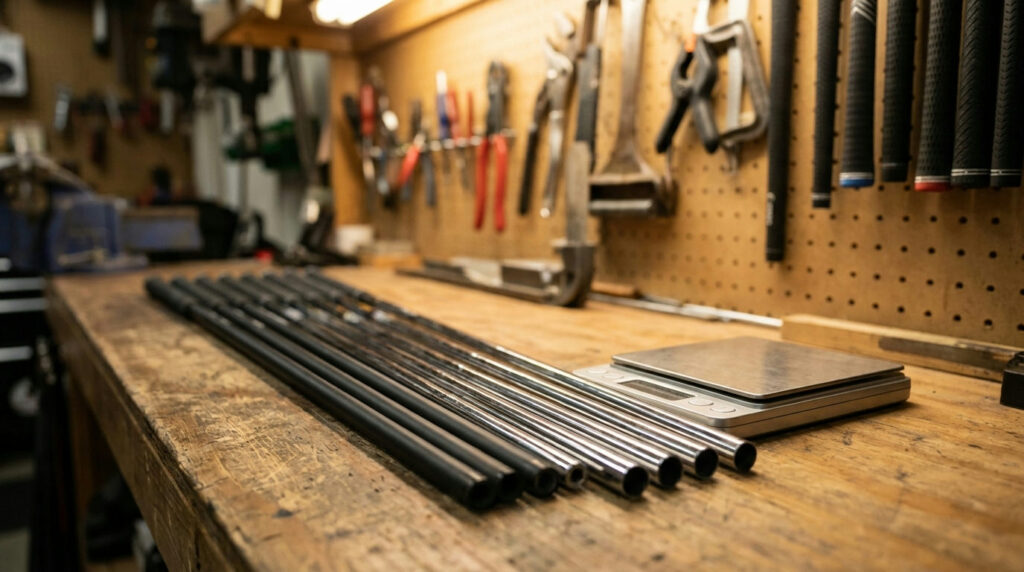
Most golfers have heard about shaft flex, but far fewer think about shaft weight. Yet weight can shape your tempo, control and energy levels just as much. This guide offers golf shaft weight explained in practical terms, so you can understand how light and heavy shafts behave, how weight differs from flex, and what clues suggest you are in the wrong shaft.
Disclosure: Best Golf Clubs may earn a commission from qualifying purchases made through links on this site, including as an Amazon Associate, at no extra cost to you.
What Does Shaft Weight Mean?
Shaft weight is simply how heavy the shaft is on its own, usually measured in grams before it is cut to length. Manufacturers often list it on the shaft label or in their specifications.
Because the shaft runs the full length of the club, its weight has a big influence on how the whole club feels in your hands. A heavier shaft makes the club feel more substantial. In contrast, a lighter shaft makes it feel easier to swing quickly.
Total club weight also includes the head and grip. However, the shaft is often the component that varies most between options, so it is the main lever fitters use to change overall feel.
Shaft Weight vs Shaft Flex: Two Different Things
It is easy to confuse weight and flex because they often move together in product lines. Still, they describe different properties.
- Flex describes how much the shaft bends under load. Common labels include ladies, senior, regular, stiff and extra stiff.
- Weight describes how heavy the shaft is, regardless of how much it bends.
For example, you can find light shafts with a stiff flex and heavier shafts with a regular flex. Therefore, choosing the right flex does not automatically mean you have the right weight. A good fitting looks at both.
Typical Shaft Weight Ranges
Exact weights vary widely by brand and model, so treat the ranges below as broad, commonly cited guides rather than precise rules.
| Club and Material | Often Falls Roughly In | Notes |
|---|---|---|
| Graphite driver shafts | The 40s to 70s in grams | Lighter options are common for slower swings |
| Graphite iron shafts | The 50s to 90s in grams | Popular for seniors and players wanting less strain |
| Steel iron shafts | The 90s to 130s in grams | Lightweight steel sits at the lower end |
If you want a deeper look at materials, our guide to steel vs graphite shafts covers how each one feels and performs.
Golf Shaft Weight Explained: How It Affects Your Swing
Shaft weight influences three main things: tempo, control and fatigue. Let’s look at each in turn.
Tempo and Timing
Your natural rhythm plays a big role here. Golfers with a quick, aggressive tempo often benefit from a heavier shaft, because the extra mass helps slow the transition and keeps the club from feeling “whippy.” On the other hand, golfers with a smooth, unhurried tempo may find a lighter shaft easier to time.
A shaft that is too light for a fast swinger can feel loose and hard to control. Meanwhile, a shaft that is too heavy for a smooth swinger can feel sluggish and difficult to square up.
Control and Consistency
Heavier shafts often help stronger players feel where the clubhead is during the swing. As a result, some golfers see a tighter dispersion with more weight. However, this only works if you can swing the heavier club without strain.
Lighter shafts can help some golfers produce more clubhead speed. That said, extra speed is only useful if contact remains solid and the face stays under control.
Fatigue Over a Round
Weight adds up over 18 holes, plus practice swings and range sessions. If your clubs feel heavy by the back nine, your swing may lose speed and timing late in the round. Consequently, lighter shafts can be a smart choice for golfers who walk the course, play frequently, or have joint or strength concerns.
Signs Your Shafts May Be Too Light or Too Heavy
Your ball flight and body give useful clues. Use these signs as a starting point for a conversation with a fitter.
Possible Signs a Shaft Is Too Light
- The club feels hard to control or “floppy” at the top of the swing.
- Your tempo gets quick and jerky.
- You struggle with inconsistent contact even on good swings.
- Shots tend to balloon or curve more than expected.
Possible Signs a Shaft Is Too Heavy
- You feel tired or sore toward the end of a round.
- Shots often fly low or leak right (for right-handers) because the face lags open.
- Your swing feels labored rather than free.
- Your distances drop noticeably on the back nine.
How Swing Speed Relates to Shaft Weight
Swing speed is one of the most common starting points in fitting. Generally, faster swingers often suit heavier shafts, while slower swingers often suit lighter ones. However, tempo and strength matter too, so speed is a guide rather than a rule.
For a broader look at how speed influences club choices, see our article on choosing golf clubs by swing speed.
Weight Progression Through the Bag
Many fitters recommend that shaft weight gradually increases from driver to wedges. In other words, the longest clubs tend to have the lightest shafts, and the shortest clubs the heaviest.
This progression helps the bag feel consistent. If your fairway woods feel much heavier than your driver, or your wedges feel lighter than your irons, your timing can change from club to club. Ideally, each step down in length should feel like a natural continuation of the last.
Shaft Weight, Balance and Swing Weight
Two shafts with the same weight can still feel different. That is because balance point and swing weight also shape how a club feels in motion.
- Balance point: Some shafts carry more of their mass toward the grip end, while others carry it toward the tip. A higher balance point can make the head feel heavier, even with a lighter shaft.
- Swing weight: This measures how heavy the club feels when swung, rather than its total weight. Changing shaft weight often changes swing weight, so a builder may add or remove head weight to compensate.
- Grip weight: A heavier or lighter grip shifts the overall feel as well, which is why fitters consider the full assembly.
In short, the number on the shaft label is only part of the story. Ultimately, how the finished club feels in your swing matters most.
Practical Fitting Cues to Watch
When you test shafts of different weights, pay attention to more than distance. Follow this checklist:
- Warm up fully before comparing shafts so your results reflect your normal swing.
- Hit several shots with each option, not just one or two.
- Watch dispersion on the launch monitor, not only carry distance.
- Notice how your tempo feels. The right weight usually feels smooth and repeatable.
- Consider fatigue. Ask yourself whether you could swing this club comfortably for a full round.
- Check consistency between clubs so your bag progresses logically.
Where to Learn More
For ongoing equipment coverage that often discusses shaft weight and fitting, visit the gear section at GOLF.com. You can also find equipment news and fitting topics at Golf Digest.
Frequently Asked Questions
Will a lighter shaft always add distance?
Not always. It may increase speed for some golfers, but if control suffers, average distance and accuracy can drop.
Can I change shaft weight without new heads?
Yes. A club builder can reshaft your existing heads, although swing weight and length may need adjusting too.
Do seniors always need light shafts?
Not necessarily. Many seniors benefit from lighter shafts, but strength, tempo and preference vary widely.
Final Thoughts
With golf shaft weight explained, you can now separate weight from flex and look for clues in your tempo, control and energy levels. The right weight should feel smooth, repeatable and comfortable for a full round. Test several options and focus on consistency over raw distance.
This guide is general information. For the best results, consider a professional club fitting or a lesson with a qualified golf professional.