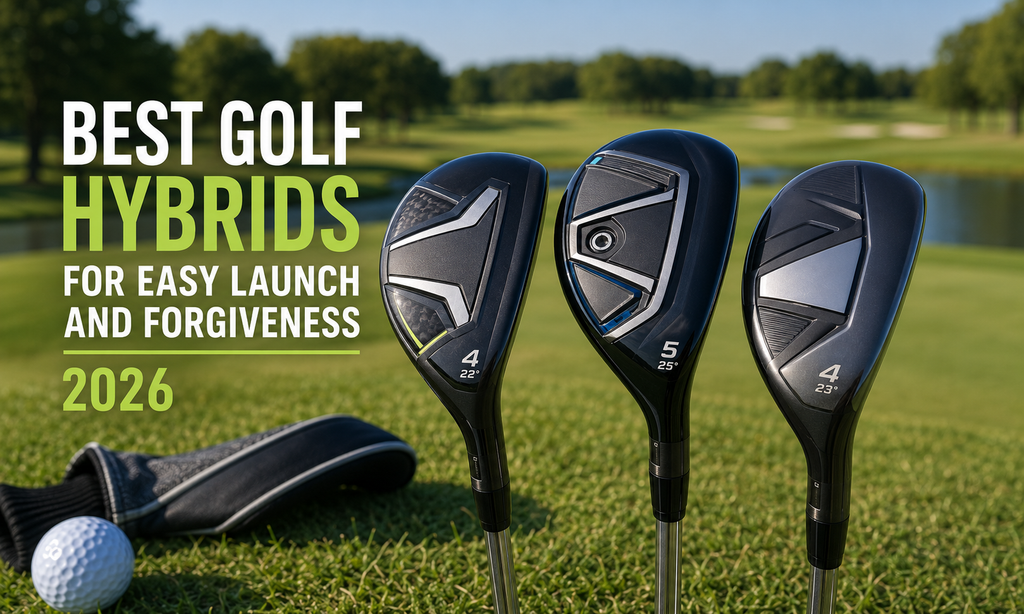
The best golf hybrids can make some of the hardest shots in golf much easier to manage. They combine characteristics of fairway woods and irons, giving golfers another option for long approach shots, tee shots, and difficult lies. For many players, a hybrid launches more easily than a comparable long iron while providing useful forgiveness on imperfect contact. However, choosing one involves more than finding the correct number on the sole. Loft, shaft length, head shape, distance, and the clubs already in your bag all matter. This guide explains what to compare in 2026 so you can choose a hybrid that fills a genuine need in your set.
Why Hybrids Are Easier for Many Golfers to Hit
Traditional long irons can be demanding because they have relatively low loft and require reliable contact.
Hybrids approach the same distance range differently.
Their heads are generally deeper than iron heads. Manufacturers can position weight to help create useful launch and stability.
Hybrids also tend to use graphite shafts and longer club lengths than equivalent irons. This combination can help golfers generate speed.
The wider sole can make turf interaction more forgiving as well.
However, hybrids are not automatic solutions. You still need reasonable contact and a suitable setup.
The best golf hybrids simply make certain long-game shots less demanding for many recreational players.
If your 4-iron rarely produces the height or carry you expect, a hybrid may provide a more practical alternative.
Forgiveness Should Be a Major Priority
Golfers rarely strike every long shot perfectly.
Therefore, forgiveness should rank high when comparing hybrids.
A forgiving head helps preserve useful ball speed and direction when contact moves away from the center.
Look for a design that inspires confidence at address. Many game-improvement hybrids use slightly larger profiles, although head size varies considerably.
The sole also matters.
A wider sole can help the club move through different lies without requiring the precision of a narrow long iron.
Still, bigger does not automatically mean better.
Some golfers feel more comfortable with a compact hybrid because it resembles an iron. Others prefer the confidence provided by a larger, wood-like shape.
When comparing the best golf hybrids, hit several shots rather than judging forgiveness from specifications alone.
Your average strike matters more than your best swing.
Easy Launch Can Transform Your Long Game
A long club is not useful if you cannot launch it high enough to produce dependable carry.
This is where hybrids can excel.
Their construction can help position the center of gravity in a way that supports easier launch compared with many traditional long irons.
Loft remains essential.
A lower-lofted hybrid will generally be harder to launch than a higher-lofted model. Therefore, do not choose the lowest loft simply because you want maximum distance.
Useful distance comes from the right combination of speed, launch, spin, and contact.
The best golf hybrids should produce a flight that fits the intended role.
For an approach club, you may want enough height to help the ball stop on the green. For a tee-shot replacement, a more penetrating flight could work well.
Test actual carry rather than judging performance from total distance alone.
Understand Hybrid Loft Before Buying
The number printed on a hybrid does not always tell you exactly how far it will travel.
A 4-hybrid from one manufacturer may have a different loft from another company’s 4-hybrid.
Therefore, always check the actual loft.
You should also compare it with your existing fairway woods and irons.
For example, adding a hybrid that travels almost exactly the same distance as your longest iron does not solve a meaningful problem.
Instead, identify the distance you need to cover.
Then test hybrids that can fill that gap.
The best golf hybrids create useful spacing between neighboring clubs.
Do not worry if the number on your hybrid does not match the iron it replaces. Performance matters more than matching labels.
A launch monitor can help you compare carry distances, but you can also learn a great deal by testing clubs outdoors and observing where shots consistently finish.
Should You Replace Your Long Irons?
Many golfers benefit from replacing one or more long irons with hybrids.
A 3-iron or 4-iron can be difficult to launch consistently, particularly for players with moderate clubhead speed.
A hybrid may produce higher flight and more predictable carry.
However, you do not need to remove every long iron.
Perhaps you hit your 5-iron confidently but struggle with your 4-iron. In that case, replacing only the 4-iron may be enough.
Other golfers prefer hybrids down to the 5- or even 6-iron range.
There is no universal transition point.
When choosing the best golf hybrids, compare them directly with the irons they might replace.
Hit both from similar lies and evaluate carry, height, dispersion, and confidence.
Keep whichever club performs the required job more consistently.
Hybrids vs Fairway Woods
Hybrids and fairway woods can cover overlapping distance ranges.
However, they often create different ball flights and visual experiences.
Fairway woods usually have larger heads and longer shafts. They may provide more distance for golfers who strike them well.
Hybrids are generally shorter and more compact. This can make them easier to control for some players.
A hybrid may also feel more comfortable from rough or uneven lies.
Still, fairway woods can be excellent from the fairway and tee.
The best golf hybrids should complement your woods rather than duplicate them.
For example, you might carry a 5-wood followed by a higher-lofted hybrid. Another golfer may prefer a 3-wood and two hybrids.
Measure your actual carry distances.
Club names matter much less than creating a useful progression through the top end of your bag.
Shaft Weight and Flex Matter
Hybrid shafts deserve the same attention as driver and iron shafts.
Weight affects how the club feels throughout the swing. A shaft that is too light may make timing difficult for some golfers, while one that is too heavy may feel demanding.
Flex also influences feel and delivery.
However, do not select flex solely from labels such as regular or stiff. These categories can feel different between shaft models.
Your tempo and transition also matter.
A golfer with a smooth swing may prefer a different profile from someone who changes direction aggressively.
The best golf hybrids pair a suitable head with a shaft that supports repeatable contact.
During testing, notice whether you can feel the clubhead naturally.
Also compare strike location and dispersion. A combination that feels comfortable and produces a consistent pattern is usually more useful than one that generates a single exceptionally long shot.
Head Shape Can Affect Confidence
Some hybrids look almost like compact fairway woods.
Others have smaller heads designed to create an iron-like appearance.
Neither shape is automatically superior.
Larger profiles can inspire confidence for golfers who want maximum forgiveness. They may also provide more visible surface area behind the ball.
Compact hybrids can appeal to players who prefer a cleaner appearance and want a club that transitions naturally into their irons.
Offset varies as well.
Some game-improvement designs position the face in a way intended to help certain golfers square the club more easily.
When evaluating the best golf hybrids, pay attention to your reaction at address.
If a club looks difficult to aim or makes you uncomfortable, good specifications may not matter.
Confidence affects commitment. Choose a shape that encourages you to make a normal swing rather than forcing adjustments before you even start the backswing.
Do Not Ignore Your Common Miss
Your normal miss can help guide your hybrid choice.
Some golfers struggle with shots that leak right. Others tend to hook hybrids because the clubs feel easier to rotate than long irons.
Neutral, draw-biased, and adjustable designs can respond differently to these tendencies.
However, equipment should not be used to hide a severe swing problem.
A fitting can help determine whether your miss comes partly from unsuitable equipment or mainly from technique.
When comparing the best golf hybrids, hit enough shots to reveal your normal pattern.
Do not delete every poor swing from your evaluation.
Those misses are important because they show how the club performs when your swing is not perfect.
The right hybrid should make your typical result more playable, not simply produce a spectacular shot when everything works perfectly.
Hybrids Can Be Excellent From the Rough
One reason golfers appreciate hybrids is their versatility.
A long iron can become difficult when the ball sits in moderate rough. The grass may reduce speed or interfere with clean contact.
A hybrid’s head and sole can make certain rough shots easier to manage.
However, lie assessment remains important.
If the ball sits deep in thick grass, trying to hit a low-lofted hybrid may be unrealistic. A shorter, more lofted club can provide the safer escape.
From a reasonable lie, though, the hybrid can be an excellent option.
The best golf hybrids give you confidence from more than one type of surface.
During testing or practice, do not hit only from perfect fairway lies.
Try the club from light rough and other realistic situations when possible. Versatility becomes much more valuable when you know exactly where the club performs well.
Use Hybrids From the Tee
Hybrids are not limited to approach shots.
They can provide an excellent alternative when driver brings too much trouble into play.
On a short par 4, a hybrid may produce enough distance while offering greater control.
It can also be useful on narrow holes where position matters more than maximum length.
Tee the ball relatively low when using a hybrid. You generally want a setup that resembles a clean fairway strike rather than a high driver tee.
Experiment during practice to find a comfortable tee height.
The best golf hybrids can become reliable positional clubs because they combine useful distance with manageable shaft length.
However, choose your target carefully.
A shorter club does not automatically guarantee accuracy. Make a committed swing and aim toward the safest section of the fairway.
Adding a dependable tee option can make the hybrid even more valuable.
Distance Is Not the Only Number That Matters
Golfers often compare clubs by asking which one travels farthest.
That approach can create problems.
Suppose one hybrid carries 190 yards consistently while another occasionally reaches 200 but usually ranges from 180 to 200. The shorter option may be far more useful.
Consistency matters because clubs need predictable roles.
Launch and descent are also important.
A hybrid intended for approach shots should ideally create a flight that gives you reasonable control when the ball lands.
Dispersion deserves attention too.
The best golf hybrids combine enough distance with repeatable carry and manageable directional misses.
When testing with a launch monitor, examine averages rather than maximum numbers.
On the course, you cannot choose your best result. You need equipment that performs reliably across ordinary swings.
Adjustability Can Be Useful
Some modern hybrids include adjustable hosels.
These systems may allow you to change loft or other aspects of the club’s setup within a limited range.
Adjustability can be helpful when dialing in distance gaps.
For example, a small loft change may create better spacing between your fairway wood and longest iron.
It can also give a fitter more options when optimizing ball flight.
However, adjustability should not become the main reason you buy a club.
A fixed-hosel hybrid that fits your game can perform perfectly well.
The best golf hybrids need suitable specifications, regardless of whether those settings can be changed later.
If you choose an adjustable model, learn how the settings affect performance before experimenting.
Record your preferred configuration once you find it. Constantly changing settings after poor shots can create more confusion than improvement.
Who Benefits Most From Hybrids?
Hybrids can suit almost any skill level.
Beginners often appreciate their forgiveness and easier launch. High-handicap golfers may use them to replace demanding long irons.
Mid-handicap players can benefit from their versatility and distance consistency.
Even low-handicap golfers sometimes carry hybrids when the club fits a specific distance or course requirement.
Senior golfers and players with moderate swing speeds may find higher-lofted hybrids especially useful because they can create launch without requiring extreme effort.
However, equipment choices should never be based entirely on handicap, age, or gender.
The best golf hybrids are the ones that solve a specific performance need.
If you already hit long irons consistently and prefer their flight, you may not need a hybrid.
If a hybrid produces better results, there is no reason to avoid one because of traditional ideas about who should use them.
How Many Hybrids Should You Carry?
There is no ideal number for every golfer.
Some players carry one hybrid. Others use two or three.
Start by examining the top of your iron set.
Which long iron becomes difficult to hit consistently? That point can help identify where hybrids should enter the bag.
Next, compare your fairway woods.
You want meaningful distance differences rather than several clubs producing nearly identical results.
For example, a golfer might carry a 5-wood, 4-hybrid, and then 5-iron. Another might prefer a 3-wood followed by 3- and 4-hybrids.
When choosing the best golf hybrids, build around your actual carry distances.
The 14-club limit does not mean you need to fill every possible category.
Each club should earn its place by covering a useful distance or shot that another club cannot handle as effectively.
How to Test a Hybrid Before Buying
Begin by hitting shots from a comfortable fairway lie.
After warming up, record several normal swings. Ignore the temptation to swing harder simply because you are testing equipment.
Evaluate centered contact, carry distance, height, and dispersion.
Then hit from light rough if the facility allows it.
Try several tee shots as well.
Compare the hybrid directly with the long iron or fairway wood it may replace.
The best golf hybrids should provide a clear reason to make the change.
Perhaps they launch higher, produce tighter dispersion, or make poor strikes less damaging.
If possible, use your normal golf ball during testing because range balls can produce different results.
Finally, judge confidence. A hybrid should feel like a club you are willing to use when a difficult long shot appears during an actual round.
Should You Get Fitted for a Hybrid?
A professional fitting can help you choose loft, shaft, length, and head design.
More importantly, a fitter can compare the hybrid with your existing clubs.
This prevents distance overlap.
Bring your longest reliable iron and nearest fairway wood to the fitting if possible.
The fitter can identify the distance window the new club needs to cover.
Launch-monitor data can reveal carry, launch angle, spin, ball speed, and dispersion.
However, numbers should support the decision rather than complicate it.
The best golf hybrids should create a clear practical improvement.
If two models produce similar data, choose the one that feels more comfortable and inspires greater confidence.
A fitting is particularly useful if you struggle with standard shaft options or cannot determine which loft belongs in your bag.
New vs Used Golf Hybrids
Used hybrids can provide excellent value.
Previous-generation models may offer plenty of forgiveness and performance for recreational golfers.
Inspect the clubface for excessive wear or damage. Check the crown, sole, shaft, grip, and hosel as well.
If the club has an adjustable hosel, confirm that the mechanism works properly.
Also verify shaft specifications.
A bargain is not useful if the shaft weight, flex, or length is unsuitable.
When shopping for the best golf hybrids, compare used prices with discounted previous-generation new models.
Sometimes the difference is small enough that a new club with warranty coverage makes more sense.
Regardless of age, prioritize fit and condition.
A properly suited older hybrid can outperform a newer model that does not match your swing or distance requirements.
Common Hybrid Buying Mistakes
The first mistake is buying according to the number printed on the club.
Always check actual loft and performance.
Another mistake is choosing a hybrid simply because it travels farther than your current long iron. If it creates a large gap to the next club, extra distance may hurt your set composition.
Do not assume every hybrid is automatically forgiving either.
Head shapes, shafts, weighting, and performance characteristics vary.
Ignoring shaft specifications can also lead to poor results.
When comparing the best golf hybrids, test normal swings rather than chasing maximum speed.
Another mistake is carrying too many clubs that produce similar distances.
Finally, avoid judging a hybrid only from perfect range lies. Golf requires shots from rough, uneven ground, and tees. A versatile club should perform in the situations where you actually plan to use it.
Build Confidence With Your New Hybrid
Once you choose a hybrid, learn exactly what it can do.
Start by establishing your average carry distance.
Then practice from fairway lies, light rough, and the tee.
Experiment with different targets rather than repeatedly hitting toward the same area.
You should also learn what the club cannot do.
If the ball sits deep in thick rough, a shorter club may be safer. Likewise, a hybrid may not be ideal when you need a very low shot beneath tree branches.
The best golf hybrids become more useful when you understand their strengths and limitations.
During rounds, choose the hybrid when it gives you a clear advantage rather than using it automatically.
Confidence grows from repeated successful experiences. Practice enough that reaching for the hybrid feels like a simple decision instead of an experiment.
Conclusion
Hybrids can make the difficult space between fairway woods and mid-irons much easier to manage.
Start with your actual distance gaps. Then determine whether a hybrid can provide more consistent launch, carry, or forgiveness than the club it would replace.
Pay attention to loft rather than relying on the number stamped on the sole. Shaft weight, flex, head shape, and overall feel also deserve careful comparison.
Test hybrids from more than perfect fairway lies. A versatile option should give you confidence from the tee, fairway, and reasonable rough.
Most importantly, choose predictable performance over maximum distance.
The best golf hybrids are not necessarily the newest, longest, or most expensive options. They are the clubs that fill a clear gap, launch comfortably, reduce the cost of imperfect strikes, and help you approach difficult long shots with greater confidence.
FAQ
1. Are hybrids easier to hit than long irons?
For many golfers, yes. Their head design and wider soles can make launching the ball and producing useful results from imperfect strikes easier.
2. What iron should a 4-hybrid replace?
It often occupies a similar general part of the bag as a long iron, but lofts and distances vary. Compare actual carry numbers rather than relying on club labels.
3. Can I use a hybrid from the rough?
Yes, when the lie is reasonable. Hybrids can be effective from light or moderate rough, although deep grass may require a shorter, more lofted club.
4. Should beginners carry more than one hybrid?
They can. If several long irons are difficult to launch consistently, replacing more than one with hybrids may create a more playable set.
5. Is a hybrid better than a fairway wood?
Neither is universally better. Fairway woods may provide more distance, while hybrids can offer greater control and versatility for some golfers. Test both for the distance you need.