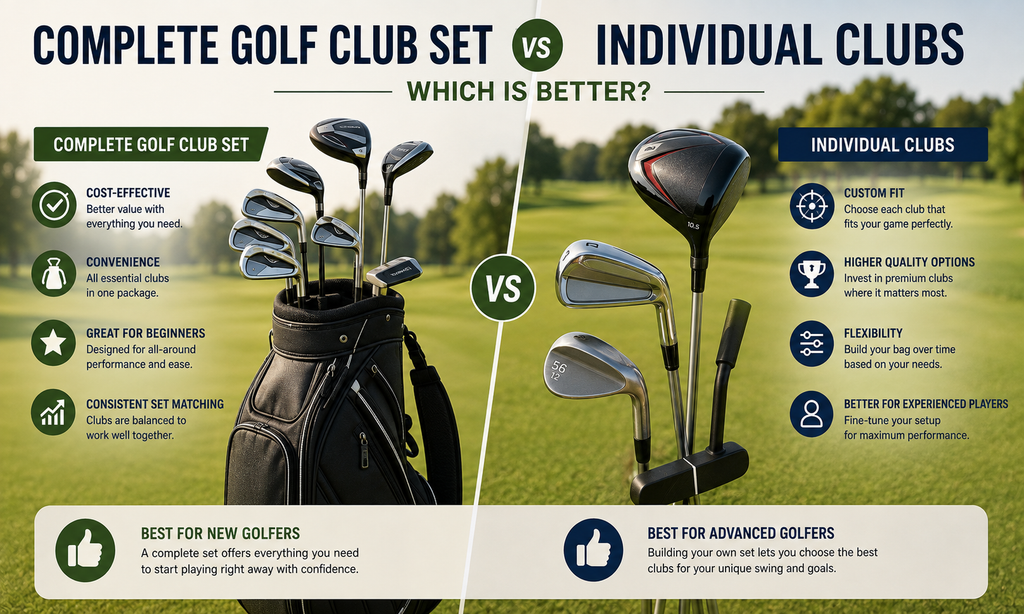
Choosing between a complete golf club set and buying individual clubs can be confusing, especially for newer golfers. Package sets offer a convenient way to get almost everything you need at once. Individual clubs, however, allow you to build a bag around your swing, preferences, and performance needs. Neither approach is automatically better. Your experience, budget, playing frequency, and long-term goals should guide the decision. Before spending money, it helps to understand what each option includes, where you may save, and when greater customization becomes worthwhile.
What Is a Complete Golf Club Set?
A package set usually includes several essential clubs designed to work together.
Depending on the product, you may receive a driver, fairway wood, hybrid, irons, wedges, putter, and golf bag. Some packages include headcovers as well.
This convenience makes package sets attractive to beginners.
Instead of researching every club category separately, you can make one purchase and have enough equipment to begin playing.
However, packages vary significantly.
Some contain only the basic clubs a new golfer needs. Others provide a larger selection intended to cover more distance gaps.
A complete golf club set may also use similar design principles throughout the bag. Manufacturers often prioritize forgiveness and easy launch because package sets frequently target recreational or developing golfers.
Always check exactly what is included before comparing prices. Two sets with similar prices may contain different numbers and types of clubs.
Why Beginners Often Choose Package Sets
New golfers face a difficult buying problem.
They may not know their swing speed, preferred shaft weight, ideal club configuration, or typical distances yet.
Buying every club individually requires many decisions.
A package removes much of that complexity. You can begin learning the game without spending weeks comparing drivers, irons, wedges, and putters.
Cost is another advantage.
Buying separate current-generation clubs can become expensive quickly. A package may provide the essential equipment at a more manageable total price.
A complete golf club set can therefore make sense when your main goal is simply getting onto the course.
Beginners also tend to change rapidly as they develop. Spending heavily on specialized equipment before building a repeatable swing may not provide much benefit.
Start with equipment that is comfortable, forgiving, and suitable for learning. You can upgrade specific areas later as your preferences become clearer.
Advantages of Buying Individual Golf Clubs
Buying clubs separately provides far more control.
You can choose a driver from one manufacturer, irons from another, and wedges or a putter from brands that best suit your preferences.
More importantly, each category can be fitted to your needs.
For example, you might perform better with a specific driver loft while preferring heavier iron shafts. Your wedges may require different lofts based on your distance gaps.
This flexibility is difficult to achieve with a standard package.
Individual purchasing also lets you prioritize your budget.
If driving is important to you, you can spend more on a properly fitted driver while saving money elsewhere.
However, building a bag this way requires more research.
Compared with a complete golf club set, individual purchasing can also become considerably more expensive when you choose premium equipment throughout the bag.
The extra cost makes the most sense when customization creates a real performance benefit.
Compare the Total Cost, Not Just One Price
Price comparisons can be misleading.
A package has one visible cost, while an individually built bag involves several separate purchases.
Start by listing everything you need.
You may require a driver, fairway wood or hybrid, irons, wedges, putter, and bag. Headcovers may add another cost.
Then compare that total with the package price.
A complete golf club set will often look attractive when starting from nothing because many necessary items are included.
However, individual clubs do not always need to be new.
Previous-generation models and quality used equipment can reduce the cost of building a customized bag.
You also do not need 14 clubs immediately.
A beginner can play with fewer clubs while gradually adding equipment.
Therefore, compare the cost over several years rather than only the amount you spend today. A carefully built bag may cost more initially but require fewer unnecessary replacements later.
Customization Is the Biggest Difference
Package sets generally offer limited specifications.
You may have choices such as right- or left-handed configuration, different lengths, or basic shaft flex options. However, extensive customization is less common.
Individual clubs provide many more possibilities.
Drivers can offer multiple lofts, shaft weights, flexes, and adjustable settings. Iron sets may be ordered with different shafts, lengths, lie angles, and grip sizes.
Wedges add loft, bounce, and grind decisions.
Putters vary in length, head shape, neck design, alignment system, and grip.
This does not mean everyone needs maximum customization.
For many beginners, a standard complete golf club set provides enough functionality to learn effectively.
Customization becomes more valuable as your swing becomes repeatable and you understand what equipment characteristics help your game.
Pay for meaningful fitting benefits rather than specifications you do not yet need.
Forgiveness Matters for New Golfers
Beginners rarely strike every shot in the center of the clubface.
Therefore, forgiving clubhead designs can make learning less frustrating.
Many package sets use larger heads, wider soles, perimeter weighting, and other game-improvement characteristics.
These features can help preserve useful performance when contact is imperfect.
Individual clubs can be equally forgiving. In fact, many dedicated game-improvement drivers and irons offer substantial assistance.
The difference is choice.
With individual equipment, you can select exactly how much forgiveness you want in each area.
When evaluating a complete golf club set, look beyond appearance. Check whether the clubs are designed for the type of player you are.
A beginner generally benefits more from easy launch and predictable performance than from compact heads designed for maximum shot-shaping feedback.
Your equipment should make common shots easier rather than demanding perfect contact.
Golf Club Fitting Can Change the Decision
A professional fitting becomes more valuable when your swing is reasonably repeatable.
The fitter can evaluate clubhead speed, launch, spin, strike location, dispersion, and other performance factors.
They can also assess club length, shaft weight, flex, lie angle, and grip size.
If standard specifications suit you reasonably well, a package may remain a practical option.
However, golfers with unusual fitting requirements may benefit from individual clubs.
For example, a very tall or short golfer may need different lengths. Another player may perform much better with a shaft weight that is unavailable in a package.
Before buying a complete golf club set, check whether the available specifications fit you comfortably.
Beginners do not necessarily need an expensive fitting session, but basic sizing advice can prevent obvious mismatches.
Equipment should support a natural setup rather than forcing you to make awkward compensations.
Think About Distance Gapping
Every club in your bag should serve a purpose.
Ideally, your clubs create useful distance intervals from the longest options down through your wedges.
Package sets often simplify this by including a selected combination of woods, hybrids, irons, and wedges.
For beginners, that can be perfectly adequate.
As your game improves, however, you may discover gaps.
Perhaps your fairway wood travels much farther than your longest iron. A hybrid could fill that space.
At the shorter end, you may need another wedge between your pitching wedge and sand wedge.
A complete golf club set provides a foundation, but it does not guarantee perfect distance spacing for every golfer.
Track your carry distances as your swing develops.
You can then add or replace clubs based on actual needs rather than trying to fill all 14 available positions immediately.
Do You Really Need 14 Clubs?
Golf rules allow players to carry up to 14 clubs during a stipulated round, but you do not need that many to enjoy the game.
Beginners can often play effectively with fewer.
A driver or fairway wood, hybrid, several irons, wedge, and putter may provide enough options while you learn.
Using fewer clubs can even simplify decision-making.
Instead of choosing between several clubs that travel similar distances, you learn to create different shots with a manageable selection.
This is another reason a complete golf club set can work well even when it does not include 14 clubs.
Focus on useful coverage rather than quantity.
As your skills improve, identify situations where another club would genuinely help.
Add equipment based on distance gaps or specific course needs. There is little value in carrying extra clubs that perform almost identical jobs.
How Package Set Quality Can Vary
Not every package set offers the same quality or durability.
Entry-level packages often prioritize affordability. That can be appropriate for occasional golfers, but you should still inspect construction and specifications.
Look at the shafts, grips, clubheads, bag, and included accessories.
Read the manufacturer’s specifications rather than judging a set only by how many pieces appear in the product name.
Some companies count headcovers or the bag as pieces. Therefore, a high piece count does not always mean more playable clubs.
When comparing a complete golf club set, focus on the actual equipment.
Consider whether the set provides clubs you will use, suitable shaft options, and a reasonable progression through the bag.
A smaller package containing useful clubs can provide better value than a larger one filled with equipment that duplicates distances or does not suit your game.
Individual Clubs Offer an Easier Upgrade Path
One advantage of building a bag individually is that each purchase can be made with long-term use in mind.
You might buy a well-fitted iron set now and keep it for many seasons.
Later, you can replace your driver without changing anything else.
Package-set owners can do this too.
In fact, gradual upgrading is often the smartest way to move beyond a beginner complete golf club set.
You do not need to replace everything at once.
Perhaps your original putter works perfectly well while the driver no longer suits your developing swing. Replace only the driver.
Next, you might upgrade the wedges when you need better distance gapping.
This approach spreads costs over time and lets performance determine each purchase.
Your original package effectively becomes a starting platform rather than equipment you must abandon completely.
Should Intermediate Golfers Buy Clubs Individually?
Intermediate golfers usually understand their games better than beginners.
They know common misses, typical distances, and which clubs inspire confidence.
Therefore, individual equipment becomes increasingly attractive.
A golfer who plays regularly may benefit from selecting an iron set based on preferred feel and forgiveness while choosing a driver through a separate fitting.
Wedges can then match specific short-game needs.
However, handicap alone should not determine your buying strategy.
A recreational golfer who enjoys a current complete golf club set and sees no equipment-related problems does not need to replace it simply because their scores improved.
Upgrade when you can identify a reason.
That reason might involve poor distance gapping, unsuitable shaft weight, limited fitting options, worn equipment, or a clear performance improvement from another club.
Buying new equipment without a defined goal can become expensive without lowering scores.
Used Individual Clubs Can Offer Excellent Value
You do not have to choose between an inexpensive package and expensive new clubs.
Used equipment creates a middle option.
Golf clubs often remain useful for years when properly maintained. Previous-generation drivers, irons, and putters may provide strong performance at lower prices.
However, condition matters.
Inspect clubfaces, grooves, shafts, grips, and adjustable components. Confirm that the specifications have not been modified in ways that make the club unsuitable.
Used wedges deserve extra attention because groove wear can affect performance.
Compare the total cost against a new complete golf club set before deciding.
A mixed bag of used individual clubs can provide greater customization, but it requires more research and careful shopping.
For golfers willing to spend time evaluating equipment, this approach can create excellent value without requiring premium new-club prices.
Consider How Often You Play Golf
Playing frequency should influence how much you invest.
Someone who plays a few casual rounds each year may not need highly customized equipment.
Convenience and affordability could matter more.
In that situation, a package set can provide everything necessary without creating an oversized investment.
A golfer who practices several times per week has different priorities.
Frequent use makes fit, durability, distance gapping, and preferred feel more important. Individually selected equipment may therefore provide greater long-term value.
A complete golf club set can still serve a frequent beginner while they develop.
However, regular players are more likely to discover specific equipment preferences quickly.
Be realistic about your habits. Do not build an expensive 14-club setup for the golfer you imagine becoming if you currently play only a few times per year.
Which Option Is Better for Junior Golfers?
Junior golfers require special consideration because they are still growing.
Club length, weight, and overall design should match their physical size and strength.
A junior package can be convenient because the clubs are designed as a coordinated set for a particular size range.
Buying adult individual clubs and simply cutting them shorter may not produce appropriate weight or balance.
As juniors grow, replacement may become necessary regardless of equipment quality.
Therefore, spending heavily on individual premium clubs may not always make sense.
A junior complete golf club set can provide a practical starting point when it matches the player’s height and ability.
For competitive juniors with developed swings, professional fitting may justify a more customized approach.
Comfort and proper sizing should remain the priority.
Common Buying Mistakes to Avoid
Buying more clubs than you need is a common mistake.
Another is assuming individual clubs are automatically superior because they cost more.
Fit and suitability matter more than price.
Likewise, do not choose a package simply because it contains the largest number of pieces. Check which actual clubs are included.
Ignoring shaft specifications can also create problems. Flex, weight, and length influence how comfortable a club feels.
If you buy a complete golf club set, make sure the available configuration reasonably matches your needs.
Individual-club buyers should avoid creating unnecessary distance overlap. Every club should have a clear role.
Finally, do not build your bag around what professional golfers carry. Their speed, skill, and course requirements differ significantly from those of most recreational players.
Your set should solve your problems.
A Simple Way to Make Your Decision
Start with your experience.
If you are completely new to golf and own no equipment, a package set offers convenience and can reduce the cost of getting started.
Next, consider your budget.
Determine how much you can comfortably spend without assuming more expensive clubs will automatically improve your game.
Then think about fitting needs.
Golfers who fit reasonably well into standard specifications have more package options. Players with specific requirements may benefit from individual equipment.
Consider how frequently you play and how quickly you expect your equipment needs to develop.
Finally, compare actual clubs rather than marketing claims.
A complete golf club set should contain useful equipment, while an individually built bag should provide enough benefit to justify the additional complexity and cost.
Choose the approach that matches your game today while leaving sensible room to improve.
Conclusion
Both buying strategies can work extremely well.
A package set offers simplicity, value, and convenience. For beginners, casual golfers, and players starting from scratch, those benefits can outweigh the limited customization.
Buying individual clubs provides greater control over fitting, feel, performance, and distance gapping. Regular golfers with established swings are more likely to benefit from that flexibility.
You can also combine both strategies.
Start with a complete golf club set, learn your game, and gradually replace individual clubs when you identify specific needs. This prevents unnecessary spending while giving you a clear upgrade path.
Most importantly, do not buy equipment based on status or the number of clubs included. Choose clubs that are comfortable, forgiving enough for your ability, and useful for the shots you actually play. A thoughtfully selected bag will serve you better than an expensive collection of clubs that does not fit your game.
FAQ
1. Is a package set good enough for a beginner golfer?
Yes. A well-chosen package can provide the essential equipment needed to learn and play without the expense and complexity of selecting every club separately.
2. Is it cheaper to buy golf clubs individually?
Not usually when buying current new equipment throughout the bag. However, used and previous-generation clubs can make an individually built setup more affordable.
3. Should beginners get fitted before buying clubs?
A detailed fitting is not essential for every new golfer, but basic guidance on length, shaft characteristics, and grip size can help prevent an unsuitable purchase.
4. When should I upgrade from a beginner package?
Upgrade when you identify a specific limitation, such as poor distance gaps, unsuitable specifications, worn equipment, or another club that produces clearly better results.
5. Do I need all 14 golf clubs when starting out?
No. Beginners can learn and play with fewer clubs. Add equipment gradually when you discover genuine distance gaps or shots that your existing clubs cannot cover effectively.