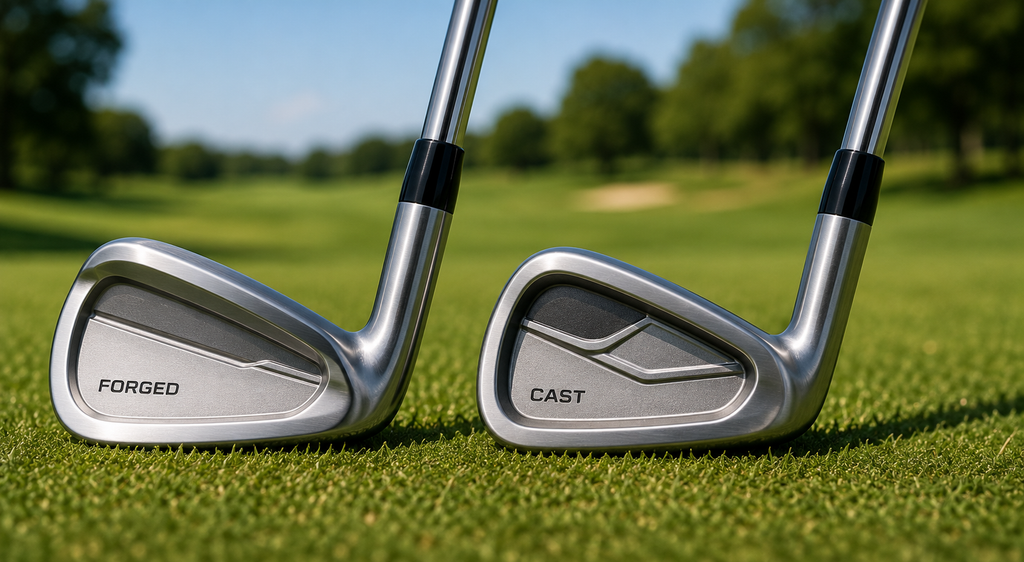
Comparing forged vs cast irons can feel confusing because golfers often connect each manufacturing method with a specific type of player. Forged clubs are commonly associated with skilled golfers and premium feel. Meanwhile, cast irons often have a reputation for forgiveness and game-improvement technology. However, modern golf equipment is more complicated than those simple labels suggest. Manufacturing method alone does not determine whether an iron is forgiving, workable, soft-feeling, or suitable for your handicap. Clubhead geometry, materials, weighting, shaft specifications, loft, sole design, and fitting all influence performance. Therefore, the smarter buying decision starts with understanding what forging and casting actually mean. From there, you can evaluate which complete iron design best supports your swing and the type of golf you want to play.
What Are Forged Golf Irons?
Forging forms a golf clubhead by shaping metal under significant pressure.
Manufacturers may use several stages to create the final shape before machining and finishing the clubhead.
Traditionally, forged irons were relatively compact and simple.
That history helps explain why golfers often associate them with blades and players’ irons.
However, modern manufacturing allows companies to produce more complex forged designs.
Some forged irons now include cavities, tungsten weighting, multiple materials, or other technologies intended to improve forgiveness.
Therefore, when comparing forged vs cast irons, do not assume that every forged model is a traditional blade.
The word “forged” describes an important part of the manufacturing process, not the entire performance profile.
What Are Cast Golf Irons?
Casting typically involves pouring molten metal into a mold that creates the basic clubhead shape.
This process gives designers considerable freedom to produce complex shapes efficiently.
As a result, casting has been widely used for cavity-back and game-improvement irons.
Manufacturers can create perimeter weighting, wider soles, larger cavities, and other features that may help improve forgiveness.
However, cast irons are not automatically oversized beginner clubs.
Manufacturers can also create compact cast designs for accomplished players.
Just as with forged clubs, the final performance depends on the complete design.
Understanding this distinction is essential when evaluating forged vs cast irons.
Does Forging Automatically Feel Softer?
Feel is one of the biggest reasons golfers become interested in forged irons.
Many players describe certain forged carbon-steel clubs as soft or solid at impact.
However, manufacturing method is only one factor affecting feel.
Material composition, clubhead construction, face thickness, internal structures, vibration management, shaft, golf ball, and strike location can all influence what you experience.
A centered strike with a well-designed cast club may feel excellent.
Likewise, a poor strike with a forged iron can feel harsh.
When testing forged vs cast irons, trust your own experience instead of assuming one category must feel better.
Forgiveness Depends More on Design
A common myth says forged irons are difficult while cast irons are forgiving.
That may have seemed accurate when many forged clubs were compact blades and many cast models were large cavity backs.
Today, the categories overlap much more.
Forgiveness comes largely from factors such as clubhead size, center-of-gravity placement, sole design, face technology, and moment of inertia.
Manufacturers can incorporate forgiveness into either manufacturing approach.
Therefore, golfers comparing forged vs cast irons should examine the actual clubhead rather than making a decision from the production method alone.
What Is a Forged Cavity-Back Iron?
A forged cavity-back combines elements golfers traditionally associate with both categories.
The head or major components may be forged, while the design includes a cavity that allows weight to be positioned strategically.
These irons can provide a compact appearance with more stability than a traditional muscle-back blade.
Some models target low-handicap players, while others provide enough assistance for a much broader range of golfers.
This category demonstrates why the forged vs cast irons debate cannot be reduced to “advanced versus beginner.”
Modern iron construction allows manufacturers to blend performance characteristics in many ways.
What About Multi-Material Irons?
Many current irons are not simply one-piece forged or one-piece cast clubs.
A manufacturer might forge one component while using casting, welding, machining, or additional materials elsewhere.
Tungsten weights, thin faces, internal structures, polymers, and other components can all become part of the finished clubhead.
This creates designs that do not fit neatly into old categories.
Therefore, always investigate the complete construction.
A label on the product page may highlight one manufacturing feature, but your golf ball responds to the finished club.
When comparing forged vs cast irons, performance should remain more important than terminology.
Which Type Offers Better Distance?
Neither manufacturing method automatically produces more distance.
Distance depends on several factors, including loft, ball speed, launch, spin, strike quality, and shaft characteristics.
A strongly lofted game-improvement cast iron may travel farther than a traditionally lofted forged players’ iron.
However, that does not prove casting creates more distance.
The clubs simply have different specifications and designs.
Likewise, a modern forged distance iron can produce significant ball speed.
When testing forged vs cast irons, compare carry distance alongside launch, descent angle, consistency, and stopping ability.
Raw yardage tells only part of the story.
Loft Can Distort Your Comparison
Suppose one 7-iron has 34 degrees of loft while another has 28 degrees.
The lower-lofted club may travel farther even if both have the number seven stamped on the sole.
Therefore, check actual specifications before declaring one iron longer.
Modern iron lofts vary substantially across categories.
Manufacturers may also design lower-lofted clubs to launch higher through center-of-gravity placement and face construction.
This means loft cannot be considered alone either.
A fair forged vs cast irons comparison requires looking at the entire launch profile.
Which Type Is More Accurate?
Accuracy depends heavily on the golfer.
A club that fits your delivery and produces predictable launch conditions can be accurate regardless of how the head was manufactured.
For some players, a compact forged iron may provide excellent distance control.
Another golfer may achieve much tighter dispersion with a larger cast cavity-back because mishits retain more speed and stability.
Neither outcome is universal.
Instead of looking only at your best shot, compare a group of normal swings.
The iron that keeps your typical misses more manageable may be the more useful choice.
Do Forged Irons Offer More Workability?
Forged irons are frequently marketed toward players who value trajectory control and shot shaping.
However, forging itself does not create workability.
Compact head shapes, center-of-gravity characteristics, sole design, and other specifications contribute to how a club responds.
Many forged players’ irons happen to use these design characteristics.
That creates the association.
A skilled golfer can still shape shots with many cast clubs.
Likewise, modern forgiving forged irons may emphasize stability over maximum shot-shaping freedom.
The forged vs cast irons decision should focus on the specific model rather than a broad claim about workability.
Which Irons Are Better for Beginners?
Beginners usually benefit from forgiveness, easy launch, and confidence at address.
Many cast game-improvement irons provide those qualities.
However, a forgiving forged cavity-back could also work for some developing golfers.
The bigger mistake is buying a compact players’ iron simply because it is forged and looks premium.
New golfers generally need equipment that supports imperfect contact.
Look for a suitable sole width, reasonable head size, helpful weighting, and shafts that match your swing.
When comparing forged vs cast irons as a beginner, prioritize ease of use over manufacturing prestige.
What Should Mid-Handicap Golfers Choose?
Mid-handicap golfers have perhaps the widest selection.
You may want forgiveness while also preferring a cleaner shape and improved feedback.
Modern players-distance and forgiving forged cavity-back irons can serve this group well.
So can compact cast cavity backs.
Your choice should depend on strike pattern and priorities.
If your misses regularly occur across the face, additional stability may help.
If you already strike the center consistently, you may prefer a more compact design.
Test several categories instead of deciding beforehand that your handicap requires one manufacturing method.
What About Low-Handicap Players?
Skilled golfers often have more consistent contact, which can make compact irons practical.
Many enjoy forged players’ irons because of their appearance, feedback, turf interaction, and traditional specifications.
However, even elite players increasingly use clubs with added forgiveness.
Some mix iron models within the same set.
A more forgiving long iron may pair with compact short irons.
Therefore, being a low-handicap golfer does not mean you must choose forged blades.
Performance remains the priority.
Forged Irons and Turf Interaction
Turf interaction depends more on sole design than manufacturing method.
Sole width, bounce, leading-edge shape, camber, and your angle of attack all matter.
A narrow sole may work beautifully for one golfer and dig excessively for another.
Similarly, a wider sole may provide helpful stability but feel less comfortable to a player with a different delivery.
Whenever possible, test irons from real grass.
Hitting only from mats can hide important differences.
A good forged vs cast irons comparison should include how the club enters and exits the turf.
Do Cast Irons Feel Harsh?
Modern cast irons can feel very different from older designs.
Manufacturers use improved materials, face structures, badges, internal damping systems, and other technologies to influence sound and vibration.
As a result, describing every cast iron as harsh is inaccurate.
Feel is also highly personal.
One golfer may prefer a crisp response, while another wants a softer sensation.
Sound plays a surprisingly important role too.
Test the clubs yourself rather than allowing the word “cast” to determine your expectations before the first swing.
Are Forged Irons More Expensive?
Forged irons often carry premium prices because their manufacturing processes can involve additional steps and finishing work.
However, price varies widely.
Modern cast clubs can also become expensive when they include complex construction and premium materials.
Likewise, older forged models may offer excellent value on the used market.
When evaluating forged vs cast irons, compare total cost against performance and expected use.
Paying more makes sense only when the club provides benefits you actually value.
Durability and Normal Wear
Both forged and cast irons can provide years of service when maintained properly.
However, materials and finishes can show wear differently.
Some softer forged carbon-steel clubs may develop bag chatter, small dents, or cosmetic marks more readily than harder materials.
That does not automatically mean performance has been compromised.
Cast stainless-steel heads can often resist certain cosmetic wear well, although they are not indestructible.
Clean and dry either type after wet rounds.
Regular inspection matters more than assuming one manufacturing method will last forever.
Can Forged Irons Be Adjusted More Easily?
Golfers often hear that forged irons are easier to bend for loft and lie adjustments.
Many forged carbon-steel models do offer useful adjustability.
However, whether a particular club can be safely adjusted depends on its material, construction, design, and manufacturer specifications.
Some cast irons can also be adjusted.
Others have more limited tolerances.
Never assume.
Ask a qualified club technician to check the exact model before attempting changes.
Improper bending can damage a clubhead.
Shaft Choice Still Matters
A great iron head paired with an unsuitable shaft can produce disappointing results.
Shaft weight, flex, length, and profile affect how the club feels and how consistently you deliver it.
Therefore, do not spend your entire fitting session debating clubhead manufacturing.
Test different shaft combinations too.
You may discover that changing the shaft improves your strike and dispersion more than moving between forged vs cast irons.
The best iron is a complete system, not just a head.
Club Length and Lie Angle Matter
Length affects posture, strike location, and comfort.
Lie angle can influence how the club interacts with the ground and how the face is oriented through impact.
These specifications deserve attention regardless of construction.
A beautifully forged iron with the wrong fit may perform worse than a properly fitted cast model.
During a fitting, evaluate strike patterns and ball flight rather than choosing specifications solely from static measurements.
Dynamic testing provides more useful information.
Look at Your Mishits
Golfers love comparing perfect strikes.
However, your misses may reveal more about which club you should buy.
Hit enough shots to include normal heel, toe, thin, and slightly heavy contact.
Then compare carry loss and directional dispersion.
Does one model keep poor strikes closer to your intended distance?
Does another reduce left-to-right variation?
A club that protects your common miss can save more strokes than one producing a spectacular result only from perfect contact.
This is especially important when comparing forged vs cast irons for real-world play.
Use Launch Monitor Data Correctly
Launch monitors can provide ball speed, carry distance, launch angle, spin, descent angle, and dispersion.
Use these numbers together.
Do not select an iron simply because it creates the longest single shot.
Look for repeatability.
Your ideal iron should produce useful carry, sufficient trajectory, and predictable landing characteristics.
If two clubs perform similarly, feel and appearance can become useful deciding factors.
Data should support your decision, not overwhelm it.
Test With the Same Golf Ball
Golf ball characteristics can influence launch, spin, feel, and distance.
Therefore, use the same ball when comparing irons.
Ideally, test with the model you normally play.
Changing both the club and ball makes it harder to determine what caused a performance difference.
This becomes particularly important when evaluating subtle differences in feel.
A consistent testing environment creates a fairer comparison.
Do Not Ignore the Long Irons
An iron set should work from top to bottom.
A compact 9-iron may feel easy to strike, while the matching 4-iron could be far more demanding.
Test the longest iron you expect to carry.
If it launches too low or produces inconsistent distance, consider a combo set or hybrid replacement.
Many modern golfers blend categories.
You might use more forgiving long irons and compact scoring irons.
There is no requirement for every club to share exactly the same construction philosophy.
Combo Sets Can Offer the Best of Both Worlds
A combo set uses different iron designs within one set.
For example, a golfer might carry forgiving 4- through 6-irons and more compact 7-irons through pitching wedge.
Manufacturers sometimes design iron families specifically to blend together.
This allows you to prioritize launch and forgiveness where you need them while maintaining a preferred appearance in the shorter clubs.
The traditional forged vs cast irons question becomes less important when you can combine technologies strategically.
Appearance Can Affect Confidence
Performance should lead the decision, but appearance still matters.
Some golfers feel confident looking down at a thin topline and compact shape.
Others prefer a larger clubhead that makes the hitting area appear more generous.
Offset can influence confidence too.
Do not choose a club you dislike looking at simply because the launch monitor says it is slightly better.
You will see the clubhead before every shot.
The ideal iron combines useful performance with an appearance that encourages commitment.
Should You Buy Used Forged Irons?
Used forged irons can provide excellent value, especially when premium models have fallen substantially in price.
However, inspect them carefully.
Check the faces and grooves for heavy wear.
Look for shaft damage, excessive rust, altered specifications, and worn grips.
Forged heads may show cosmetic bag chatter, which is not necessarily a performance problem.
Still, severe damage deserves caution.
If possible, confirm whether loft or lie angles have previously been adjusted.
Should You Buy Used Cast Irons?
Used cast game-improvement irons can also be an excellent option.
Because golf club technology evolves gradually, a quality set from several seasons ago may still perform very well.
Inspect the faces, soles, shafts, ferrules, and grips.
Check that the set contains the clubs you need.
Also verify shaft model, flex, and length.
A low used price becomes less attractive if you immediately need expensive alterations.
Do You Need a Professional Fitting?
A fitting is especially valuable if you plan to spend significantly on a new iron set.
Bring your current clubs so the fitter has a baseline.
Compare several head designs and shafts.
Ask to see averages rather than only your longest shots.
If possible, test from turf as well as mats.
A fitter can help separate genuine performance improvements from assumptions about forged vs cast irons.
You may leave with a club category you did not initially expect.
A Simple Buying Process
Start by identifying what you dislike about your current irons.
Maybe long irons launch too low. Perhaps mishits lose too much distance. You may simply want a different feel or appearance.
Next, establish a realistic budget.
Test both forged and cast models that address your needs.
Compare centered strikes and mishits.
Review carry, dispersion, trajectory, turf interaction, and feel.
Then evaluate the complete specifications, including shafts, length, loft, and lie.
Buy the club that produces the best overall results rather than the one with the most prestigious manufacturing label.
Common Buying Mistakes
One mistake is assuming forged automatically means better.
Another is believing cast irons are only for high handicappers.
Golfers also become distracted by one unusually long launch-monitor shot.
Ignoring shaft fit is another common problem.
Likewise, buying compact irons because you hope to “grow into them” can make golf unnecessarily difficult.
Equipment should support the game you have while leaving reasonable room for improvement.
The forged vs cast irons debate should help you understand construction, not dictate your purchase.
Conclusion
Forged and cast irons can both provide excellent performance.
Forging is commonly associated with premium feel, compact designs, and traditional players’ clubs. Casting offers manufacturers flexibility to create complex shapes and highly forgiving designs.
However, modern equipment has blurred those lines.
You can find forgiving forged cavity backs, compact cast irons, and multi-material clubs that use several manufacturing techniques.
Therefore, manufacturing method should be one part of your evaluation rather than the deciding factor.
Compare clubhead size, sole design, loft, weighting, shaft specifications, launch, carry distance, dispersion, and turf interaction. Most importantly, pay attention to your normal misses.
A golf club needs to perform when your swing is less than perfect.
When deciding between forged vs cast irons, choose the complete iron design that produces reliable results, feels comfortable, fits your budget, and gives you confidence over the ball. The manufacturing story is interesting, but your shots should make the final decision.
FAQ
1. Are forged irons better than cast irons?
Not automatically. Both manufacturing methods can produce excellent clubs. The better option depends on the complete design, your swing, fitting specifications, and performance needs.
2. Are forged golf irons only for low-handicap players?
No. Modern forged cavity-back and multi-material designs can provide significant forgiveness. Some models can suit mid-handicap and other recreational golfers.
3. Do cast irons go farther than forged irons?
Manufacturing method alone does not determine distance. Loft, face design, ball speed, launch, spin, shaft specifications, and strike quality all influence carry.
4. Which type of iron lasts longer?
Both can last for many years with proper care. Materials and finishes may wear differently, so condition depends on the specific club and how frequently it is played.
5. Should beginners buy forged or cast golf clubs?
Beginners should prioritize forgiveness, easy launch, appropriate shafts, and proper fit. Many cast game-improvement irons meet those needs, but forgiving forged models can also work.