Poor golf club distance gaps can make even a well-struck round harder than necessary. You may have two clubs that travel almost the same distance, followed by another pair separated by a much larger gap. When that happens, approach shots become difficult because no club comfortably covers the yardage you need. Fortunately, you do not have to replace your entire set. Start by measuring real carry distances, identifying overlaps, and understanding which clubs actually earn a place in your bag. From there, small equipment changes or smarter club selection can create a more useful progression from driver through wedges.
What Are Distance Gaps in Golf?
Distance gapping describes the difference in yardage between neighboring clubs.
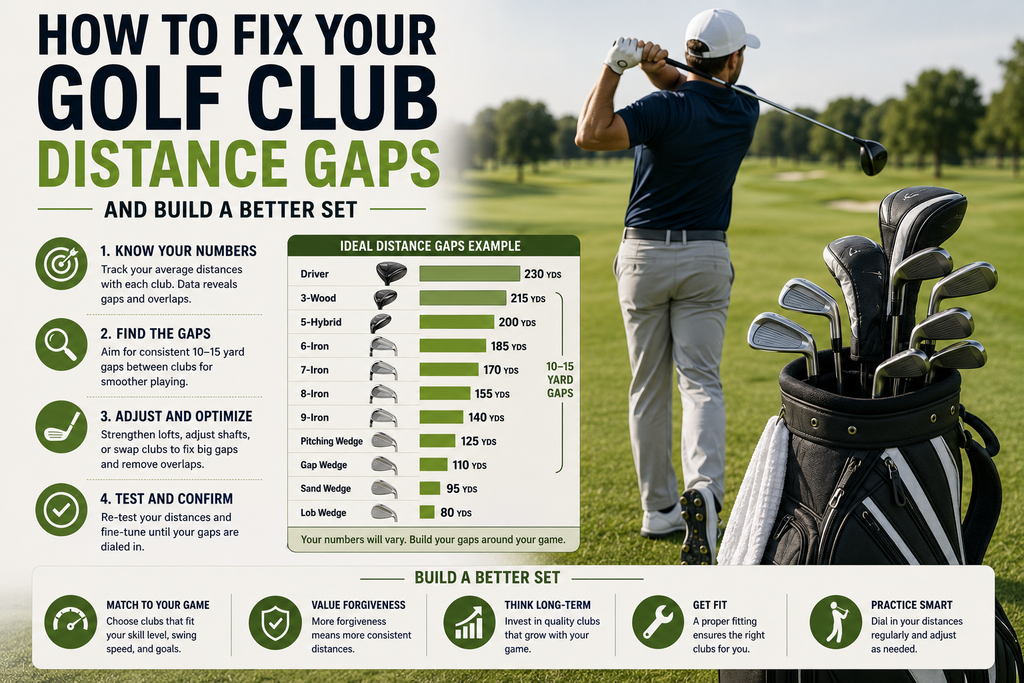
For example, imagine your 7-iron carries 145 yards and your 6-iron carries 155. That creates a 10-yard gap.
The exact spacing does not need to be identical throughout your bag.
What matters is having useful coverage.
Problems appear when two clubs travel nearly the same distance or when one gap becomes so large that you regularly face uncomfortable shots.
A golfer might carry a fairway wood 205 yards and the next club only 180. That leaves a significant area without an obvious choice.
Understanding your golf club distance gaps helps you see your set as a complete system instead of a collection of individual clubs.
Every club should ideally provide a useful distance or shot that another club does not already cover.
Measure Carry Distance, Not Just Total Distance
Carry distance tells you how far the ball travels through the air before landing.
Total distance includes the roll after landing.
For most approach shots, carry is the more useful number because ground conditions can change dramatically.
A firm fairway may produce substantial roll. A soft course may produce almost none.
Likewise, a ball landing on a green usually behaves differently from one landing in the fairway.
Therefore, begin your gapping analysis with carry numbers.
If you have access to a reliable launch monitor, hit several normal shots with every club.
Remove obvious mishits, but do not keep only your best strikes.
You want a realistic average.
When measuring golf club distance gaps, your normal performance is far more valuable than the longest shot you have ever hit.
Those average carry numbers will help you make better decisions on the course.
Create a Full Distance Chart
Once you have gathered your yardages, place them in order from longest to shortest.
Your chart might include driver, fairway woods, hybrids, irons, and wedges.
Write down average carry for every club.
You can also record total distance when useful, particularly for tee clubs.
Then calculate the difference between neighboring clubs.
The pattern will quickly reveal areas that deserve attention.
For example, your irons may have reasonable spacing until you reach the 5-iron. Perhaps your 5-iron and 6-iron carry almost the same distance because you struggle to launch the longer club.
Your golf club distance gaps chart should reflect what actually happens rather than what manufacturers suggest should happen.
Do not estimate yardages from the loft printed on the club or from one perfect range shot.
Real numbers create a much stronger foundation for building your set.
Why Long Irons Often Create Gapping Problems
Long irons can become difficult to launch as loft decreases.
Golfers with moderate swing speeds may find that their 4-iron does not carry much farther than their 5-iron.
The lower loft should theoretically produce more distance. However, if launch and strike quality decline, the expected separation can disappear.
This creates distance compression.
Instead of carrying two useful clubs, you effectively carry two clubs for the same yardage.
A hybrid or higher-lofted fairway wood may solve the problem.
These designs can help some golfers produce more launch and consistent carry.
When reviewing golf club distance gaps, pay close attention to the point where your iron distances begin bunching together.
That may be the natural place to transition from irons into hybrids or woods.
Do not keep a long iron simply because it came with the set. Every club should justify its position through performance.
Hybrids Can Fill Difficult Gaps
Hybrids are valuable because they can cover the space between fairway woods and mid-irons.
However, buying a hybrid according to the number on its sole can create another problem.
A 4-hybrid does not automatically travel the same distance as every 4-iron. Actual lofts, shaft lengths, head designs, and individual swings vary.
Test the club instead.
Suppose your 5-iron carries 165 yards while your 5-wood carries 195. A hybrid that consistently carries around the middle of that range could create better coverage.
The goal is not to match club labels.
It is to improve your golf club distance gaps.
A hybrid should fill a genuine yardage need while also providing a useful ball flight.
Compare carry, height, dispersion, and confidence before deciding which club belongs in your bag.
Fairway Woods Need Clear Roles Too
Golfers sometimes carry multiple fairway woods without knowing their actual distances.
A 3-wood and 5-wood may look different on paper but produce surprisingly similar results for some players.
This can happen when the lower-lofted club is difficult to launch from the turf.
If your 3-wood only carries a few yards farther than your 5-wood, ask whether both clubs deserve space.
You might perform better with one reliable fairway wood followed by a hybrid.
Alternatively, the 3-wood could remain valuable primarily as a tee club even if its fairway performance overlaps.
Your golf club distance gaps should consider function as well as raw yardage.
Two clubs can travel similar distances and still serve different purposes. However, that distinction should be intentional.
Avoid carrying duplicate clubs simply because traditional set composition says you should have them.
Wedge Gapping Deserves Extra Attention
The scoring end of your bag is one of the most important areas to evaluate.
Modern iron sets can have relatively strong pitching-wedge lofts. As a result, the distance between the pitching wedge and traditional sand wedge may become too large.
For example, if your pitching wedge carries 125 yards and your sand wedge carries 95, you have a 30-yard space to manage.
A gap wedge could provide a useful solution.
However, loft alone does not determine distance.
Clubhead design, shaft, strike quality, and swing length all affect how far a wedge travels.
Measure full-swing carry with every wedge.
Then evaluate your golf club distance gaps from the shortest iron through your highest-lofted wedge.
You may discover that adding one wedge creates better scoring coverage than adding another long club.
Because many approach shots occur inside 130 yards, sensible wedge spacing can make club selection much simpler.
Know Your Partial Wedge Distances
Full-swing numbers are only part of wedge gapping.
You will frequently face distances that fall between your normal full swings.
Instead of forcing a shorter club to travel farther, learn controlled partial swings.
For example, you might develop comfortable three-quarter and half-swing distances with several wedges.
This creates additional yardage options without adding more clubs.
Keep the system simple.
You do not need dozens of memorized combinations. Start with a few repeatable swing lengths.
Write down the carry distances you produce.
While golf club distance gaps are usually discussed in terms of full swings, partial wedge shots can solve many short-game gaps.
Practice them from realistic targets rather than hitting only toward an open range.
The goal is to develop dependable numbers you can trust when the course presents an awkward distance.
Loft Matters More Than the Club Number
Club numbers are not standardized.
One manufacturer’s 7-iron may have a different loft from another model’s 7-iron.
Even within the same brand, game-improvement and players-style irons can use different loft structures.
Therefore, check the actual loft specifications of your set.
This becomes especially important when combining clubs from different manufacturers or generations.
Suppose you buy a new hybrid to sit above an older iron set. The labels might suggest logical progression, yet the lofts could overlap.
Your golf club distance gaps should be built around actual performance rather than numbers stamped on clubheads.
Loft provides useful context, but even identical lofts can produce different distances because club length and design vary.
Use specifications to guide testing, then let real carry numbers make the final decision.
Do Not Chase Perfectly Equal Gaps
Many golfers assume every neighboring club should be separated by exactly the same yardage.
That is unnecessary.
Your driver-to-fairway-wood gap may be larger than the spaces between your mid-irons. Wedge spacing may also require a different approach.
What matters is whether your set covers the distances you regularly encounter.
A 12-yard gap might be completely manageable in one part of the bag. A 20-yard gap could also work if you rarely need the missing distance and can adjust another club comfortably.
Instead of chasing mathematical perfection, evaluate practical usefulness.
The best golf club distance gaps fit your game, courses, and shot patterns.
Ask yourself where you frequently feel stuck between clubs.
Those situations deserve attention first.
A set that looks perfect on a spreadsheet but does not solve real course problems is not truly optimized.
Your Strike Quality Changes Your Gapping
Club specifications cannot overcome inconsistent contact.
If your 6-iron strikes vary widely across the face, its carry distance will also vary.
That makes it difficult to determine a reliable average.
Before changing equipment, examine strike consistency.
Hit several shots and record where the ball contacts the clubface. If you produce frequent severe mishits, work on contact before making expensive set changes.
This is especially important with long irons.
Poor strike quality can make it appear that you have bad golf club distance gaps when the real issue is inconsistent ball striking.
Once your contact becomes more predictable, measure again.
Equipment adjustments become much more meaningful when they are based on a repeatable swing.
Account for Real Course Conditions
Launch-monitor numbers are useful, but golf does not happen in a controlled indoor environment.
Temperature, wind, elevation, lie, and turf conditions can all affect distance.
A shot from light rough may not travel like one from a clean fairway lie.
Cold weather can also change how far the ball carries.
Therefore, treat your distance chart as a baseline rather than an absolute promise.
You should know your standard carry under normal conditions, then adjust based on the shot in front of you.
Understanding golf club distance gaps gives you a starting point for those decisions.
For example, if you know your 7-iron normally carries 150 yards, you can make a more informed choice when facing wind or elevation.
Without a baseline, every adjustment becomes guesswork.
Do Not Use Your Best-Ever Distance
One perfectly struck 7-iron should not define your 7-iron yardage.
Golfers often remember exceptional shots and begin treating them as normal.
That can lead to repeated short misses.
Instead, use a realistic average or typical carry.
If most good 7-irons travel between 145 and 150 yards, but one reached 158, planning around 158 is unlikely to produce reliable results.
The same rule applies throughout the bag.
Your golf club distance gaps should reflect repeatable performance.
This is especially important when testing new equipment. Manufacturers and retailers may highlight maximum distance, but your goal should be predictable coverage.
A club that carries 175 yards repeatedly is more useful than one that occasionally reaches 185 but produces large variations.
Consistency makes course management easier.
Remove Clubs That Overlap Too Much
Distance overlap is not automatically bad.
For example, you might carry two clubs with similar carry distances because one flies high while the other produces a lower trajectory.
However, unnecessary overlap wastes space.
If your hybrid and long iron produce nearly identical distance, flight, and accuracy, you probably do not need both.
Choose the one you trust more.
Removing duplicate performance can create room for another wedge, fairway wood, or specialized club that covers a genuine need.
When reviewing golf club distance gaps, ask what each club contributes beyond its number.
Does it offer a unique distance? Different trajectory? Better performance from rough? More control from the tee?
If you cannot identify a clear purpose, that club may be a candidate for replacement.
Adjustable Clubs Can Fine-Tune Your Set
Some drivers, fairway woods, and hybrids offer adjustable hosels or movable weighting systems.
These features can help refine performance.
A loft adjustment may change launch and distance enough to improve spacing between clubs.
However, adjustments can influence several characteristics at once.
Therefore, avoid changing settings randomly.
Test each configuration and record the results.
If you use an adjustable hybrid to improve golf club distance gaps, compare its new carry against both neighboring clubs.
Make sure solving one gap does not create another.
Follow the manufacturer’s instructions when making adjustments and use the proper tool.
Once you find a configuration that works, keep it consistent long enough to evaluate it on the course.
A Club Fitting Can Reveal Hidden Problems
Professional fitting can be particularly helpful when the top or bottom of your bag has confusing overlaps.
A fitter can measure every club and compare your actual ball flight.
This process may reveal that two clubs have similar lofts or that one shaft configuration makes a club difficult to launch.
The solution may be surprisingly small.
You might need a different hybrid loft, another wedge, or a simple adjustment rather than an entirely new set.
A fitter can also help evaluate golf club distance gaps using carry data rather than estimates.
Bring your current clubs whenever possible.
The goal should be improving the set you actually play, not testing new equipment in isolation.
If your existing clubs already provide useful spacing, there may be no reason to replace them.
Build Your Set Around Your Game
There is no perfect club setup for every golfer.
One player may prefer several fairway woods. Another might replace long irons with hybrids.
Some golfers carry four wedges, while others prefer fewer wedges and additional options at the top of the bag.
Your swing speed, typical course, strengths, and weaknesses should influence the structure.
For example, if you rarely attempt long approaches but frequently face shots from 80 to 120 yards, an extra wedge may provide more value than another long club.
When correcting golf club distance gaps, prioritize the shots that actually affect your rounds.
Do not copy a professional golfer’s bag simply because their setup looks complete.
Their distances and course requirements may be very different from yours.
Create a Distance Card for Your Bag
Once your set is organized, create a simple reference card.
List each club and its normal carry distance.
You can keep the information on your phone, in a yardage book, or somewhere accessible during practice.
Avoid adding too many numbers initially.
A reliable carry distance for each club is enough to make better decisions.
As you become more experienced, you can add controlled swing distances, particularly for wedges.
Update the chart whenever equipment changes.
You should also recheck your numbers if your swing speed or technique improves significantly.
Your golf club distance gaps are not permanent.
They can change as your game develops.
A current distance chart ensures your club selection reflects the golfer you are now rather than numbers you measured several seasons ago.
Common Distance-Gapping Mistakes
Guessing yardages is one of the most common mistakes.
Another is using total distance instead of carry for every club.
Golfers also assume that club numbers guarantee consistent spacing. They do not.
Ignoring long-iron compression is another problem. If your 4-iron and 5-iron travel almost the same distance, carrying both may provide little benefit.
At the other end, overlooking the loft difference between pitching and sand wedges can create a major scoring gap.
Do not fix golf club distance gaps by purchasing clubs before measuring what you already own.
Finally, avoid chasing perfect mathematical spacing.
Golf is played under changing conditions, and your swing naturally varies.
Build practical coverage that gives you confident choices from the distances you face most often.
A Simple Gapping Session
Warm up before collecting any numbers.
Then begin with your shortest full-swing club and work upward through the bag.
Hit several normal shots with each club.
If you have access to reliable launch data, record average carry. Remove obvious severe mishits, but keep ordinary shots.
Take breaks so fatigue does not distort your longer-club numbers.
Once finished, arrange the clubs by carry distance.
Mark any large gaps and obvious overlaps.
Next, identify which problem areas actually matter during your rounds.
A structured session makes golf club distance gaps much easier to understand.
Repeat the test after making equipment changes.
The goal is not to create impressive numbers. You want dependable information that helps you choose the correct club when standing over a real shot.
Conclusion
A well-built golf bag gives every club a clear purpose.
Start by measuring realistic carry distances instead of relying on club numbers, manufacturer claims, or your longest-ever shots.
Then look for large gaps, unnecessary overlaps, and areas where distance begins to compress.
Pay particular attention to long irons and wedges. Hybrids can solve difficult gaps at the top of the iron set, while an additional wedge may improve scoring coverage at shorter distances.
However, do not assume new equipment is always necessary. Better strike consistency, partial wedge swings, or a simple club adjustment may solve the problem.
Ultimately, fixing golf club distance gaps is about making decisions easier. When you know how far each club normally carries and why it belongs in your bag, you can approach more shots with a clear plan and greater confidence.
FAQ
1. How much distance should there be between golf clubs?
There is no perfect number for every player. Useful spacing depends on your swing, clubs, and the shots you regularly face. Consistency matters more than perfectly equal intervals.
2. Why do my 4-iron and 5-iron travel almost the same distance?
You may not generate enough launch or consistent contact with the lower-lofted iron. Testing a hybrid could provide better separation.
3. Should I use carry distance or total distance when building my set?
Carry is generally more useful for approach clubs because rollout changes with turf and weather. Total distance can still be helpful for certain tee shots.
4. Can changing wedge lofts improve my scoring setup?
Yes. Appropriate wedge lofts can reduce large yardage spaces at the short end of your bag. Test actual carry before making changes.
5. How often should I check my club distances?
Recheck them after major equipment changes or meaningful swing improvements. Periodic testing is also useful because your speed and strike patterns can change over time.