
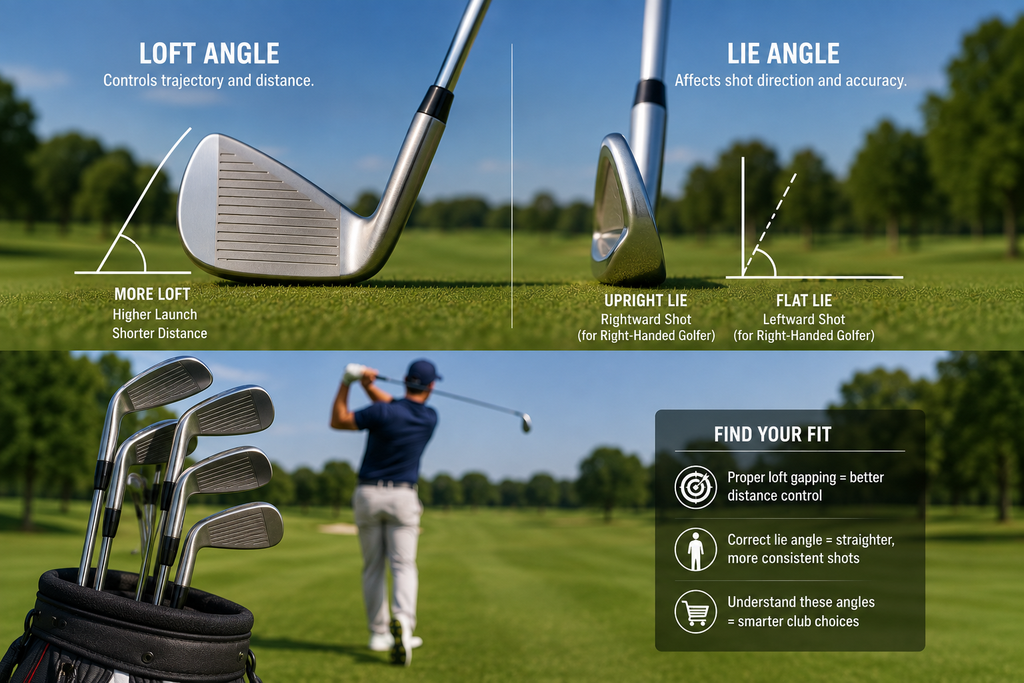
Understanding golf club loft and lie can make golf equipment much easier to compare. Two irons may both have a 7 printed on the sole yet use different lofts, while two golfers using the same iron model may need different lie-angle settings. These specifications influence how a club launches the ball, covers distance, interacts with the ground, and fits your swing. Therefore, buying clubs based only on brand, appearance, or club number can lead to poor distance gaps or an uncomfortable fit. You do not need to become a club-building expert, though. Learning a few basic principles will help you understand specifications and ask better questions during a fitting.
What Is Golf Club Loft?
Loft is the angle of the clubface relative to a vertical reference when the club is measured in its proper position.
In simple terms, more loft generally helps produce a higher launch and shorter distance. Less loft generally creates a lower launch and greater distance potential.
That is why a pitching wedge has much more loft than a 5-iron.
However, loft does not work alone.
Club length, head design, shaft characteristics, swing speed, impact position, and dynamic loft all influence the actual shot.
When comparing golf club loft and lie, treat the published loft as a useful specification rather than a guaranteed distance.
Two golfers using the same loft can produce very different launch and carry numbers.
Therefore, actual testing remains essential.
What Is Lie Angle?
Lie angle describes the relationship between the shaft and the ground when the club is positioned for measurement.
It influences how the clubhead sits relative to the turf.
A club that is too upright or too flat for a golfer’s delivery can influence impact conditions and starting direction, especially with more lofted clubs.
For a right-handed golfer, a lie that is excessively upright can tend to encourage shots to start farther left. An excessively flat setup can encourage the opposite tendency. The directions reverse for a left-handed golfer.
However, lie angle should not be diagnosed from ball flight alone.
Understanding golf club loft and lie means recognizing that your swing delivery matters.
A qualified fitter can use impact data, launch information, and club measurements to determine whether an adjustment is appropriate.
Why Club Numbers Can Be Misleading
Golf club numbers do not guarantee identical specifications.
One manufacturer’s 7-iron may have significantly different loft from another manufacturer’s 7-iron.
Even within the same brand, different iron families can use different loft structures.
A distance-oriented game-improvement iron may have a stronger loft than a more traditional players-style model.
That does not automatically make one better.
The clubhead designs may be engineered to produce different launch conditions.
Therefore, comparing golf club loft and lie specifications is more informative than comparing only the number stamped on the sole.
If you are replacing an iron set, check the actual loft progression.
Otherwise, you might assume your new 7-iron gained significant distance when part of that difference comes from stronger loft.
Distance can be useful, but proper gapping matters more.
How Loft Influences Launch
Loft plays a major role in determining launch, but the loft printed in a specification chart is not exactly what you deliver at impact.
Golfers add or reduce loft dynamically through shaft lean, attack angle, release patterns, and other swing characteristics.
For example, two players can use the same 8-iron yet launch the ball at different angles.
Clubhead design also matters.
Weight placement can help a stronger-lofted iron launch higher than you might expect from the static loft alone.
This is why golf club loft and lie should be evaluated as part of the complete club.
Do not assume a stronger loft automatically produces an unusably low flight.
Likewise, more loft does not guarantee an ideal trajectory.
Launch-monitor testing can show what actually happens with your swing.
How Loft Affects Distance
Lower loft can contribute to more distance because it can produce a stronger trajectory and different launch conditions.
However, simply reducing loft does not guarantee better performance.
If the club launches too low or lacks enough carry, extra strength may become counterproductive.
This is particularly important with long irons.
Golfers with moderate swing speeds sometimes reach a point where their 4-iron and 5-iron travel nearly the same distance.
Although the 4-iron has less loft, they cannot launch it effectively enough to create useful separation.
When reviewing golf club loft and lie, always connect specifications to actual carry distance.
The purpose of your iron set is not to make every club travel as far as possible.
Instead, each club should provide a useful and predictable yardage.
Strong Lofts Are Not Automatically Bad
The term “strong loft” simply means the club has less loft than another club used for comparison.
Some golfers criticize modern strong-lofted irons because a current 7-iron may resemble the loft of an older 6-iron.
However, club design has also changed.
Manufacturers can position weight differently and use modern face designs to influence launch and ball speed.
Therefore, loft should not be judged in isolation.
When comparing golf club loft and lie, ask whether the complete set creates suitable trajectory, stopping power, consistency, and distance gaps for you.
A strong-lofted iron that launches properly and produces useful spacing can work well.
A club that flies too low or creates compressed gaps may not.
Performance should determine whether the specification suits your game.
Weak Lofts Are Not Automatically Better Either
More traditional or weaker lofts can provide advantages for certain golfers.
They may help produce more height or create preferred distance spacing.
However, simply adding loft does not automatically improve control.
A golfer who already launches the ball very high may not need additional loft.
Furthermore, head construction and swing delivery continue to influence the result.
Instead of choosing equipment because its specifications appear traditional, compare actual performance.
A smart golf club loft and lie evaluation focuses on how the club behaves for your swing.
Look at carry distance, launch, peak height, descent, dispersion, and strike quality where possible.
Numbers on a specification sheet should guide your testing, not replace it.
Loft Gapping Matters Throughout Your Irons
A well-designed iron set normally uses progressive loft changes.
Those loft differences help create distance separation between clubs.
However, equal loft gaps do not guarantee equal yardage gaps.
For example, a four-degree loft difference may produce good spacing in your short irons but less useful separation in your long irons.
Swing speed and strike quality become increasingly important as loft decreases.
Therefore, measure your actual carry yardages.
When evaluating golf club loft and lie, look for places where distance begins to bunch together.
If your 5-iron and 6-iron carry almost the same distance, you may benefit from replacing the longer iron with a hybrid or fairway wood.
The goal is useful coverage, not simply owning every iron number.
Pay Close Attention to Wedge Lofts
Wedge loft deserves careful attention because modern pitching wedges vary considerably.
Suppose your pitching wedge is relatively strong while your next wedge has much more loft.
That difference can create a large yardage gap.
You may then struggle with approach shots that fall between comfortable full-swing distances.
Check the actual loft of your pitching wedge before buying additional wedges.
Then measure how far each wedge carries.
A proper golf club loft and lie review should include the short end of your bag, not only the irons.
You might need a gap wedge to create better progression.
However, do not buy wedges solely by loft spacing.
Bounce, grind, sole design, feel, and your preferred short-game technique also matter.
Loft Is Important in Woods and Hybrids Too
Loft affects more than irons.
Drivers, fairway woods, and hybrids all use loft to help shape launch and distance.
A lower-lofted driver is not automatically longer.
If you cannot create suitable launch conditions, adding loft may actually produce better carry.
Likewise, a 3-wood can be difficult to launch from the turf for some golfers. A higher-lofted 5-wood may produce more reliable distance.
Hybrids also vary significantly between models.
When studying golf club loft and lie, do not assume the number printed on a hybrid directly matches the iron it is designed to replace.
Test carry distance.
A hybrid should fill a specific yardage rather than simply match a club number.
Why Lie Angle Becomes Important With Irons
Lie angle is especially relevant with irons because the club interacts with the ground and has enough loft for face orientation to influence starting direction noticeably.
However, the ideal specification depends on how you deliver the club.
Two golfers of the same height may require different settings because their arm length, posture, swing plane, and impact dynamics differ.
That is why height-only charts have limitations.
They can provide a starting point, but they cannot fully determine your ideal golf club loft and lie setup.
A dynamic fitting evaluates what happens when you actually hit shots.
That information is generally more useful than choosing a lie angle from body measurements alone.
What Does Upright Mean?
An upright lie angle positions the shaft and clubhead relationship differently from a flatter setting.
Fitters may recommend an upright adjustment when the player’s impact delivery indicates that the current club is too flat.
For a right-handed golfer, a club that is excessively upright can influence the face so shots tend to begin farther left than intended, particularly with higher-lofted clubs.
Still, do not automatically bend clubs flatter because you miss left.
Swing path and face angle may be the real causes.
Correct golf club loft and lie fitting requires separating equipment effects from swing mechanics.
Use impact data and professional measurement whenever possible.
Random adjustments can create another problem without solving the original one.
What Does Flat Mean?
A flatter lie angle changes the relationship in the opposite direction.
For a right-handed golfer, an excessively flat club can contribute to shots starting farther right.
Again, this is not a complete diagnosis.
A golfer can miss right because of clubface control, swing path, strike location, or several other factors.
That is why lie adjustments should follow testing.
If your fitter identifies a consistent delivery pattern and confirms that the club specification contributes to it, an adjustment may help.
Understanding golf club loft and lie protects you from treating every directional miss as an equipment problem.
Your clubs should complement your swing, but they cannot replace sound impact conditions.
Your Height Does Not Tell the Whole Story
Tall golfers do not automatically need upright clubs.
Short golfers do not automatically need flat clubs.
Height matters, but arm length and address posture also influence how you interact with the club.
Most importantly, your dynamic delivery can differ from your static setup.
Therefore, fitting should consider both physical measurements and actual shots.
When buying irons, avoid selecting golf club loft and lie settings from height alone unless no better fitting option is available.
Use static measurements as an initial reference.
Then hit balls and examine strike, starting direction, consistency, and launch data.
A few minutes of dynamic testing can reveal information that a basic chart cannot.
Lie Angle Can Affect Turf Interaction
When an iron reaches the ground, the sole should interact with the turf in a way that supports consistent contact.
If the lie setting is poorly matched to your delivery, one side of the sole may interact differently.
However, old-fashioned lie boards and sole marks should not be interpreted without context.
Modern fitting methods can combine strike data and ball flight for a fuller picture.
The goal of golf club loft and lie fitting is not to make the club look perfect while sitting still.
It is to improve how it performs dynamically.
A golfer may address the ball with the toe slightly raised yet deliver the club differently at impact.
That is another reason static appearance should not be your only guide.
Adjusting Loft Can Affect Other Specifications
Iron lofts can sometimes be adjusted by a qualified club technician, depending on head construction and material.
However, bending a club stronger or weaker can influence other aspects of its geometry and turf interaction.
Therefore, avoid making large adjustments simply to gain distance.
If your set has poor gapping, identify the cause first.
Perhaps a different club would solve the problem more effectively.
The relationship between golf club loft and lie becomes especially important when clubs are bent.
A professional technician can measure the current specifications, make appropriate adjustments, and verify the final results.
Not every iron design is equally suitable for bending, so manufacturer guidance should also be considered.
Lie Angle Can Change Over Time
Depending on the club material and how frequently it is used, iron specifications can sometimes shift.
Repeated impacts and normal play may alter certain bendable clubs slightly over long periods.
If you own forged irons, practice frequently, or notice an unexpected change in ball flight, having the lofts and lies checked can be worthwhile.
That does not mean you need constant adjustments.
Most recreational golfers simply need occasional verification.
Maintaining accurate golf club loft and lie specifications can be particularly useful if you have previously been professionally fitted.
A club technician can compare current measurements with your intended setup.
If everything remains correct, no adjustment is necessary.
Used Clubs Require Extra Attention
Buying used golf clubs can save money, but specifications deserve closer inspection.
Previous owners may have altered loft or lie angles.
Those changes are not always obvious from appearance.
A set advertised as standard could have been bent upright, flat, strong, or weak.
Therefore, ask about previous modifications whenever possible.
If you purchase a used iron set, consider having a club professional measure the golf club loft and lie specifications.
That gives you a reliable baseline.
You can then determine whether the clubs fit your needs or require adjustment.
Checking used equipment is particularly important when individual clubs have been replaced within a set.
One iron with different specifications can disrupt otherwise sensible distance progression.
Do Not Assume Factory Specifications Are Perfect for You
Standard specifications are designed to suit a broad range of golfers.
They are not personalized.
Many players perform perfectly well with standard equipment, but others benefit from adjustments.
If you consistently struggle with contact or directional patterns, fitting can determine whether specifications contribute.
However, avoid assuming custom automatically means better.
Your ideal golf club loft and lie setup might be very close to standard.
The purpose of fitting is to discover what works, not to make equipment different for the sake of customization.
Start with baseline clubs and let your results guide changes.
How to Compare Iron Sets Before Buying
Begin by checking the loft chart for each set you are considering.
Compare equivalent club numbers.
Then look at the loft progression from the longest iron through the pitching wedge.
Next, examine available lie-angle specifications and customization options.
After reviewing the numbers, hit the clubs.
This is where the specifications become meaningful.
Measure carry distance, launch, dispersion, peak height, and strike consistency if fitting technology is available.
A good golf club loft and lie comparison combines published specifications with actual performance.
Do not choose an iron set simply because its 7-iron travels farther.
Determine whether the complete set creates useful distances and trajectories throughout your bag.
Bring Your Current Clubs to a Fitting
Your existing equipment provides an important baseline.
Without it, a new club may feel impressive even when the performance improvement is small.
Bring several current irons to the fitting.
Hit enough shots to establish normal carry, launch, and dispersion.
Then compare new options under similar conditions.
Ask the fitter to explain differences in golf club loft and lie, shaft characteristics, head design, and club length.
This helps you understand why a new model behaves differently.
You may discover that your existing set already performs well.
Alternatively, the comparison may reveal a clear fitting issue that a new set or adjustment can solve.
Either result helps you spend more intelligently.
Common Loft and Lie Buying Mistakes
One mistake is assuming a lower-lofted iron is automatically better because it travels farther.
Another is comparing irons only by the number on the sole.
Golfers also sometimes change lie angle based entirely on height or one directional miss.
Those shortcuts ignore how the club performs dynamically.
When evaluating golf club loft and lie, avoid focusing on a single specification.
Consider the full design and your actual ball flight.
Another mistake is ignoring wedge lofts after buying strongly lofted irons.
That can leave a large scoring gap.
Finally, used clubs should not be assumed to retain original factory specifications.
Measurement can prevent surprises.
A Smarter Buying Checklist
Before purchasing clubs, identify your current carry distances.
Next, find the actual lofts of the models you are considering.
Check how those lofts progress through the set.
Pay particular attention to the transition from your shortest iron into your wedges.
Then test the clubs dynamically.
Evaluate launch, carry, strike quality, dispersion, and comfort.
Ask whether the available lie settings match your delivery.
If you are ordering custom equipment, confirm the final golf club loft and lie specifications on your order.
After receiving the clubs, test your distances again.
New equipment can change your gapping, so update your yardage chart before relying on old numbers during a round.
Conclusion
Loft and lie angle are two of the most useful specifications to understand when buying golf clubs.
Loft influences launch and distance, while lie angle helps determine how an iron is oriented and interacts with your individual delivery.
However, neither number should be judged alone.
Clubhead design, shaft characteristics, club length, swing speed, strike quality, and impact conditions all influence the final shot.
That is why two clubs with similar specifications can perform differently.
When comparing golf club loft and lie, start with manufacturer specifications, but finish with real testing.
Measure carry distances, examine ball flight, and check how each club fits into the rest of your set.
If possible, work with a qualified fitter who can measure your dynamic delivery rather than relying only on static charts.
Understanding these basics will help you look beyond club numbers, avoid unnecessary purchases, and choose equipment that provides useful distance, reliable contact, and better overall gapping.
FAQ
1. Does a stronger golf club loft always create more distance?
No. Less loft can increase distance potential, but launch, strike quality, speed, and clubhead design also matter. A club that launches too low may not produce useful carry.
2. Can two 7-irons have different lofts?
Yes. Loft specifications vary between manufacturers and even between different iron models from the same company.
3. How do I know if my irons are too upright or too flat?
A dynamic fitting is the best way to evaluate this. A fitter can consider impact, starting direction, strike pattern, and your delivery rather than relying on height alone.
4. Should I change my wedge lofts after buying new irons?
Check them. If your new pitching wedge creates a large distance gap to your next wedge, adjusting your wedge setup may provide better scoring coverage.
5. Can used golf clubs have altered specifications?
Yes. A previous owner may have adjusted the irons. Having used clubs measured can confirm their current specifications before you make further changes.