Building a golf club set on a budget does not mean filling your bag with poor equipment. In fact, golfers who shop carefully can create a practical setup without buying the newest premium clubs. The key is understanding which clubs you actually need, where used equipment makes sense, and which specifications matter most. Beginners especially can waste money by purchasing 14 clubs immediately, choosing demanding equipment, or paying for technology that does little for their game. Instead, start with a smaller group of versatile clubs and expand as your skills develop. A good budget setup should make golf easier, cover the distances you regularly face, and leave enough money for lessons, practice, green fees, or future upgrades.
Set Your Total Budget Before Shopping
Before looking at individual clubs, decide how much you can comfortably spend.
Your budget should include more than clubheads.
You may need a golf bag, grips, headcovers, or minor adjustments. Used clubs may also require new grips shortly after purchase.
Creating a spending limit prevents one expensive driver from consuming most of your equipment budget.
When building a golf club set on a budget, think about the complete bag rather than individual bargains.
A $200 driver is not a bargain if it leaves you without suitable irons or a putter.
You Do Not Need 14 Clubs Immediately
Golf rules allow a maximum of 14 clubs during a round, but you do not have to carry that many.
Beginners can often play effectively with fewer clubs.
A basic setup might include a driver or fairway wood, hybrid, several irons, a wedge, and putter.
As your game develops, you can identify genuine distance gaps and add clubs accordingly.
Starting smaller has another advantage.
You learn what each club does instead of carrying several options that produce nearly identical distances.
Prioritize Clubs You Will Actually Use
Think about the shots you face most often.
Your putter gets used frequently, so it deserves attention. Irons or hybrids handle many approach shots, while a forgiving club from the tee can make longer holes easier.
Meanwhile, a specialty club that you use once every few rounds may not deserve a large portion of your budget.
A practical golf club set on a budget puts money toward clubs that influence many shots.
Do not build your bag according to what professional golfers carry.
Build it around your own game.
Start With a Forgiving Tee Club
Many golfers automatically begin with a driver.
That can make sense, but a driver is not your only option from the tee.
Beginners who struggle with a driver may feel more comfortable using a fairway wood or hybrid on narrow holes.
If you do buy a driver, prioritize forgiveness and appropriate loft.
You do not necessarily need the newest release.
A quality driver from several generations ago can still provide excellent performance, especially when its specifications suit your swing.
Previous-Generation Drivers Can Offer Better Value
Drivers receive frequent product updates, which creates opportunities for budget shoppers.
When a new model arrives, older versions may become less expensive even though they remain perfectly capable.
Look at reputable previous-generation models instead of assuming the latest technology is essential.
Compare head condition, shaft specifications, loft, and adjustability.
A well-fitted older driver can outperform a new driver that does not suit your swing.
That principle applies throughout a golf club set on a budget.
Do Not Buy a Driver Only Because It Is Cheap
A heavily discounted club is still wasted money if the specifications are wrong.
Check loft, shaft flex, shaft weight, length, and overall condition.
If possible, test the driver before purchasing.
Golfers with moderate swing speeds may struggle with an extremely low-lofted, low-spin head designed for faster players.
Likewise, an unsuitable shaft can make a good head difficult to control.
Price should narrow your options, not replace proper selection.
Spend Wisely on Your Irons
Irons can represent one of the largest expenses in a golf bag.
Fortunately, they can also last for many seasons.
Budget-conscious golfers should consider forgiving cavity-back sets from established manufacturers.
Previous-generation models often provide strong value.
Beginners usually do not need compact blades or expensive players’ irons.
Look for equipment that provides confidence, useful launch, and reasonable forgiveness across the face.
When building a golf club set on a budget, reliable irons are often a better investment than chasing premium appearance.
Used Irons Can Be an Excellent Purchase
Used iron sets are widely available because golfers frequently upgrade before their existing clubs stop performing.
Inspect the faces for excessive wear.
Check the grooves, shafts, ferrules, and grips.
Make sure every club belongs to the same intended set unless you understand why the set has been mixed.
Also verify shaft flex and model.
A low price becomes less attractive if you immediately need to replace several damaged shafts or grips.
Cosmetic scratches are usually less concerning than structural problems.
Do Not Worry About Cosmetic Bag Chatter
Used irons often have small marks from contacting other clubs.
These scratches can make a set look older without significantly changing its performance.
If your goal is value, cosmetic imperfections may actually help you negotiate a better price.
Focus on the hitting surfaces, grooves, shafts, and structural condition.
A visually perfect used set is nice, but you do not need showroom appearance to play good golf.
Consider a Hybrid Instead of Long Irons
Long irons can be difficult for many recreational golfers to launch consistently.
Rather than spending money on a full iron set that includes clubs you rarely use, consider replacing the longest irons with a hybrid.
A 4-hybrid or 5-hybrid may provide easier launch and more forgiveness for some golfers.
It can also serve multiple purposes from fairways, light rough, and even certain tee shots.
Versatility is especially valuable in a golf club set on a budget because one club can cover several situations.
A Fairway Wood Can Fill Several Roles
You do not necessarily need a 3-wood, 5-wood, and 7-wood.
Start with one fairway wood that gives you a useful distance.
For some golfers, a 5-wood may be easier to launch than a traditional 3-wood.
Others may prefer a 7-wood.
The correct choice depends on your speed and distance gaps.
Test if possible.
Avoid purchasing multiple woods simply because complete premium bags often contain them.
Keep Your Wedge Setup Simple
Wedges are another category where golfers can overspend.
You may see bags containing several specialized lofts, grinds, and bounce options.
Those choices can be valuable for experienced players, but beginners do not always need them.
Start with the pitching wedge included in your iron set and one additional higher-lofted wedge if necessary.
As your short game improves, you can identify where another loft would genuinely help.
A simple wedge setup also reduces difficult club-selection decisions around the green.
Check the Wedges in a Used Iron Set
Some iron sets include a pitching wedge and gap wedge.
That can save money.
Before purchasing separate wedges, determine exactly what is already included.
Check the loft specifications if possible because modern pitching wedges vary considerably.
Your goal is creating useful distance gaps rather than collecting specific labels.
For example, buying another wedge only a few degrees from an existing club may add little practical value.
Do Not Overspend on a Putter
Putters range from inexpensive designs to premium models costing hundreds of dollars.
However, price does not guarantee better putting.
A simpler putter that suits your alignment, stroke, and feel can perform very well.
Try several head shapes if possible.
Compare blades and mallets.
Pay attention to length and comfort.
A used putter can be an excellent addition to a golf club set on a budget because these clubs do not experience the same high-speed impact as drivers and irons.
Choose a Putter You Can Aim Comfortably
Appearance matters on the green.
Some golfers aim a simple blade naturally, while others prefer the alignment features and stability of a larger mallet.
Do not buy a putter only because a professional golfer uses it.
Likewise, avoid selecting one solely because it has a premium brand name.
Roll several putts from different distances.
The best budget putter is one that gives you confidence and starts the ball consistently on your intended line.
A Practical Starter Set Can Be Surprisingly Small
You can play a lot of golf with a carefully selected group of clubs.
For example, consider a driver, 5-wood, hybrid, 6-iron through pitching wedge, sand wedge, and putter.
That is only eleven clubs.
Another golfer might prefer a driver, hybrid, 7-iron through pitching wedge, two wedges, and putter.
There is no universal formula.
A golf club set on a budget should cover meaningful distances without unnecessary duplication.
Understand Distance Gapping Before Adding Clubs
Adding another club makes sense when it solves a problem.
Suppose your hybrid carries 180 yards and your longest iron carries 155.
A club that consistently fills that gap could be useful.
However, if two clubs both carry around 170 yards, carrying both may provide little benefit.
Measure carry distances rather than relying only on the loft or number stamped on each club.
Real performance matters more than theoretical spacing.
Complete Boxed Sets Can Make Sense
A complete packaged set can be an attractive option for beginners.
These packages often include a driver, fairway wood, hybrid, irons, wedge, putter, and bag.
Buying everything together simplifies the process.
However, quality and specifications vary.
Check what is included before purchasing.
Some packages provide excellent beginner value, while others contain clubs you may quickly outgrow.
Compare the package price against a carefully selected used setup.
Neither approach automatically offers better value.
Who Should Consider a Complete Set?
A packaged set works particularly well for someone starting from nothing who wants to begin playing quickly.
You avoid spending weeks researching individual components.
The clubs are usually designed to work together and often emphasize forgiveness.
However, golfers with unusual fitting requirements may benefit more from buying clubs separately.
Very tall or short players, for example, may need length or lie adjustments.
Consider your needs before choosing convenience.
Buying Used Is Often the Biggest Money Saver
The used market can dramatically reduce the cost of a golf club set on a budget.
Golfers replace equipment frequently, creating a steady supply of capable clubs.
You can find drivers, irons, hybrids, wedges, and putters from respected manufacturers at substantial discounts.
However, shop carefully.
Ask for clear photographs when buying online.
Confirm specifications.
When possible, purchase from a retailer or seller with a reasonable return policy.
Saving money is useful only when the equipment arrives in playable condition.
Know What to Inspect on Used Clubs
Start with the clubhead.
Check for cracks, severe dents, unusual deformation, and excessive face wear.
Then inspect the shaft for corrosion, cracks, dents, splintering, or other damage.
Look at the grip.
A worn grip is replaceable, but you should include replacement costs in your budget.
For adjustable woods, verify that the adapter and adjustment mechanism appear intact.
Minor cosmetic scratches are normal.
Structural damage is different.
If you are uncertain, have the club professionally inspected.
Be Careful With Used Graphite Shafts
Graphite shafts deserve close attention.
Look for deep scratches, visible fibers, cracking, or splintering.
Surface paint marks may be cosmetic, but significant structural damage can be more serious.
Avoid buying questionable graphite equipment simply because the price is low.
Ask for detailed photos of any suspicious area.
If the seller cannot provide enough information, another club will eventually become available.
Patience is one of the most valuable tools for budget shopping.
Factor Grip Replacement Into the Price
A used iron set may appear inexpensive until you discover every grip needs replacement.
Grip costs add up across several clubs.
Before buying, examine photographs or inspect the grips yourself.
Look for smooth surfaces, cracks, hardened rubber, or significant wear.
If replacement is necessary, calculate that cost before comparing the deal with another set.
A slightly more expensive set with good grips could ultimately cost less.
Do Not Forget Basic Fitting
Budget equipment still needs to fit reasonably well.
You do not necessarily need an expensive fitting for every used club, but understand your basic requirements.
Club length, shaft flex, shaft weight, grip size, loft, and lie can influence performance.
If you are far outside standard measurements or have a distinctive swing, professional fitting becomes more valuable.
The goal is not perfect optimization at any cost.
Instead, avoid obvious specification mismatches.
Shaft Labels Do Not Tell the Whole Story
A shaft marked regular does not necessarily feel identical to every other regular-flex shaft.
Manufacturers use different designs and standards.
Weight also matters.
Therefore, avoid buying purely from the flex letter.
If you can test the club, pay attention to how easily you can deliver it and whether contact remains consistent.
When building a golf club set on a budget, a suitable older shaft can be more useful than a newer one with the wrong characteristics.
Do Not Replace Every Club at Once
If you already own golf clubs, identify the weakest parts of your setup.
Maybe your irons remain perfectly usable while your driver no longer suits your swing.
Perhaps your driver performs well, but your long irons are difficult to launch.
Upgrade the clubs that create genuine problems first.
This spreads spending over time and helps you learn what improvements actually matter.
Replacing everything at once can also make adjustment harder because every club suddenly feels different.
Create an Upgrade Order
A simple priority list keeps your spending focused.
First, replace clubs that are damaged or clearly unsuitable.
Next, address large distance gaps.
Then consider clubs that create frequent problems during rounds.
Finally, upgrade equipment primarily for preference or appearance.
This approach helps ensure every purchase has a purpose.
It also makes a golf club set on a budget easier to improve gradually.
Avoid Paying for Features You Will Not Use
Adjustable weights, premium materials, specialty finishes, and advanced construction can be useful.
However, they may not be necessary for every golfer.
Before paying extra, ask whether the feature solves a problem in your game.
For example, extensive adjustability offers limited value if you never test or change the settings.
Likewise, a premium compact iron may not help if you need more forgiveness.
Buy performance you can use rather than specifications that simply sound impressive.
Do Not Chase Professional Golfers’ Equipment
Tour players select clubs for extremely specific performance requirements.
Their swing speeds, strike consistency, course conditions, and fitting resources differ from those of most recreational golfers.
A low-spin driver or compact long iron used by a professional may make your game harder.
You do not need professional equipment to become a better golfer.
You need equipment that supports your own swing.
Lessons Can Be a Better Investment Than Another Club
Suppose you have $300 remaining after building a functional bag.
You could spend it on another club that fills a small gap.
Alternatively, part of that money could fund a golf lesson or several practice sessions.
For many developing golfers, instruction may produce a larger improvement.
Equipment matters, but it cannot correct every swing problem.
Leave room in your golf budget for actually learning and playing the game.
Compare Price Per Useful Club
When evaluating a complete set, count how many clubs you expect to use.
A 12-club package may seem like better value than an eight-club package.
However, if four clubs duplicate distances or feel difficult to hit, the larger package may not provide meaningful extra value.
Think about usefulness rather than quantity.
A smaller golf club set on a budget containing clubs you trust can outperform a crowded bag of cheap options.
Shop During Model Transitions
Golf equipment prices often change when manufacturers release new generations.
Retailers may discount remaining inventory from previous lines.
That can create opportunities to buy brand-new equipment without paying the original launch price.
However, do not buy simply because a discount looks large.
Compare the final price against used options and competing models.
A 40 percent discount is irrelevant if the club still costs more than an equally suitable alternative.
Watch for Incomplete Iron Sets
Used listings sometimes omit individual clubs.
A set advertised as 5-PW should contain the expected clubs unless the seller clearly states otherwise.
Check photographs carefully.
Replacing a missing iron later can be surprisingly difficult, especially for older models.
Individual replacement clubs may also cost more than expected.
Make sure you know exactly what you are buying before paying.
Beware of Counterfeit Golf Clubs
Premium golf equipment can attract counterfeiters.
Extremely low prices on supposedly new high-end clubs deserve caution.
Buy from reputable retailers, established used-equipment specialists, authorized sellers, or trusted individuals when possible.
Compare serial numbers and product details where appropriate.
If a deal appears dramatically better than every legitimate alternative, investigate carefully.
A counterfeit club is not a successful budget purchase.
Do Not Forget the Golf Bag
You need a practical way to carry your equipment, but the bag does not have to be expensive.
Used golf bags can offer good value if the zippers, straps, stand mechanism, dividers, and base remain functional.
Check for mold or strong odors caused by poor storage.
If you walk frequently, prioritize comfortable straps and manageable weight.
Cart golfers may prefer additional storage.
Spend according to how you actually play.
Build Around Versatility
Versatile clubs stretch a limited budget.
A hybrid can work from the tee, fairway, and light rough.
A mid-lofted wedge can handle pitches, chips, bunker shots, and controlled approaches.
A fairway wood can serve as a safer tee club and a long approach option.
The more useful situations a club covers, the more value it can provide.
That does not mean one club should do everything.
Instead, avoid overly specialized purchases until your game requires them.
Sample Budget Bag for a Beginner
A practical beginner setup could include a forgiving previous-generation driver, one fairway wood, one hybrid, cavity-back irons from 6-iron through pitching wedge, one additional wedge, and a comfortable putter.
Add an affordable stand or cart bag.
That setup covers most situations without reaching the 14-club maximum.
As your distances become more consistent, you can add another wedge, long club, or specialty option.
This gradual approach prevents unnecessary purchases.
Sample Budget Bag for an Improving Golfer
An improving player may already understand personal distance gaps.
A setup could include a driver, 5-wood, hybrid, 5-iron through pitching wedge, gap wedge, sand wedge, and putter.
That still leaves room for another club later.
The exact combination should depend on measured carry distances.
Avoid adding a 3-wood or lob wedge simply because other golfers carry one.
Every club should earn its position.
When Should You Spend More?
Spending extra can make sense when the improvement is measurable and relevant.
For example, a professional fitting may reveal that a particular driver configuration significantly improves your average carry and dispersion.
A higher-quality iron set may also make sense if you expect to use it for many years.
Likewise, paying more for equipment in excellent condition can be smarter than repeatedly replacing cheap damaged clubs.
Budget shopping means maximizing value, not automatically choosing the lowest price.
Common Budget-Buying Mistakes
One mistake is purchasing too many clubs immediately.
Another is buying solely according to brand reputation.
Golfers also waste money by ignoring shaft specifications, choosing demanding clubs because they look better, or failing to inspect used equipment.
Constant upgrading creates another expense.
A functional golf club set on a budget should remain useful for years, not weeks.
Finally, remember that discounts do not create value when the club does not fit your needs.
Conclusion
You do not need an expensive 14-club setup to enjoy golf or improve your scores.
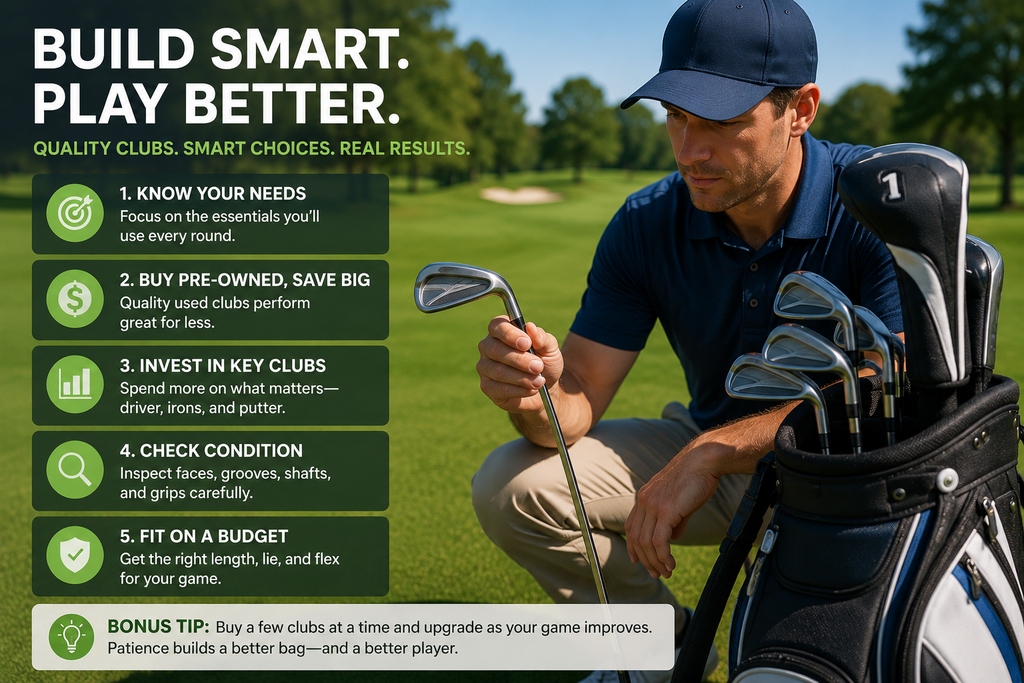
Start with a realistic total budget and prioritize the clubs you will use most often. Look for forgiving, versatile designs and consider previous-generation equipment before paying premium prices for current releases.
Used clubs can provide outstanding value, especially for irons, putters, hybrids, and older drivers. However, inspect clubheads, shafts, grooves, adapters, and grips carefully before purchasing.
Keep your initial setup simple. A driver or reliable tee club, fairway wood or hybrid, several forgiving irons, one or two wedges, and a putter can cover most situations.
As your game improves, measure your carry distances and add clubs only when they solve a genuine problem.
Most importantly, leave some money for playing, practice, and instruction.
Building a golf club set on a budget is not about finding the cheapest equipment available. It is about spending deliberately, avoiding unnecessary purchases, and creating a bag that makes the game easier without paying for features you do not need.
FAQ
1. How many clubs does a beginner really need?
Beginners do not need the full 14-club allowance. A smaller set with a tee club, hybrid or fairway wood, several irons, wedge, and putter can cover most situations.
2. Are used golf clubs worth buying?
Yes, when they are in suitable condition and have appropriate specifications. Inspect the clubhead, shaft, grip, and other components carefully before buying.
3. Should I buy a complete golf set or individual clubs?
Complete sets offer convenience and can provide good beginner value. Buying individually gives you more control over specifications and may produce better value through used equipment.
4. Which golf clubs should I spend the most money on?
Prioritize clubs you use frequently and equipment that solves clear performance problems. There is no single category that deserves the largest budget for every golfer.
5. Should I buy the newest golf clubs?
Not necessarily. Previous-generation clubs can still provide excellent performance and often cost considerably less once newer models reach the market.