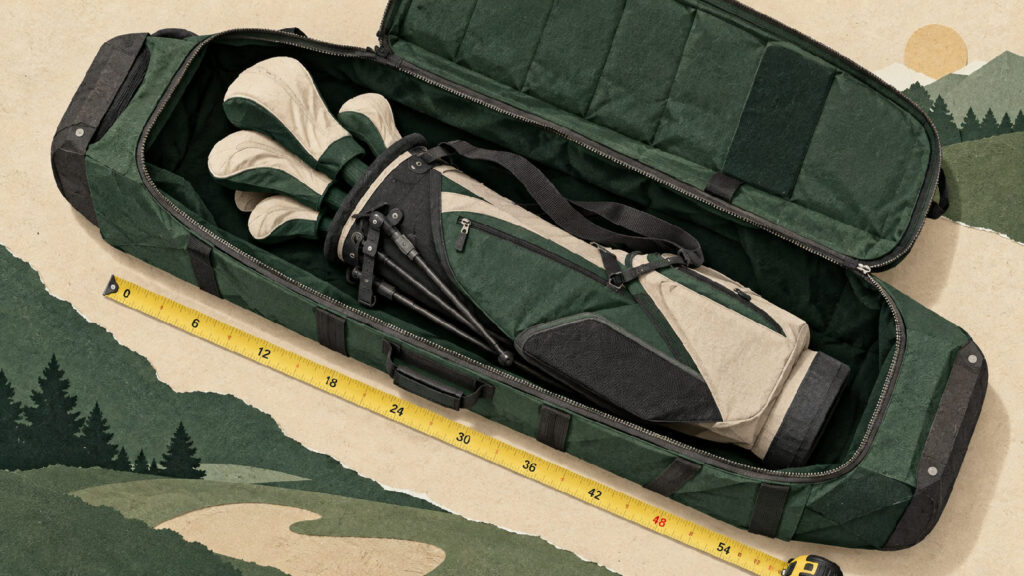
Golf travel bag fit is a question about your complete packed setup, not just the length of a golf club. Your everyday bag, fitted headcovers and any intended support accessory all belong in the check. Before ordering a travel cover, work out whether those items can sit inside it without forcing the closure.
This guide focuses on choosing the right-sized cover and carrying out a trial packing session. It does not promise damage-free transport or compare products from hands-on testing. Use the exact manufacturer’s instructions alongside this editorial checklist, and ask the seller about anything the dimensions do not explain.
List the equipment that must go inside
Put the golf bag you intend to travel with beside the clubs, headcovers and accessories you expect to pack. Do not measure a small practice bag if you will take a larger everyday bag. Decide which equipment is essential before using extra pockets as a reason to select a cover.
Record the bag’s model, type and visible shape. Note the position of its handles, stand legs, base and any bulky top cuff. Photograph it from the front and side if you will ask a retailer about compatibility. A recognisable model description and clear photographs are more useful than “standard golf bag.”
Write a separate list of loose items you are considering carrying. Leave those out of the first fit check so you can see how the core equipment sits. You can add permitted items later according to the cover’s instructions and your carrier’s current packing requirements.
Read dimensions with the right questions
Check whether published dimensions describe the exterior or usable interior space. Titleist’s Club Traveler page, for example, labels its dimensions as exterior and recommends particular bag types. That illustrates why a number alone cannot establish fit for every golf bag.
Ask the seller to clarify measurements that are not labelled. Request the usable opening size, available height and the area where the widest part of your bag will sit. Do not assume that a rectangular set of measurements describes every part of a shaped or padded cover.
If you make a rough comparison at home, label it as a preliminary check. A drawing or measured outline can expose an obvious mismatch, but it cannot confirm zipper clearance, padding thickness or how the loaded bag sits. Keep those questions open until you have a reliable answer.
Check golf travel bag fit with clubs and covers in place
Use your intended club arrangement for the trial, including headcovers. Identify the highest point of that actual setup. It may differ from the top of the empty golf bag, so measuring the bag alone leaves part of the packing question unanswered.
Follow the travel-cover maker’s loading instructions. With the cover open, place the bag in its intended position and check the top, sides and base. Look for places where equipment presses directly into a seam or closure. Ask the seller about any area that looks crowded.
If the cover cannot close normally, stop the test. Do not pull hard on a zipper or bend equipment to force the shape. Remove the bag and reassess the dimensions, loading position or model choice. A cover that fits only after forcing it has not passed a useful buying check.
Include any support accessory in the trial
If you intend to use a support device, check its compatibility and operating instructions separately. Club Glove describes its Stiff Arm as an adjustable telescoping club protector. That is a description of one accessory, not proof that every support device fits every cover.
Ask the cover manufacturer which accessories it supports and how they should be positioned. Include the actual recommended accessory in the trial rather than leaving it as a later addition. Confirm that you can operate its adjustments without pressing clubs into the closure.
Keep protection claims in perspective. An accessory’s advertised purpose does not guarantee the outcome of a particular journey. Your buying decision should establish compatibility and a clear packing process, with unanswered questions referred to the manufacturer.
Look at the base and internal restraint
Check where the inner golf bag rests when the cover is standing in its intended orientation. Read the maker’s instructions for straps or other restraints. Titleist lists an interior stability strap and padded clubhead area on the Club Traveler, but the presence and operation of such features varies by model.
Use the restraint exactly as instructed and check that it is accessible with your bag inside. If a strap runs across an awkward part of the bag, ask whether you are loading it correctly. Do not invent an alternative fastening arrangement or attach it around a club shaft.
Inspect the opening after the internal setup is complete. Can you close it without trapping a handle, loose strap or cover edge? A good trial includes both loading and unloading, because you will need to repeat the process away from your usual packing space.
Test moving and storing the loaded cover
Where the seller permits it, try the handles and wheels with a representative load. Start in a clear area and keep the movement controlled. Ask whether the model is designed to be carried, rolled or handled in a particular orientation, then follow that guidance.
Consider the spaces you actually use. Will the packed cover fit in your vehicle? Can you store it at your destination? If you travel with someone else, compare the complete luggage arrangement rather than checking only one case in isolation.
Also examine the empty cover’s storage instructions. If it folds or collapses, learn the intended sequence and where any separate parts go. Decide on a storage location before buying. The convenience of moving a case and the convenience of keeping it between trips are separate checks.
Build a trial-packing record
Write down what you tested and what still needs confirmation. This helps you ask a retailer a focused question and prevents an early estimate from becoming a confident but unsupported fit claim.
| Check | Evidence to record | Next step if unclear |
|---|---|---|
| Inner bag | Exact model, bag type and photographed shape. | Ask the cover maker about that specific bag. |
| Published measurements | Whether dimensions are exterior or interior. | Request clarification of usable space. |
| Complete club setup | Clubs and covers used during the trial. | Repeat with the equipment you will actually take. |
| Support accessory | Compatible accessory and instructed position. | Confirm compatibility before adding it. |
| Closure and movement | Normal closure, restraint access and handling observations. | Resolve crowding or handling concerns with the seller. |
Add a note about which trial items were unavailable. If you tested a display cover without your own bag, say so. That observation is useful, but it should not be recorded as a successful test of your complete travel setup.
Prepare clean equipment and unpack thoughtfully
For your packing routine, follow the care instructions for the clubs and bag. Golf Pride advises drying grips thoroughly and storing equipment in a cool, dry place away from heat and sunlight. Avoid treating a closed travel cover as your automatic long-term storage solution.
Before the trip, inspect the cover’s closures and restraints and remove anything left from an earlier journey. Check the current packing requirements directly with your carrier. This article does not state an airline allowance or assume that all carriers handle golf equipment the same way.
At your destination, open the case and check the equipment before play. Document a concern and follow the appropriate reporting process if something is wrong. After returning home, unpack, inspect and store the equipment according to its care instructions rather than leaving the trip setup untouched.
Common golf travel bag fit questions
Can I buy from the exterior dimensions alone?
Use them as an initial screen, then confirm usable space, recommended bag types and closure clearance. If you cannot trial pack, ask the maker about your actual bag and club setup before ordering.
Should I choose the largest cover available?
Choose a model that accommodates your intended setup and gives you a clear restraint and handling process. More space is not automatically a reason to prefer a cover; compare storage and movement as well as capacity.
Confirm golf travel bag fit with the equipment you will carry, the instructions for the exact cover and an honest record of the trial. A clear fit check makes the purchase decision easier and gives you a packing routine you can repeat.
Find more equipment topics on the Best Golf Clubs home page.
By Best Golf Clubs Editorial.