
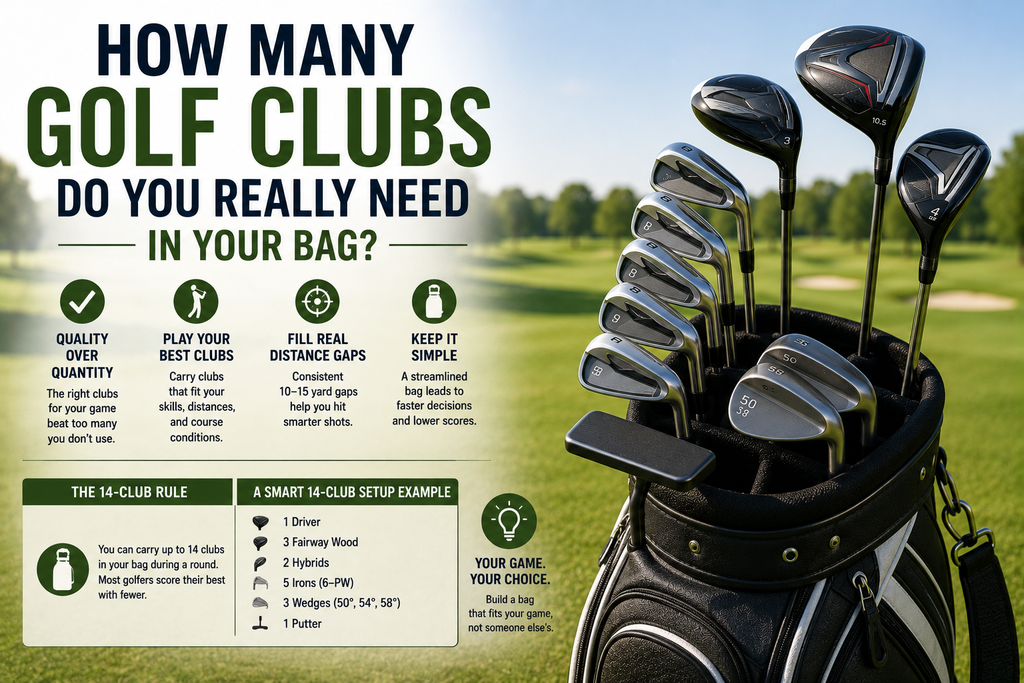
If you are building a golf bag, you may wonder how many golf clubs you actually need. Golfers can carry up to 14 clubs during a round played under the standard Rules of Golf, but that does not mean every player needs all 14. Beginners can often learn with a much smaller set, while experienced golfers may benefit from additional options for specific distances and shots. The right number depends on your skill level, distance gaps, course conditions, and confidence with each club. Instead of filling every available space, focus on creating a practical set where every club has a clear purpose.
Understanding the 14-Club Limit
Under the Rules of Golf, a player is limited to 14 clubs during a round.
However, 14 is a maximum rather than a requirement.
You can play with fewer clubs. In fact, carrying fewer may simplify the game for beginners and casual players.
A typical full bag might contain a driver, one or more fairway woods, hybrids or long irons, several mid- and short irons, wedges, and a putter.
Yet there is no single correct combination.
When deciding how many golf clubs belong in your bag, think about the shots you need rather than simply trying to reach the maximum.
If two clubs perform almost identical jobs, carrying both may add little value.
Likewise, an extra wedge or hybrid could be more useful than a club you rarely hit.
The goal is to create sensible coverage from your longest tee shots to your shortest shots around the green.
Beginners Usually Do Not Need 14 Clubs
New golfers can benefit from keeping equipment simple.
Learning how to use several clubs effectively is often easier than trying to understand a full 14-club setup immediately.
A beginner might start with a driver or fairway wood, a hybrid, several irons, a wedge, and a putter.
For example, you could carry every other iron rather than a complete iron set.
A smaller selection reduces decisions on the course.
Instead of choosing between three clubs that travel similar distances, you have clearer options.
When beginners ask how many golf clubs they should buy, the answer should reflect their current ability rather than what experienced golfers carry.
Start with enough equipment to cover basic situations.
As your swing becomes more consistent, you will learn where genuine distance gaps exist. You can then add clubs that solve specific problems.
What Clubs Does a Beginner Actually Need?
A practical beginner bag should cover tee shots, longer fairway shots, approaches, short-game situations, and putting.
For tee shots, a driver can provide useful distance. However, some beginners feel more confident using a fairway wood or hybrid.
Next, consider a hybrid. It can replace difficult long irons and provide versatility from several lies.
A few irons can cover medium and shorter approach shots. You do not necessarily need every number.
Add at least one suitable wedge for shorter shots and bunker situations.
Finally, every normal golf bag needs a putter.
This basic structure provides a useful answer to how many golf clubs a beginner needs without creating unnecessary complexity.
You can expand the set later.
Most importantly, choose forgiving clubs that are comfortable to swing. A smaller collection of suitable equipment is more useful than a full bag of clubs you cannot confidently hit.
Intermediate Golfers May Benefit From More Options
As golfers improve, their distances often become more predictable.
That makes smaller gaps between clubs more valuable.
An intermediate golfer may begin noticing situations where a limited starter set creates awkward yardages.
For example, one iron may carry 140 yards while the next available club carries 165. Adding another club could provide a useful option between them.
Short-game development can create similar needs.
A golfer who originally used one wedge may benefit from adding a gap wedge or another loft to cover specific scoring distances.
Therefore, how many golf clubs an intermediate player needs depends largely on distance control.
You may eventually use 12, 13, or all 14 available positions.
However, adding a club should solve a clear problem.
If your current setup already covers your common distances, there is no reason to buy additional equipment simply because your bag has empty spaces.
Experienced Golfers Can Use All 14 Strategically
Skilled players often benefit more from a full set because they can produce predictable distances and understand how different clubs behave.
One position might be dedicated to a specialized wedge.
Another could hold a utility iron, hybrid, or fairway wood selected for a particular course.
Experienced golfers may also use clubs with overlapping distances but different trajectories.
For example, a hybrid and utility iron might travel similar yardages while producing different flights and performing better from different lies.
This is where the question of how many golf clubs becomes more strategic.
The goal is no longer simply covering distance. It involves covering specific shot requirements.
Still, every club should justify its place.
Even an advanced golfer does not gain anything from carrying a club that never gets used and offers no meaningful advantage over another option.
Start With the Putter
The putter is one of the easiest choices when building your bag.
You will use it on most holes, so it deserves a permanent position.
Choose a putter based on alignment, feel, length, and how naturally it works with your stroke.
Unlike other categories, golfers generally carry only one putter during a normal round.
That means one of your available club positions is straightforward.
From there, build outward.
Think about the shots closest to the green, then your approach clubs, long-game options, and finally your driver.
Breaking the process into sections makes determining how many golf clubs you need much easier.
Instead of viewing your bag as 14 empty slots, think of it as several distance and shot categories.
Fill each category only when another club provides a useful benefit.
Build a Sensible Wedge Setup
Wedges cover some of the most important scoring distances.
A typical iron set includes a pitching wedge. Depending on its loft, you may then add a gap wedge, sand wedge, or lob wedge.
However, carrying four wedges is not automatically better than carrying three.
Start by checking the loft of your pitching wedge.
Modern iron sets vary significantly. A relatively strong pitching wedge may create a large loft and distance gap to a traditional sand wedge.
In that situation, a gap wedge could become valuable.
When deciding how many golf clubs to dedicate to wedges, measure your actual carry distances.
Also consider the short-game shots you prefer.
Some golfers use one wedge for many situations. Others benefit from multiple lofts and sole designs.
Choose a setup that creates manageable distance gaps without adding clubs you rarely use.
Do You Need Long Irons?
Long irons can be excellent tools for golfers who strike them consistently.
However, many recreational players struggle to launch them high enough.
If your 4-iron and 5-iron travel almost the same distance, carrying both may not make sense.
A hybrid could provide easier launch and better separation.
Some golfers remove several long irons and replace them with hybrids. Others prefer fairway woods.
There is no requirement to carry a traditional 3-iron or 4-iron.
Your answer to how many golf clubs you need should therefore depend on performance rather than convention.
Test your longest irons and record their carry distances.
If each provides a useful, repeatable number, keep them.
If distance begins to overlap, consider another club type.
Your bag should reflect what you can actually hit, not what a traditional set is supposed to contain.
How Many Fairway Woods Should You Carry?
Some golfers carry one fairway wood, while others use two or more.
A 3-wood can provide distance from the tee and fairway. However, its lower loft may make it difficult for some golfers to launch from the ground.
A 5-wood or 7-wood can be easier to elevate.
Higher-lofted fairway woods have become useful alternatives to long irons and hybrids for many players.
Before adding multiple woods, compare carry distances.
If two clubs travel almost the same yardage, determine whether they provide different enough trajectories or uses to justify both.
The question of how many golf clubs you need at the top of the bag is really about coverage.
Your fairway woods, hybrids, and longest irons should work together.
Avoid choosing each category separately because that can create unnecessary overlap.
Hybrids Can Simplify Your Set
Hybrids are especially useful for golfers who struggle with long irons.
They can offer easier launch, useful forgiveness, and versatility from the fairway or light rough.
A hybrid can also serve as a controlled tee club.
You may need only one hybrid between your fairway wood and irons. Alternatively, two or three hybrids may replace several long irons.
Look at actual carry distances rather than the number printed on the club.
A 4-hybrid does not automatically replace every 4-iron because specifications vary between manufacturers.
When calculating how many golf clubs belong in your bag, choose hybrids that create clear distance separation.
If adding a hybrid simply duplicates another club, it may not improve your set.
Every addition should make club selection easier rather than more confusing.
Distance Gapping Matters More Than Club Count
A bag with 14 poorly spaced clubs can be less useful than one with 10 carefully selected clubs.
Measure your normal carry distance with every club.
Then arrange the results from shortest to longest.
Look for two problems: large gaps and excessive overlaps.
A large gap means you may frequently face distances without a comfortable full-swing option.
An overlap means two clubs may perform nearly the same job.
Neither situation automatically requires a purchase. You may be able to use partial swings or different trajectories.
However, the data will show where another club could help.
Instead of asking only how many golf clubs you own, ask whether each one adds meaningful coverage.
A balanced set makes decisions clearer because you know what each club is designed to accomplish.
Think About the Courses You Usually Play
Course design can influence your ideal setup.
A golfer who regularly plays a long course may value additional options at the top of the bag.
Fairway woods and hybrids can help cover long approaches and tee shots.
On a shorter course, extra wedges might provide more value because you face many scoring shots from closer range.
Firm and windy conditions can create another need.
A lower-flying utility club may become useful even if its distance overlaps slightly with another club.
Therefore, how many golf clubs you need can change with the courses you play.
Experienced golfers sometimes adjust their setup before a round.
You do not need to own every possible club, but understanding your regular playing environment can prevent you from filling the bag with options that rarely serve a purpose.
Walking Golfers May Prefer Fewer Clubs
Carrying a lighter bag can make walking more comfortable.
Golf clubs may not seem extremely heavy individually, but the combined weight of clubs, balls, water, accessories, and the bag adds up.
If you walk frequently, consider whether every club earns its place.
Removing two or three rarely used clubs can reduce weight while simplifying decisions.
This approach works particularly well for casual rounds.
However, do not remove important distance coverage solely to save a small amount of weight.
Finding how many golf clubs you need while walking requires a balance between convenience and performance.
Start by identifying the clubs you use least often.
If they duplicate other options, they are the easiest candidates to leave behind.
A lightweight, thoughtfully organized set can make walking rounds more enjoyable.
Budget Should Influence Your Buying Strategy
You do not need to purchase 14 clubs at once.
Beginners should especially avoid spending heavily before they understand their equipment preferences.
Start with the essentials.
A package set can provide good value because it includes several important clubs and often a golf bag.
Another option is building your set gradually with used or previous-generation equipment.
As your game develops, identify real gaps and fill them one at a time.
This approach answers how many golf clubs you should buy based on actual need rather than marketing.
It also allows you to spend more carefully.
For example, you may discover that your starter putter works perfectly well but your long-game setup needs improvement.
Instead of replacing everything, invest only where the change provides a practical benefit.
Do Not Carry Clubs You Cannot Hit Confidently
A club has little value if you consistently avoid using it.
Perhaps your 3-wood looks useful on paper, but you never trust it from the fairway.
Maybe your lob wedge creates more mistakes than good shots.
These clubs occupy space without improving your decisions.
That does not mean you should immediately sell every difficult club. Practice may help you become more comfortable.
However, your playing set should favor equipment you can use with reasonable confidence.
When considering how many golf clubs to carry, evaluate actual use.
Review your last few rounds.
Which clubs did you hit frequently? Which remained untouched?
A rarely used club may still have a specialized purpose, but you should be able to explain what that purpose is.
If you cannot, another option may deserve the spot more.
A Simple 8-Club Beginner Setup
A beginner does not need a complicated set.
One practical eight-club example could include a driver, 5-wood, hybrid, 6-iron, 8-iron, pitching wedge, sand wedge, and putter.
This is only an example, not a universal formula.
Another golfer might prefer a 7-wood instead of a hybrid. Someone uncomfortable with a driver could use a fairway wood from the tee while learning.
The point is that eight clubs can cover many basic situations.
When deciding how many golf clubs to start with, simplicity has real value.
A reduced set encourages you to learn different shots with the same club.
It also lowers the initial cost of getting into golf.
Once you understand your distances and preferences, adding clubs becomes much more purposeful.
When Should You Add Another Club?
Add a club when you can clearly describe the problem it solves.
Perhaps you repeatedly face 175-yard shots, while your current options carry 160 and 190.
A hybrid that consistently covers the middle could make sense.
Maybe your pitching wedge carries 120 yards and your sand wedge only 90. A gap wedge could provide useful coverage.
You may also add a club for a specific trajectory, such as a higher-flying fairway wood.
The best answer to how many golf clubs you need will change as these needs appear.
Do not add equipment simply because there is space in your bag.
Test potential additions against the clubs you already own.
If the new club does not improve distance coverage, consistency, or versatility, it may not be necessary.
When Should You Remove a Club?
Removing a club can be just as useful as adding one.
Start with distance overlap.
If two clubs repeatedly carry within a few yards of each other and produce similar ball flights, decide which one you trust more.
Next, consider usage.
A specialized club that has not been used for months may not deserve a permanent position.
Poor confidence is another clue.
If you constantly avoid one club because another option produces better results, reconsider its role.
Reviewing how many golf clubs you carry is especially worthwhile after equipment changes.
A new hybrid, for example, might make an older long iron unnecessary.
Building a better bag is an ongoing process. Your setup should evolve as your swing, speed, and playing style change.
Common Mistakes When Building a Golf Bag
One common mistake is believing that every golfer needs exactly 14 clubs.
Another is copying a professional golfer’s setup.
Tour players have different speeds, skills, and course requirements.
Buying every iron from 3-iron through pitching wedge without testing your long-iron performance can also create unnecessary overlap.
Likewise, adding several wedges without checking lofts and carry distances may produce redundant clubs.
When deciding how many golf clubs you need, avoid shopping by category alone.
Build the bag as one connected system.
Another mistake is purchasing clubs before measuring current distances.
Finally, do not assume a more expensive or larger collection will automatically lower scores.
Useful equipment is equipment you can confidently put into play.
Build Your Ideal Bag Step by Step
Begin with your putter and core scoring clubs.
Next, establish an iron setup that provides dependable approach distances.
Add hybrids or fairway woods where your irons become difficult to launch.
Then choose a reliable tee club.
Afterward, measure your entire set.
Look for gaps, overlaps, and clubs you rarely use.
This process makes deciding how many golf clubs belong in your bag much easier.
Beginners may finish with eight or nine clubs. Experienced players may use all 14.
Both setups can be correct.
What matters is that every club has a job and that the collection gives you sensible choices from the tee to the green.
Conclusion
You do not need 14 clubs simply because the rules allow that many.
Beginners can often learn effectively with a smaller, simpler set. Intermediate players may add clubs as their distances become more predictable, while experienced golfers can use additional positions for precise gapping and specialized shots.
Start with clubs that cover the essential parts of the game. Then measure your carry distances and identify genuine needs.
Remove unnecessary overlaps and avoid carrying equipment you never trust.
Your budget, playing style, preferred courses, and whether you walk or ride can also influence the ideal setup.
Ultimately, the answer to how many golf clubs you need is the smallest number that gives you reliable coverage for the shots you regularly face. Build around usefulness rather than quantity, and every club in your bag will have a reason to be there.
FAQ
1. Can a golfer play a round with fewer than 14 clubs?
Yes. Fourteen is the maximum allowed under the standard Rules of Golf. You can carry fewer clubs if you prefer.
2. Is eight clubs enough for a beginner?
It can be. A carefully selected eight-club setup can cover tee shots, longer approaches, iron shots, short-game situations, and putting while keeping decisions simple.
3. Should beginners carry a driver?
Not necessarily. A driver can be useful, but beginners who feel more confident with a fairway wood or another tee club can start there while developing their driver swing.
4. Do I need a 3-iron and 4-iron?
No. Many golfers replace difficult long irons with hybrids or higher-lofted fairway woods. Choose whichever clubs provide useful distance and consistent contact.
5. How do I know whether I have too many similar clubs?
Measure your average carry distances. If two clubs repeatedly travel nearly the same distance and serve similar purposes, one may be unnecessary.