
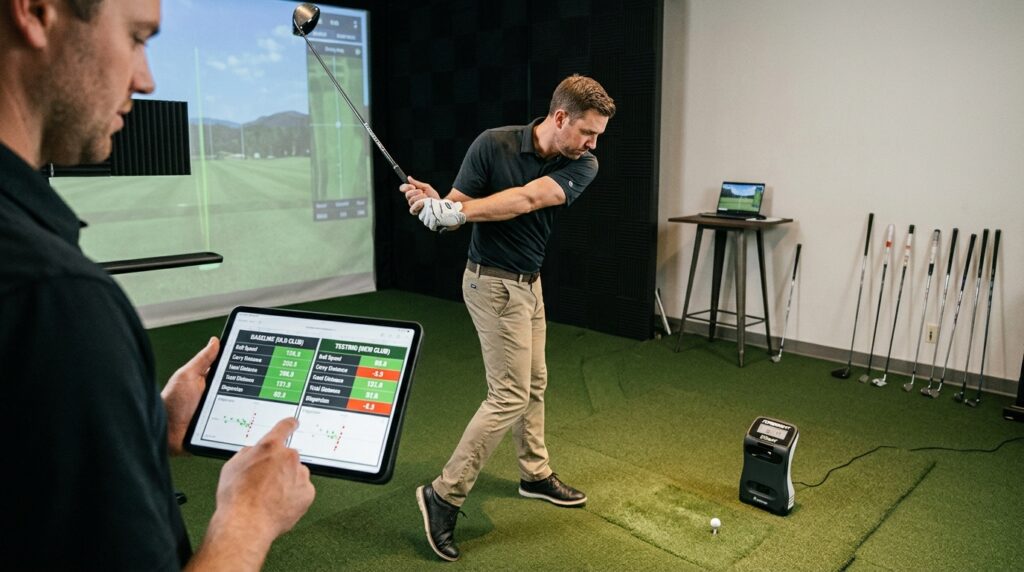
Before investing in new equipment, it’s important to test new golf clubs properly. Many golfers assume that newer gear automatically leads to better performance. However, without a clear testing approach, it’s difficult to know if those clubs truly improve your game.
At first, excitement can cloud judgment. Shiny designs and marketing promises often create high expectations. Yet, real improvement comes from measurable results. Therefore, learning how to test new golf clubs helps you make smarter decisions.
Instead of relying on guesswork, you can evaluate distance, accuracy, and consistency. As a result, you understand whether your investment delivers real value. This approach not only saves money but also ensures your equipment supports your progress.
Why Proper Testing Matters More Than You Think
When golfers skip proper testing, they often choose clubs that feel good initially but fail over time. To test new golf clubs effectively, you need more than a few swings at the range.
Consistency is the key factor. A single great shot does not represent overall performance. Instead, you should look for repeatable results across multiple swings. As a result, you gain a clearer picture of how the clubs perform.
Additionally, testing helps identify subtle improvements. For example, you might notice tighter shot dispersion or better launch angles. Consequently, these small gains can lead to better scores.
Without proper evaluation, it’s easy to mistake excitement for improvement. Therefore, taking a structured approach ensures more reliable outcomes.
Start with a Baseline of Your Current Clubs
Before you test new golf clubs, you need a reference point. This means understanding how your current clubs perform. Without this baseline, comparisons become meaningless.
Begin by tracking your average distance and accuracy. For example, note how far you typically hit your irons and driver. Additionally, observe your shot patterns and consistency.
Recording this data allows you to compare results objectively. As a result, you can clearly see whether new clubs provide improvement.
It’s also helpful to assess how your current clubs feel. Comfort and confidence play a role in performance. Therefore, including these factors in your baseline gives you a more complete picture.
Establishing this starting point ensures that when you test new golf clubs, your evaluation is accurate and meaningful.
Use Launch Monitors for Accurate Data
Technology has made it easier than ever to test new golf clubs. Launch monitors provide detailed data that goes beyond what you can see with the naked eye.
These devices measure ball speed, launch angle, spin rate, and carry distance. As a result, you gain precise insights into your performance. This data helps you understand how each club behaves.
For example, you may find that a new driver increases ball speed but also adds too much spin. Consequently, distance gains may not be as significant as expected.
Using a launch monitor removes guesswork. Therefore, your decisions become based on facts rather than impressions.
If possible, test in a controlled environment. This ensures that external factors like wind do not affect your results.
Evaluate Distance, But Don’t Focus on It Alone
Distance is often the first thing golfers look at. However, when you test new golf clubs, it should not be the only factor.
While longer shots are appealing, accuracy matters just as much. A slight increase in distance means little if your shots become less consistent. Therefore, balance is essential.
Pay attention to how far your shots carry, not just total distance. Carry distance provides a more reliable measure of performance. As a result, you get a clearer understanding of improvement.
Additionally, consider trajectory. Higher or lower ball flights can affect how your shots perform in real conditions.
By evaluating multiple factors, you can determine whether new clubs truly enhance your game.
Focus on Shot Dispersion and Consistency
Consistency is often the most valuable improvement. When you test new golf clubs, look at how tightly your shots group together.
Shot dispersion refers to how spread out your shots are. A tighter pattern indicates better control. Consequently, you are more likely to hit fairways and greens.
Even if distance gains are small, improved consistency can lead to better scores. Therefore, it’s an important metric to consider.
Testing multiple shots with each club helps identify patterns. As a result, you avoid relying on isolated results.
Consistency also builds confidence. When you trust your equipment, you can focus on execution. This makes a significant difference in performance.
Test Clubs in Real Playing Conditions
Range testing is useful, but it doesn’t tell the whole story. To fully test new golf clubs, you should also use them on the course.
Real conditions introduce variables like uneven lies and course strategy. As a result, you see how the clubs perform in actual play.
For example, a club that performs well on the range may feel different during a round. Consequently, testing in real situations provides valuable insights.
Pay attention to how the clubs handle different shots. This includes approach shots, recovery shots, and tee shots under pressure.
On-course testing helps you evaluate practical performance. Therefore, it’s an essential part of the process.
Consider Feel and Confidence
Performance data is important, but feel should not be ignored. When you test new golf clubs, consider how they feel in your hands.
Comfort influences your swing. If a club feels awkward, it can affect your timing and confidence. As a result, your performance may suffer.
Confidence is another key factor. When you trust your equipment, you swing more freely. Consequently, your results improve.
While feel is subjective, it still matters. Therefore, balancing data with personal preference leads to better decisions.
The best clubs are those that perform well and feel right at the same time.
Avoid Common Testing Mistakes
Many golfers make mistakes when they test new golf clubs. These errors can lead to poor decisions.
One common mistake is testing too quickly. Rushing the process prevents you from gathering enough data. Instead, take your time and evaluate thoroughly.
Another issue is comparing clubs on different days. Conditions can vary, affecting results. Therefore, testing in similar conditions ensures accuracy.
Fatigue can also impact performance. Testing too many clubs at once may lead to inconsistent swings. As a result, your evaluation becomes less reliable.
Finally, avoid focusing on one feature. Instead, consider overall performance. This approach provides a more complete picture.
When Results Show Real Improvement
After testing, the results should be clear. If new clubs consistently outperform your current set, the upgrade makes sense.
Look for improvements in distance, accuracy, and consistency. Even small gains can add up over time. Consequently, your scores may improve.
However, if differences are minimal, upgrading may not be necessary. In such cases, investing in lessons or practice could provide better value.
Testing helps you make objective decisions. Therefore, you avoid unnecessary spending and focus on meaningful improvements.
Conclusion
Learning how to test new golf clubs properly gives you a significant advantage. Instead of relying on assumptions, you base your decisions on real data and experience.
By establishing a baseline, using technology, and evaluating consistency, you gain a complete understanding of performance. As a result, you can confidently choose equipment that supports your game.
While new clubs can offer benefits, they must deliver measurable improvements. Therefore, a structured testing process ensures that your investment is worthwhile.
In the end, the goal is to play better and enjoy the game more. When you test new golf clubs effectively, you make choices that move your game forward.
FAQ
- How many shots should I hit when testing clubs?
You should hit multiple shots, ideally 10–15, to identify consistent performance patterns. - Do I need a launch monitor to test equipment?
It’s not required, but it provides valuable data that improves accuracy in testing. - Should I test clubs indoors or outdoors?
Both are useful, but outdoor testing shows how clubs perform in real conditions. - What matters more, distance or accuracy?
Both matter, but consistency and accuracy often lead to better overall results. - Can new clubs fix a poor swing?
No, clubs can help performance, but technique remains the most important factor.