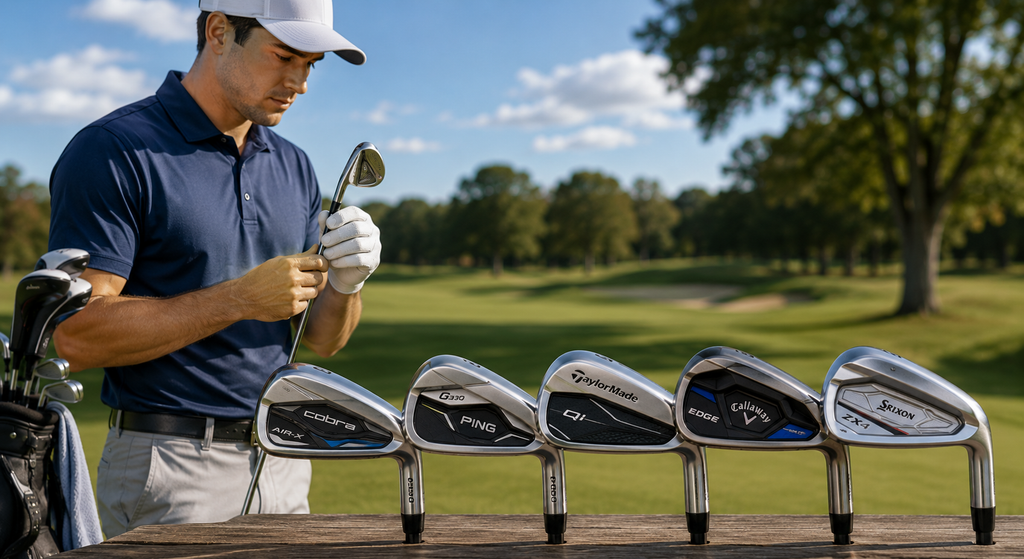
Choosing the best golf irons can make learning the game easier and far less frustrating. Beginners rarely strike every shot from the center, so forgiveness matters more than workability or a compact appearance. A suitable iron should help launch the ball, preserve useful distance on mishits, and inspire confidence at address. However, beginners also face dozens of models, technical terms, and price points. Instead of buying whatever looks impressive, focus on features that support your current swing. This guide explains what beginners should compare in 2026 and how to choose irons that can remain useful as your game improves.
What Beginners Need From Their Golf Irons
Beginner golfers need equipment that makes ordinary shots easier. Therefore, forgiveness should sit near the top of your shopping list.
Forgiving irons typically have larger clubheads and wider soles. They may also place more weight around the perimeter of the head. As a result, the club can remain more stable when contact moves away from the center.
Easy launch matters too. Beginners often struggle to get longer irons airborne. A club designed to launch naturally can make approach shots more useful and enjoyable.
Distance is helpful, but predictable distance matters more. An iron that produces one exceptionally long shot followed by several poor results will not necessarily improve your scores.
The best golf irons should also look comfortable behind the ball. A slightly larger head and thicker top line can give new golfers confidence before the swing begins.
Finally, consider how the set fits into your entire bag. You may not need traditional long irons. Hybrids can replace difficult clubs while maintaining useful distance coverage.
Game-Improvement Irons Are a Strong Starting Point
Golf irons generally fall into several broad design categories. For beginners, game-improvement and super game-improvement models often make the most sense.
These clubs emphasize forgiveness, launch, and distance. Their larger profiles also provide manufacturers with more space to position weight strategically.
Cavity-back construction is common. Instead of concentrating material directly behind the center, designers can distribute weight around the clubhead. This can improve stability on off-center strikes.
Wider soles are another useful feature. They may help the club move through the turf without digging as severely on slightly heavy shots.
Some models use hollow-body construction. These irons can combine a relatively clean appearance with technologies designed to improve speed and launch.
By contrast, traditional blade-style irons generally demand more precise contact. They can provide excellent feedback and control for skilled golfers, but beginners rarely need that extra challenge.
For most new players, the best golf irons offer assistance without requiring perfect contact. You can always explore more compact designs later as your ball striking develops.
Top Iron Types Beginners Should Compare in 2026
Rather than choosing one universal model, beginners should compare several types of forgiving irons. Different swings can respond differently to the same club.
Super game-improvement irons provide maximum help. They usually feature larger heads, generous soles, and strong stability. Therefore, they suit players who struggle with consistent contact or launch.
Standard game-improvement irons offer a more balanced package. They still provide forgiveness, but their appearance may be slightly less oversized. Consequently, they can appeal to beginners who expect to improve quickly.
Hybrid-style irons take forgiveness even further. Their designs resemble hybrids more than traditional irons. Players who struggle to launch conventional irons may find these particularly useful.
Combo sets provide another option. These sets may use hybrids in the longer positions and conventional irons in shorter positions. That structure can make difficult shots easier while maintaining familiar scoring clubs.
The best golf irons are ultimately the ones that suit your strike pattern. Therefore, test more than one category instead of assuming every beginner needs exactly the same design.
Why Forgiveness Matters So Much
A perfectly struck iron shot feels great, but beginners need equipment that also handles imperfect contact.
Forgiveness refers to how well a club maintains useful performance when the ball misses the ideal strike point. The difference can appear in distance, direction, launch, or all three.
For example, a toe strike with a forgiving iron may still reach close to its intended distance. A less forgiving design could lose considerably more yardage.
This matters because golf scores are often influenced by misses rather than perfect shots. Keeping a mishit near the green can be far better than leaving it well short.
Modern club designers use several methods to increase stability. Perimeter weighting, low centers of gravity, wider soles, and larger head shapes can all contribute.
However, forgiveness cannot fix every swing. A severely open clubface or very heavy strike will still produce a poor result.
The best golf irons simply make reasonable mistakes less costly. For a beginner developing a repeatable swing, that extra margin can build confidence and make practice more productive.
Easy Launch Can Make Golf More Enjoyable
Many beginners believe they need to help the ball into the air. As a result, they may scoop or lean backward through impact.
Suitable equipment can make launching the ball feel more natural.
Game-improvement irons often position the center of gravity to support higher launch. In addition, wider soles and thoughtful weighting can make solid contact easier.
Long irons deserve special attention. A 4-iron or 5-iron can be difficult for a new golfer to launch consistently because these clubs have less loft and longer shafts.
Therefore, you do not have to carry them. A hybrid can provide a more forgiving alternative.
When comparing the best golf irons, watch the actual flight rather than simply checking distance. A strong approach shot should reach a useful height and land predictably.
Very low shots may run through greens, while extremely high shots can lose efficiency. Your goal is a repeatable trajectory that suits your speed.
A launch monitor can help, although observing outdoor ball flight also provides valuable feedback.
Should Beginners Choose Steel or Graphite Shafts?
Both steel and graphite iron shafts can work for beginners. The correct choice depends on your speed, strength, tempo, and preferred feel.
Graphite shafts are often lighter. Therefore, they may help golfers who benefit from reducing overall club weight.
They can also feel more comfortable to players who dislike vibration at impact. However, graphite is not automatically the better choice for every beginner.
Steel shafts remain popular because they offer many weight and flex options. Some golfers prefer the sense of stability they provide.
Do not choose solely according to age or gender. Instead, test different shaft weights and profiles.
The best golf irons should feel manageable throughout an entire round. If a club feels heavy after several swings, maintaining technique can become difficult as fatigue develops.
Likewise, extremely light equipment can feel hard to control for some golfers.
A basic fitting can help identify a suitable shaft without making the process overly complicated.
How Many Irons Does a Beginner Really Need?
Beginners do not need to carry every traditional iron from 3-iron through pitching wedge.
In fact, removing difficult long irons can simplify club selection and make the bag easier to use.
Many modern sets begin at the 5-iron or 6-iron. Hybrids or fairway woods can then cover longer distances.
For example, a beginner might carry irons from 6-iron through pitching wedge. A hybrid could replace the 4-iron and 5-iron positions.
The exact setup depends on your distances. If two clubs travel almost the same yardage, carrying both provides little benefit.
The best golf irons should create useful gaps rather than simply filling every numbered position.
As your swing develops, track your carry distances. You may eventually discover that adding another iron improves your set.
Remember that golf rules allow up to 14 clubs, but you are not required to carry all 14. A simpler setup can make decisions easier while you learn.
Do Stronger Lofts Automatically Mean Better Irons?
Modern iron lofts vary significantly between models. Therefore, comparing clubs only by the number printed on the sole can be misleading.
One company’s 7-iron may have considerably less loft than another model. Naturally, that can affect distance and trajectory.
Stronger lofts are not automatically bad. Manufacturers may combine them with low centers of gravity to produce useful launch while increasing distance.
However, beginners should not choose an iron simply because it travels farther in a simulator.
Consider how the ball launches and lands. You also need sensible distance gaps between clubs.
The best golf irons provide usable performance throughout the set. If your 7-iron flies a long way but creates an awkward gap to your 8-iron or hybrid, the extra distance may not help.
During testing, compare carry distance rather than total distance. Carry provides a clearer picture of how far the ball travels through the air before landing.
How to Compare Iron Sets Before Buying
Start with your current ability rather than your future ambitions. Buying demanding irons because you hope to become a low-handicap player can make improvement unnecessarily difficult.
Next, set a realistic budget. Include possible costs for fitting, grips, or additional wedges.
Then narrow your choices to forgiving designs that match your needs. If launch is a problem, prioritize clubs designed to help the ball get airborne.
Test your finalists whenever possible. Use the same golf ball and similar conditions so the comparison remains fair.
When evaluating the best golf irons, look beyond your longest strike. Compare average carry, dispersion, launch, and mishit performance.
Pay attention to comfort too. The club should sit naturally behind the ball and feel manageable during repeated swings.
Finally, check the set composition. Make sure the longest iron is a club you can actually use. Otherwise, consider a hybrid replacement.
Should You Buy a Complete Set or Individual Irons?
Complete beginner packages can offer excellent value. They often include a driver, woods or hybrids, irons, wedges, putter, and bag.
For someone starting from nothing, this can simplify the buying process.
However, package sets offer fewer customization options. Golfers who already know their swing characteristics may prefer building a set from individual categories.
Buying a dedicated iron set can also provide more choices in shaft, length, lie angle, and set composition.
Neither approach is automatically superior. Your budget and commitment level should influence the decision.
If you expect to play regularly, investing in the best golf irons you can reasonably afford may provide equipment that remains useful as your swing improves.
However, beginners should avoid overspending simply because premium equipment appears more advanced. Proper fit and forgiveness matter more than price.
Are Used Golf Irons Good for Beginners?
Used irons can be an excellent way to access quality equipment at a lower cost. Golf clubs do not become ineffective simply because a newer generation launches.
However, inspect used equipment carefully.
Check the faces and grooves for excessive wear. Some cosmetic scratches are normal, but deep damage deserves closer attention.
Inspect steel shafts for significant rust or bending. Graphite shafts should not show cracks or splintering.
Grips may also need replacement. Fortunately, worn grips are usually much cheaper to address than damaged clubheads or shafts.
Previous-generation best golf irons can offer strong value when their design still matches a beginner’s needs.
Avoid older blades or demanding players irons simply because the price seems attractive. A forgiving used set is usually a better learning tool.
Whenever possible, test the clubs before buying. At minimum, confirm specifications such as shaft flex, length, and set makeup.
Why Club Fitting Can Help Beginners
A beginner does not need a tour-level fitting session to benefit from basic measurements.
Height, arm length, posture, swing speed, and impact pattern can help identify equipment that feels more natural.
Standard specifications work for many golfers, but they do not suit everyone. Clubs that are too long or short may create unnecessary setup problems.
Likewise, a shaft that feels excessively heavy or stiff can make the swing harder to repeat.
A fitter can also help identify whether hybrids should replace long irons.
When searching for the best golf irons, fitting information can prevent expensive mistakes. More importantly, it can stop you from blaming your developing technique for problems caused partly by unsuitable equipment.
Beginners should still expect their swings to change. Therefore, focus on sensible specifications and forgiveness rather than extreme customization.
Common Beginner Iron Buying Mistakes
One of the biggest mistakes is buying clubs because professional golfers use them. Tour players have exceptional strike consistency, speed, and control.
Their equipment priorities may be completely different from yours.
Another mistake is focusing only on distance. Longer irons can be appealing, but predictable carry and direction matter more for scoring.
Some beginners also buy very stiff shafts because they believe stiffness represents quality. In reality, the shaft needs to match the golfer.
Ignoring hybrids is another common problem. There is no prize for struggling with a long iron when a hybrid produces better results.
Likewise, do not buy based only on appearance. A compact club may look attractive in the bag but feel intimidating over the ball.
The best golf irons should reduce difficulty rather than add to it.
Finally, avoid purchasing an entire set without checking the lofts and club composition. You want useful distance gaps from the longest iron through your wedges.
How Long Should Beginner Irons Remain Useful?
Quality irons can last for many years. Therefore, beginners should not assume they will need another set after one season.
As your game develops, you may improve enough to prefer different equipment. However, forgiving irons can continue serving many golfers well into the intermediate stage.
Physical wear is rarely a quick problem for recreational players. Regular cleaning and dry storage can keep clubs in good condition.
Grips generally require attention sooner than clubheads. When they become slick or hard, replacing them can make an older set feel much better.
Your swing may also change. Increased speed or improved delivery could eventually make a different shaft or club design more suitable.
Still, the best golf irons for beginners should provide enough performance to support improvement without requiring an immediate upgrade.
Buy for the player you are now while leaving reasonable room to develop.
Making Your Final Choice
Start by choosing forgiveness over prestige. Your first priority should be making solid, playable golf shots more frequently.
Next, consider launch. If longer irons repeatedly fly too low, test hybrids or more launch-friendly designs.
Pay attention to shaft weight and overall club weight. Equipment should feel easy enough to control without forcing your swing.
Then compare actual performance. Look at average carry distance and shot dispersion instead of focusing on one perfect strike.
The best golf irons should also perform reasonably well when contact is slightly off center. Those are the shots where forgiveness earns its value.
Finally, stay within your budget. Previous-generation and used clubs can provide excellent performance if they remain in good condition.
A beginner-friendly set does not need to be complicated. It simply needs to help you develop confidence and learn consistent ball striking.
Conclusion
Beginner golfers have more equipment choices than ever, but selecting irons does not need to become confusing. Focus on features that make the game easier.
Game-improvement or super game-improvement designs are strong starting points. Look for generous forgiveness, easy launch, useful distance, and a comfortable appearance.
Consider replacing difficult long irons with hybrids. In addition, test shaft weights and flexes instead of relying on labels alone.
Do not let maximum distance decide your purchase. Consistent carry, manageable misses, and confidence at address provide greater value.
Ultimately, the best golf irons are the ones that support your current swing while giving you room to improve. Choose clubs that make ordinary shots easier, fit your budget, and create sensible distance gaps. With the right setup, you can spend less time fighting your equipment and more time developing a golf game you enjoy.
FAQ
1. What type of irons should a beginner golfer use?
Most beginners benefit from game-improvement or super game-improvement irons. These designs generally offer larger heads, more forgiveness, and easier launch than compact players irons.
2. Should beginners use a 4-iron or a hybrid?
Many beginners find a hybrid easier to launch and strike consistently. However, individual results vary, so testing both options provides the clearest answer.
3. Is graphite or steel better for a new golfer?
Neither material is automatically better. Graphite often offers lighter options, while steel provides many weights and profiles. Choose according to comfort, speed, tempo, and consistency.
4. How much should a beginner spend on an iron set?
Spend within a comfortable budget and prioritize suitable specifications over premium branding. Used and previous-generation sets can offer excellent value when they remain in good condition.
5. Do beginners need a full set of irons?
No. Many new golfers can play effectively with a shorter iron set supported by hybrids and wedges. Useful distance gaps matter more than carrying every traditional iron number.