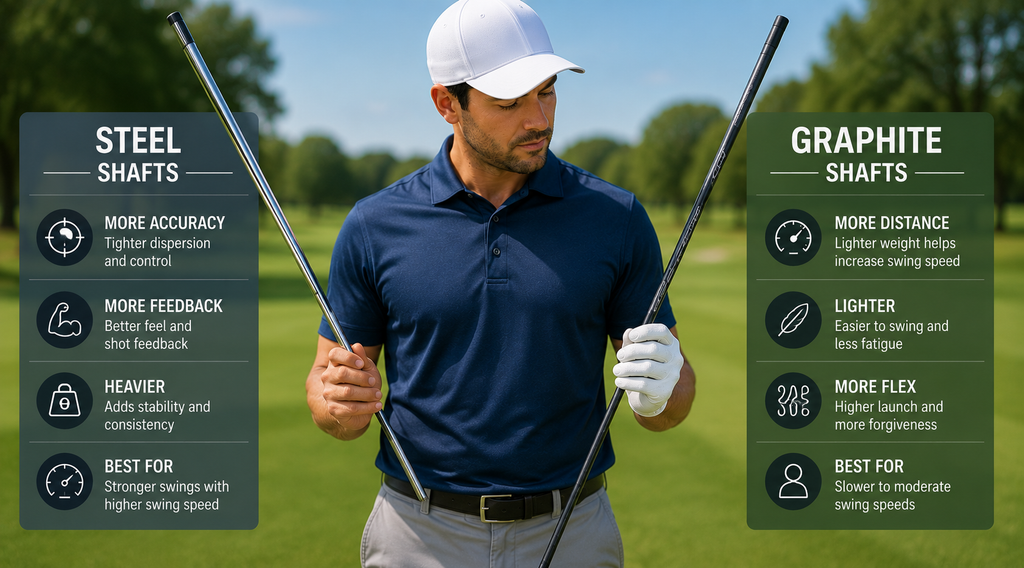
Choosing between steel vs graphite shafts can affect how your golf clubs feel, swing, and perform. Steel has traditionally been popular in irons because of its stable feel and consistent performance. Graphite, meanwhile, is common in drivers and woods and has become increasingly popular in irons. However, neither material is automatically better. Modern shaft design offers a wide range of weights, flex profiles, and performance characteristics in both categories. Your ideal choice depends on your swing speed, strength, preferred feel, desired club weight, and how consistently you deliver the club.
Understanding the Basic Difference Between Shaft Materials
Steel golf shafts are made primarily from steel and are traditionally associated with irons and wedges. They tend to provide a solid, familiar feel that many golfers enjoy.
Graphite shafts use layers of carbon-fiber-based materials arranged to create specific performance characteristics. Manufacturers can adjust these layers to change weight, stiffness, torque, and feel.
One of the biggest traditional differences has been weight. Graphite shafts can be made significantly lighter than many steel options.
However, modern designs have reduced the simplicity of that comparison. Lightweight steel shafts exist, while some graphite iron shafts are built at weights that overlap with steel.
Therefore, comparing steel vs graphite shafts based only on material can be misleading.
The complete design matters more. Weight, flex, balance, torque, bend profile, and clubhead combination all influence how a shaft performs in your hands.
Shaft Weight Can Influence Your Swing
Weight is one of the most noticeable differences golfers feel when testing shafts.
A lighter shaft may help some players generate additional clubhead speed. It can also make the club feel easier to swing throughout a full round.
That does not mean lighter is always better.
Some golfers lose awareness of the club when the shaft becomes too light. Their timing may become less predictable, which can hurt contact and dispersion.
A heavier shaft may provide a stronger sense of where the club is during the swing. However, excessive weight can cause fatigue or make it harder to generate comfortable speed.
When evaluating steel vs graphite shafts, test several weights rather than choosing a material first.
For example, a golfer may perform poorly with heavy steel but very well with a lightweight steel option. Another player might prefer a heavier graphite model.
The correct weight should help you produce speed without sacrificing control.
How Feel Differs Between Steel and Graphite
Feel is personal, but it plays an important role in confidence.
Steel often provides a direct sensation at impact. Many golfers appreciate this feedback because they can easily distinguish between centered and off-center contact.
Graphite can feel smoother and may reduce the amount of vibration transmitted through the shaft. However, modern graphite designs vary considerably.
Some feel soft and responsive. Others are built to provide a firmer, more stable sensation.
Neither feeling guarantees better performance.
When comparing steel vs graphite shafts, pay attention to what happens throughout the entire swing. Does the shaft feel stable during transition? Can you sense the clubhead? Does impact feel comfortable?
Do not select a shaft simply because someone describes it as smooth, firm, or responsive. Those descriptions are subjective.
Hit enough shots to identify which option helps you swing naturally. The best feel is the one that supports repeatable contact and confidence.
Does Graphite Help Increase Swing Speed?
Graphite’s ability to achieve lower weights can help certain golfers increase speed.
A lighter overall club can require less effort to move. Therefore, players with moderate or slower swings may find that a suitable graphite shaft helps them generate additional clubhead speed.
However, speed gains are not guaranteed.
If the shaft becomes too light for your timing, you may lose centered contact. A faster swing combined with poorer strikes may not produce additional useful distance.
Furthermore, shaft weight is only one factor influencing speed. Club length, head weight, physical ability, technique, and overall club balance matter too.
The steel vs graphite shafts decision should therefore include both speed and strike quality.
Measure average results rather than focusing on your single fastest swing.
If graphite gives you slightly more speed while maintaining or improving your strike pattern, the change may be valuable. If dispersion becomes much wider, another weight could work better.
Which Material Offers Better Control?
Steel has a longstanding reputation for control, particularly in irons. However, it is inaccurate to assume every steel shaft is automatically more accurate than graphite.
Modern graphite shafts can provide excellent stability and consistency.
Control depends on how well the shaft’s overall characteristics match your swing.
A golfer with an aggressive transition may prefer a shaft that feels more stable during the change of direction. Another player with a smooth tempo may perform better with a different profile.
Weight can influence control as well. Some golfers become more consistent when they can clearly feel the club throughout the swing.
Others benefit from reducing weight because they can move more freely.
When testing steel vs graphite shafts, compare shot dispersion instead of relying on assumptions.
Hit several shots with each option and look at the overall pattern. A shaft that produces a tighter group is usually more useful than one that occasionally creates an exceptional shot.
Graphite Can Be a Strong Option for Iron Players
Graphite is no longer limited to drivers, fairway woods, and hybrids.
Modern graphite iron shafts are available in many weights and profiles. As a result, they can suit beginners, recreational players, experienced golfers, and even highly skilled competitors.
Golfers seeking lighter irons may find graphite especially attractive.
It can also provide a different vibration sensation at impact, which some players prefer.
However, switching from steel to graphite changes more than the material. Overall weight, balance, and feel may change significantly.
Therefore, do not assume that choosing graphite means simply installing a lighter version of your current shaft.
When considering steel vs graphite shafts for irons, test the complete club.
Compare launch, carry distance, strike pattern, dispersion, and how the club feels during repeated swings. Your performance should determine whether graphite offers an advantage.
Why Steel Remains Popular in Irons
Steel continues to be widely used because it offers dependable performance across many weights and flexes.
Many golfers enjoy the solid feedback it provides. In addition, players who grew up using steel irons may simply prefer the familiar sensation.
Steel shafts are available in traditional heavier configurations as well as lighter designs. Therefore, choosing steel does not necessarily mean using a heavy club.
Cost can also influence the decision. Depending on the specific models being compared, some steel shafts may be less expensive than premium graphite alternatives.
Durability is another reason golfers appreciate steel, although every shaft still requires proper care and inspection.
The steel vs graphite shafts comparison should not treat steel as outdated technology.
For a golfer who produces excellent speed, contact, and dispersion with steel, there may be no reason to switch.
Equipment changes should solve a problem or create a measurable benefit rather than simply follow a trend.
What About Drivers and Fairway Woods?
Graphite dominates modern drivers and fairway woods because manufacturers can create lightweight shafts with a broad range of performance profiles.
Drivers benefit from the ability to generate speed while controlling launch and feel.
Fairway woods also commonly use graphite because their longer club lengths pair well with lighter shaft designs.
Steel wood shafts, once more common, are now unusual in mainstream equipment.
Still, the same fitting principles apply. A driver shaft should not be chosen solely because it is graphite.
Weight, flex, torque, length, and bend profile all matter.
Although the steel vs graphite shafts discussion is most relevant when choosing irons, understanding graphite characteristics remains important throughout the longer end of the bag.
A driver fitting can help identify a combination that produces useful speed while maintaining acceptable launch, spin, and dispersion.
Do Not Choose Shaft Flex by Swing Speed Alone
Shaft flex labels include categories such as senior, regular, stiff, and extra stiff. However, those labels are not perfectly standardized across manufacturers.
One company’s stiff shaft may feel different from another company’s version.
Swing speed provides useful information, but it should not be the only factor.
Tempo and transition matter. Two golfers with similar clubhead speeds may load the shaft differently.
Club length, shaft weight, and overall profile also influence how the club feels.
When comparing steel vs graphite shafts, avoid assuming you need the same labeled flex in every model.
Instead, test the actual shaft.
Look at ball flight, strike quality, dispersion, carry distance, and comfort. If possible, work with a fitter who can compare several combinations under similar conditions.
The correct flex should complement your delivery rather than satisfy a label printed on the shaft.
Consider Comfort During a Full Round
A shaft can perform well during ten swings in a fitting bay but feel different after 18 holes.
This is why overall club weight deserves attention.
Golfers who become tired late in a round may struggle to maintain tempo and posture with equipment that feels too demanding.
A lighter graphite option can reduce overall weight and may feel easier to swing for some players.
However, going too light can introduce other problems. You still need enough awareness and stability to control the club.
When comparing steel vs graphite shafts, think about your performance across an entire round rather than only your freshest swings.
Try to test enough shots to understand how each option affects effort.
A shaft that helps you maintain speed and contact later in the round may offer more practical value than one that produces slightly better numbers during your first few swings.
Which Is Better for Beginners?
Beginners do not automatically need graphite or steel.
The right choice depends on physical ability, swing characteristics, budget, and the type of clubs being purchased.
A beginner with moderate speed may enjoy lightweight graphite because it makes the clubs easier to swing.
Another beginner may prefer steel because the weight and feel help create a more controlled motion.
Forgiveness in the clubhead often matters more than shaft material alone.
Beginners should also consider cost. If you are still learning your preferences, spending heavily on specialized shafts may not be necessary.
The steel vs graphite shafts decision should remain simple for a new golfer.
Choose a comfortable setup that allows balanced swings and reasonably consistent contact. As your technique develops, a professional fitting can provide more detailed guidance.
Do not buy equipment based entirely on assumptions about age, gender, or handicap.
Which Is Better for Senior Golfers?
Many senior golfers consider graphite because lighter options may help maintain speed with less effort.
This can be useful when a heavier set begins to feel demanding.
Graphite may also provide a different impact sensation because of the way it transmits vibration. Some golfers find this more comfortable.
However, age alone should never determine shaft selection.
A strong senior golfer with good speed may still perform extremely well with steel. Likewise, a younger golfer may benefit from graphite.
Physical capability, tempo, strike quality, and personal preference provide better guidance.
When testing steel vs graphite shafts, senior players should compare both immediate performance and overall effort.
The best option should make the club comfortable to swing while maintaining predictable contact and dispersion.
If your current clubs feel increasingly difficult to swing late in a round, testing lighter configurations may be worthwhile.
Should High-Speed Golfers Avoid Graphite Irons?
No. Graphite iron shafts are available in heavier and more stable configurations designed for a wide range of swing types.
A golfer with high speed does not automatically require steel.
Likewise, a strong player does not necessarily need the heaviest shaft available.
What matters is whether the shaft provides suitable feel, timing, and delivery.
Higher-speed golfers should pay close attention to dispersion and strike pattern. They may prefer a profile that remains stable during a powerful transition.
However, that profile can exist in either material.
The steel vs graphite shafts debate becomes less useful when you reach advanced equipment fitting. At that point, the exact model and specifications matter more than broad material categories.
Test performance objectively. If graphite provides excellent control and the desired feel, there is no reason to reject it simply because steel has traditionally been common in irons.
Think About Your Entire Set
Shaft selection should make sense across your bag.
You do not need the same shaft material in every club. In fact, most golfers already use graphite in the driver and steel or graphite in their irons.
However, dramatic weight changes between clubs can affect feel.
For example, moving from very lightweight graphite irons into extremely heavy wedge shafts may feel awkward for some players.
Others prefer heavier wedges because they use those clubs differently.
Hybrids can also help bridge the transition between woods and irons.
When considering steel vs graphite shafts, think about how each club fits into the complete set.
You want sensible progression in weight, feel, and performance.
A fitter can help you evaluate these transitions. However, golfers can also learn by testing clubs side by side and paying attention to which combinations feel natural during normal swings.
Test Shafts With the Same Clubhead When Possible
Comparing two completely different clubs makes shaft evaluation difficult.
If one club has a different head, loft, length, and shaft, you cannot easily determine which component caused the result.
Therefore, try to compare shafts using the same or very similar clubhead.
Hit enough shots with each option to establish a pattern.
Record carry distance, launch, strike location, and dispersion if suitable technology is available.
Also, note subjective factors. Which option feels easier to swing? Which gives you more confidence?
Do not select the winner based on one perfect shot.
During a steel vs graphite shafts test, average performance matters much more than your best result.
If possible, alternate between options rather than hitting dozens of shots with one before switching. This can reduce the effect of fatigue or changing swing quality during the session.
Consider the Cost of Changing Shafts
Replacing shafts in an existing iron set can become expensive.
The cost includes the shafts themselves as well as installation. New grips may also be required.
Depending on the value and age of your irons, a full reshaft may not always make financial sense.
Compare the modification cost with the price of another set already built with suitable shafts.
If you are ordering new clubs, selecting the correct shaft from the beginning is usually simpler.
Used clubs create another possibility. You may find the model you want with an appropriate shaft already installed.
However, confirm specifications carefully before buying.
The steel vs graphite shafts choice should include your budget alongside performance.
A premium shaft is not automatically better for your game. The goal is to find a suitable combination at a price that makes sense for the equipment you own.
Professional Fitting Can Simplify the Choice
A good fitting allows you to compare options using real performance data.
The fitter can examine clubhead speed, ball speed, launch, spin, carry, strike pattern, and dispersion.
However, numbers are only part of the process.
You should also discuss how each shaft feels. A technically efficient option that feels uncomfortable may be difficult to trust on the course.
Tell the fitter about your normal misses and any problems with your current clubs.
If you become fatigued during a round, mention that as well.
A proper steel vs graphite shafts comparison should evaluate your overall performance rather than search for the longest individual shot.
Bring your current clubs to establish a baseline. New equipment should provide a meaningful improvement over what you already use.
Common Shaft-Buying Mistakes to Avoid
One common mistake is assuming graphite is only for slower golfers. Modern graphite options cover a broad range of weights and swing profiles.
Another is believing steel always provides superior accuracy. Fit matters more than material alone.
Do not choose flex solely from your driver swing speed either. Iron delivery and individual shaft designs deserve separate evaluation.
Selecting the lightest possible option can also backfire. Some golfers need additional weight to maintain timing and awareness.
Likewise, choosing a heavy shaft because it feels more “professional” may create unnecessary effort.
When comparing steel vs graphite shafts, avoid making decisions based on stereotypes.
Test actual clubs, compare average results, and consider comfort.
Finally, remember that a shaft cannot fix every swing problem. Equipment should complement your technique, not replace sound fundamentals.
Conclusion
Steel and graphite can both deliver excellent golf performance. The better option depends on the golfer rather than a universal rule.
Steel remains popular because it offers familiar feedback, stability, and many available weight options. Graphite provides tremendous design flexibility and can reduce overall club weight while delivering excellent performance.
Start by considering weight and comfort. Then evaluate flex, feel, strike pattern, distance, and dispersion.
Think about your entire set as well. Shaft choices should create a comfortable progression from your longest clubs through your scoring clubs.
Most importantly, test real options whenever possible.
The steel vs graphite shafts decision becomes much easier when you stop asking which material is universally better. Instead, ask which specific shaft helps you produce your most repeatable swing. Choose the option that gives you comfortable speed, predictable contact, manageable dispersion, and confidence throughout an entire round.
FAQ
1. Are graphite iron shafts only for slow swing speeds?
No. Modern graphite iron shafts are available in many weights and profiles. They can suit slower, moderate, and high-speed golfers depending on the specific design.
2. Does steel automatically provide better accuracy?
No. Accuracy depends on the complete shaft specification and how well it matches your swing. A properly fitted graphite option can provide excellent control.
3. Can changing to a lighter shaft increase distance?
It can for some golfers because lower weight may help increase speed. However, a shaft that is too light can reduce timing and contact quality.
4. Are graphite shafts more comfortable to hit?
Some golfers prefer their vibration characteristics and lighter overall feel. Comfort is personal, so testing is the best way to compare options.
5. Should my wedges use the same shaft as my irons?
Not necessarily. Some golfers prefer continuity, while others like heavier or differently designed wedge shafts. Your full-swing and short-game preferences should guide the choice.