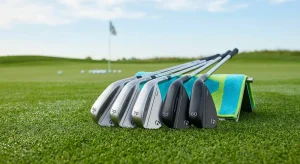

Bounce is one of the most misunderstood numbers on a wedge, yet it can make chipping and bunker play feel far easier. With wedge bounce explained in simple terms, you will learn what the angle does, how to read the stamping on your club, and how to match bounce to your swing and the courses you play.
Disclosure: Best Golf Clubs may earn a commission from qualifying purchases made through links on this site, including as an Amazon Associate, at no extra cost to you.
What Is Wedge Bounce?
Bounce angle is the angle between the leading edge of the wedge and the lowest point of the sole when the shaft is upright. In other words, it describes how much the back of the sole hangs below the leading edge.
Think of the sole of a boat. A boat with a curved hull skims across water instead of diving under it. Similarly, a wedge with more bounce tends to skim through sand and turf, while a wedge with less bounce lets the leading edge sit closer to the ground.
Bounce is measured in degrees. Most wedge makers stamp it on the clubhead next to the loft.
Why Bounce Matters for Your Short Game
Bounce protects you from digging. When the leading edge enters the ground too steeply, the club can stick, and the ball comes up short. The bounce lets the sole contact the ground first, so the club keeps moving.
However, too much bounce for your conditions can cause the opposite problem. On firm, tight lies, a high-bounce sole can strike the ground and push the leading edge up into the middle of the ball. As a result, you may hit thin shots that fly too low and too far.
So the goal is not “more” or “less” bounce. Instead, the goal is the right amount for how you swing and where you play.
How to Read Wedge Stampings
Most wedges show two numbers together, often separated by a dot or dash. For example, a stamping of “56.10” or “56-10” usually means 56 degrees of loft and 10 degrees of bounce.
Some brands also add a letter that refers to the sole grind, such as a shape that removes material from the heel or toe. The grind changes how the bounce behaves when you open the face. Because grind names vary by manufacturer, check the maker’s own description rather than assuming letters mean the same thing across brands.
If your wedge has no visible bounce number, a club fitter or golf shop can measure it with a loft and lie machine.
Low, Mid and High Bounce Compared
Wedges are often grouped into three broad bounce categories. The exact ranges vary between manufacturers, so treat these as general guides rather than fixed rules.
| Bounce Category | Typical Range | Often Suits | Best Conditions |
|---|---|---|---|
| Low bounce | Often around 4 to 6 degrees | Shallow swings, “sweepers,” players who open the face often | Firm turf, tight lies, coarse or compact sand |
| Mid bounce | Often around 7 to 10 degrees | Moderate attack angles, most everyday golfers | Average or mixed conditions |
| High bounce | Often 10 degrees or more | Steep swings, “diggers,” players who take deep divots | Soft turf, lush grass, fluffy sand |
Because mid bounce covers the widest set of situations, it is usually the safest starting point if you are unsure.
Wedge Bounce Explained Through Your Divot Pattern
Your divots are one of the best clues for choosing bounce. Next time you practice from grass, look closely at what the club leaves behind.
Deep, Thick Divots (The Digger)
If you take large, deep divots, you probably have a steep angle of attack. In that case, more bounce can help the club glide rather than bury. Diggers often find high-bounce wedges more forgiving, especially on soft ground.
Shallow Divots or Bruised Grass (The Sweeper)
If you barely brush the grass or take thin, shallow divots, your attack angle is likely shallow. Consequently, lower bounce can help the leading edge get under the ball on tight lies.
Moderate Divots (The Neutral Swing)
If your divots are medium depth and fairly consistent, mid bounce is often a sensible fit. You can then adjust individual wedges based on how you use them.
Matching Bounce to Course Conditions
Your home course matters as much as your swing. Here is how conditions typically interact with bounce:
- Firm, fast fairways: Lower bounce often works better because the sole has less ground to push against.
- Soft, wet or lush turf: Higher bounce helps prevent the club from digging in.
- Fine, fluffy bunker sand: Higher bounce helps the club skim through without burying.
- Firm, compact or wet sand: Lower or mid bounce usually prevents the sole from skipping off the surface.
If you play a mix of courses, it is worth considering different bounce options across your wedges rather than one setting for all of them.
Building a Wedge Set With Different Bounce
Many golfers carry two to four wedges. Rather than matching bounce across all of them, you can vary it according to each club’s job.
- Pitching or gap wedge: These are often used for full shots from the fairway. Low to mid bounce typically works well here.
- Sand wedge: This club handles bunkers and many greenside shots. Mid to high bounce is common, depending on your sand.
- Lob wedge: Used for high, soft shots around the green. Players who open the face a lot may prefer lower bounce or a versatile grind.
Loft gapping matters too. Our guide on choosing the right wedge lofts explains how to space your wedges so you do not have big distance holes.
How Technique Changes Effective Bounce
The number stamped on the club is not the whole story. Your setup and technique change how much bounce actually comes into play.
- Opening the face adds effective bounce, which is why bunker shots often use an open face.
- Leaning the shaft forward reduces effective bounce, which can help on tight lies but increases the risk of digging.
- Ball position also matters. A ball played farther back tends to reduce effective bounce.
Therefore, two golfers with the same wedge may experience bounce very differently. A lesson can help you learn to use the sole rather than fight it.
Common Bounce Mistakes to Avoid
Even experienced golfers make a few predictable errors when choosing wedges. Watch out for these:
- Choosing by loft alone. Two 56-degree wedges can behave very differently if their bounce and grind differ.
- Testing only on mats. Hitting mats hide digging, so a low-bounce wedge may feel great indoors and then struggle on soft turf.
- Ignoring your bunkers. If you rarely escape the sand on the first try, the sole design may be working against you.
- Copying a tour player’s setup. Professionals often play firm, fast conditions and have highly refined technique. Their choices may not suit your game.
Above all, base your decision on your own divots and courses rather than what looks popular.
Quick Checklist for Choosing Bounce
- Check your divots: deep, moderate or shallow?
- Consider your home course: soft or firm turf?
- Look at your bunkers: fluffy or compact sand?
- Think about how often you open the face.
- Read the stampings on your current wedges.
- Test options on real turf or sand when possible, not only a hitting mat.
Where to Learn More
For broader equipment coverage, including wedge design trends, the equipment section at Golf Digest is a useful resource. Likewise, GOLF.com’s gear coverage regularly discusses bounce and grind in practical terms.
Frequently Asked Questions
Is high bounce better for beginners?
Often, yes. Many beginners have steeper swings and play softer courses, so mid to high bounce can be more forgiving. However, firm conditions may call for less.
Can I change the bounce on my wedge?
A fitter can sometimes adjust bounce slightly by bending loft or grinding the sole. Bending loft changes bounce as well, so discuss it with a professional first.
Does bounce matter on full shots?
It matters less than on short shots, but it still affects turf interaction. Diggers may notice cleaner contact with more bounce.
Final Thoughts
With wedge bounce explained, you can now read your stampings, study your divots and think about your course conditions before choosing a wedge. Start with mid bounce if you are unsure, then adjust based on what the turf and sand tell you.
This guide is general information. For the best results, consider a professional club fitting or a lesson with a qualified golf professional.