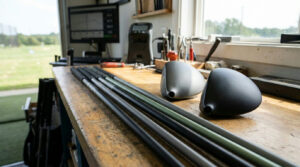

The fairway wood vs hybrid question comes up for almost every golfer once the long irons start feeling like a chore. Both clubs are built to hit the ball high and far from the turf, yet they get there in different ways. In this guide, we break down head shape, launch, and the lies each club handles best, so you can decide how to build the top end of your bag with confidence.
Disclosure: Best Golf Clubs may earn a commission from qualifying purchases made through links on this site, including as an Amazon Associate, at no extra cost to you.
Why the Top End of the Bag Matters
Most golfers have a clear plan for their irons and wedges. However, the space between the driver and the longest iron is often filled by habit rather than by design. That is a missed opportunity, because these clubs handle long par 4 approaches, reachable par 5s, and tee shots on tight holes.
If the gaps up there are too big or too small, you end up hitting awkward half swings or forcing a club you do not trust. For a wider look at spacing, our guide to golf club distance gaps walks through the full set. Here, we focus on the two main candidates for those long slots.
Head Shape: The Most Visible Difference
A fairway wood looks like a smaller driver. It has a wide, shallow face and a long, flat sole that runs well behind the face. A hybrid, on the other hand, is more compact. Its head is shorter from front to back, the face is a little taller, and the shape sits somewhere between a wood and an iron.
That difference in shape changes how each club behaves in practice:
- Fairway woods spread weight over a larger footprint, which pushes the center of gravity low and back. As a result, they tend to launch high and stay stable on off-center strikes from a good lie.
- Hybrids keep the mass closer to the face. Because of this, they are easier to control, and the narrower sole moves through thicker grass with less resistance.
Neither shape is better in every situation. Instead, think of each as a tool that suits certain shots.
Shaft Length and How It Feels Over the Ball
Fairway woods typically have longer shafts than hybrids of similar loft. A longer shaft can produce more clubhead speed, which is one reason a fairway wood often carries a touch farther. However, a longer club is also harder to strike consistently in the center of the face.
Hybrids usually sit closer to iron length. Consequently, many golfers find the setup more familiar. You stand a little closer to the ball, and the swing feels more like an iron swing than a sweeping wood swing. Length, loft and lie all interact, so a small change in one affects how the others feel.
Launch and Ball Flight
Both clubs are designed to get the ball airborne without a perfect strike. Even so, their flight patterns tend to differ.
Fairway Woods
A fairway wood generally launches high with moderate spin and a penetrating, sweeping flight. It often produces more roll after landing. That makes it useful when you want maximum distance on a second shot or a reliable option off the tee.
Hybrids
A hybrid often launches high as well, but the ball tends to come down at a steeper angle. As a result, it usually stops faster on the green. Golfers who struggle to hold greens with long irons often find hybrids helpful for this reason.
Also note that hybrids can lean toward a draw for some players, partly because of their upright lie and face design. If you already fight a hook, that is worth testing before committing.
Lie Types: Where Each Club Shines
This is where the fairway wood vs hybrid decision becomes practical. Think about where your long shots are usually played from.
| Situation | Fairway Wood | Hybrid |
|---|---|---|
| Tee shot on a tight hole | Strong choice for distance with control | Good choice when accuracy matters most |
| Clean fairway lie | Excellent; sole glides along the turf | Very good; easy to make solid contact |
| Light rough | Workable if the ball sits up | Usually easier; head cuts through grass |
| Thick rough | Often difficult | Better option, though still challenging |
| Fairway bunker | Risky unless the lie is clean | Often easier to pick cleanly |
| Bump-and-run around the green | Rarely used | A useful option from tight lies |
In short, fairway woods reward good lies and give you distance. Hybrids, meanwhile, are the more versatile choice when the ball is sitting down.
Swing Speed and Player Type
Swing speed plays a big role in choosing between these clubs. Slower swing speeds often struggle to launch long irons high enough, so higher-lofted fairway woods and hybrids both make sense. Faster swingers may prefer a hybrid or a driving iron because a fairway wood can balloon or spin too much for them.
Your strike pattern matters too. Golfers who sweep the ball off the turf often get along well with fairway woods. In contrast, golfers who hit down on the ball, taking a divot like they do with irons, frequently find hybrids more natural. Our guide on how to choose golf clubs by swing speed covers this in more detail.
Fairway Wood vs Hybrid: A Simple Decision Framework
If you are unsure which way to go, work through these questions in order:
- What is your longest iron that you hit confidently? Everything above it is the gap you need to fill.
- Where do your long shots come from? Mostly fairways and tees point toward a fairway wood. Frequent rough and uneven lies point toward a hybrid.
- Do you need the ball to stop quickly? If you are hitting into greens from long range, a hybrid’s steeper landing helps.
- Do you sweep or dig? Sweepers often prefer woods, while diggers often prefer hybrids.
- How many slots do you have? With 14 clubs allowed, adding one club may mean removing another.
Many golfers end up with a blend. For example, a common setup is a driver, one fairway wood for distance, and one or two hybrids to replace long irons. That combination covers both long tee shots and tricky approach lies.
Checking Your Gaps on the Range
Before you finalize anything, check your distances. Hit several shots with each candidate club and note the typical carry distance, not just your best shot. Then compare those numbers with your driver and longest iron.
- Look for roughly even steps between clubs.
- Watch for two clubs that land in the same place, which means one is redundant.
- Note how each club performs from different lies, not just a perfect mat.
- Pay attention to dispersion; a club you hit straighter may be worth more than extra yards.
Trying clubs before buying is the easiest way to avoid a costly mistake. Ask to hit from grass where possible, since mats can hide poor contact.
Fairway Wood vs Hybrid FAQs
Is a hybrid easier to hit than a fairway wood?
For many golfers, yes. The shorter shaft and compact head make solid contact more repeatable, especially from the rough. That said, golfers with a sweeping swing may find a fairway wood just as easy.
Can I carry both a fairway wood and hybrids?
Absolutely. In fact, many golfers do. The key is making sure each club fills a distinct distance and job.
Should a fairway wood and hybrid share the same loft?
Usually not. Two clubs with similar lofts often produce overlapping distances. Instead, space them so each covers its own yardage window.
For more on current equipment trends, the gear coverage at GOLF.com and the equipment section at Golf Digest are useful places to keep up with new designs.
Final Thoughts
The fairway wood vs hybrid debate has no single right answer. Fairway woods give you distance and a sweeping flight from good lies. Hybrids, by contrast, offer versatility, easier contact from rough, and softer landings. Start by identifying your gap, consider where you usually play from, and test both on the range. Once you match each club to a clear job, the top end of your bag becomes a strength rather than a guess.
This guide is general information. For the best results, consider a professional club fitting or a lesson with a qualified golf professional.