
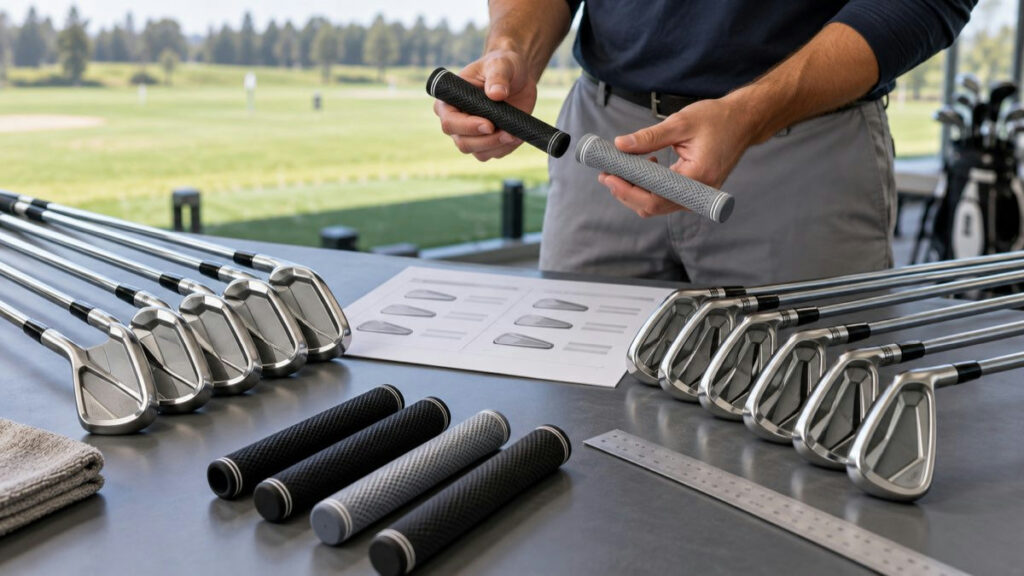
Disclosure: This direct-to-consumer golf clubs guide may contain links through which this site earns a commission from qualifying purchases. This checklist is designed to help you compare clubs and order terms, including brands we do not link to.
Direct-to-consumer golf clubs can look attractive when a familiar specification appears beside a lower advertised price. The practical question is whether the club you receive will fit your swing and whether you can resolve a mistake after ordering. A lower ticket price alone does not answer either question. This guide gives you a repeatable way to compare a direct-to-consumer (DTC) set with a set sold through a shop, without claiming that one channel always produces better clubs.
Start with your current clubs, a written list of the shots you want to improve, and the exact configuration you are considering. Then compare the full order: heads, lofts, shafts, grips, fitting help, delivery, and after-sales terms. You should be able to explain what you are changing before paying for it. If you are building your first bag, begin with the site’s beginner golf club guides before comparing custom options.
What do direct-to-consumer golf clubs mean for a buyer?
A DTC brand primarily sells through its own website rather than relying on a large chain’s shelf space. That sales route may change how you inspect, customize, and return an order. It does not tell you how a particular head will perform for your swing. Sub 70 offers an online fitting tool and says its clubs are built to order; Haywood lists in-person fitting appointments. Those examples show why it is more useful to check each company’s service than to assume every DTC purchase is an untested box at your door.
Make a comparison sheet with one column for your current set, one for each candidate, and one for uncertainties you must ask the seller to answer. Include the seller’s written policy link and the date you checked it. Catalog descriptions and policies can change, so save the version that applies before ordering.
1. Define the job the new clubs need to do
Write down the part of your bag that gives you trouble. Is there a large distance gap between your longest iron and shortest wood? Do you strike a specific iron inconsistently? Are you simply trying to replace worn grips? The answer determines whether you need a whole set, one club, or a service on clubs you already own. Avoid buying a full set to solve a single, poorly defined problem.
Record the model, shaft label, shaft flex, grip, and any known length or lie adjustment on your present clubs. Then note the typical carry distance and common miss for three clubs in the affected part of the bag. You do not need a perfect launch-monitor session to write an honest baseline. A range session with the same ball and similar conditions is enough to make your questions specific. If you do have measured data, keep the date, ball, and conditions beside the numbers so a fitter can interpret them.
2. Compare the actual set makeup, not only the set name
Two iron sets with the same number of clubs may cover different lofts. Open each manufacturer’s specification table and compare the loft of each numbered iron, the highest-lofted club included, and the next wedge you would need. A set that ends with a strong-lofted pitching wedge may leave a gap before your current sand wedge. That could change the total cost of the bag.
For example, Takomo publishes a product page for its Iron 201, and its iron comparison page separates several models by intended role. Use official model pages for the exact revision you are ordering. Do not copy a loft from a review of an older version into a current order sheet. If a manufacturer does not show an item you need, ask before you buy rather than guessing from the club number.
List the clubs you actually intend to carry, including your existing wedges, hybrids, and putter. For competition play, the USGA’s Rule 4 limits a player to 14 clubs. The rule does not tell you which 14 to select; your distance gaps and preferred shots should drive that decision.
3. Separate head choice from fit variables
The head is only one part of a club. Length, lie angle, shaft model and flex, grip size, and swing weight can all change the feel of an order. On your comparison sheet, give each variable its own row. Mark a row “unknown” when the seller has not specified it. Do not assume a stock option from one brand is equivalent to a stock option from another simply because both are called “regular” or “standard.”
Ask what the seller’s fitting recommendation is based on. Does the process use body measurements, your current club specifications, ball-flight data, an in-person session, or a short questionnaire? Sub 70 describes online fitting around club length, lie angle, and shaft flex; Haywood describes a fitting service at its headquarters. Neither page proves which club is best for you. They tell you what kind of input the seller can use.
If you can attend a fitting, bring your current seven iron and the ball you normally play. Hit your current club first and again near the end, so fatigue or a changing swing does not turn a single early number into the whole story. Compare the pattern of strikes and dispersion as well as your best shot. Ask the fitter to write down the exact specification they recommend, not just the brand and model.
4. Test the purchase path before you buy
A DTC order often asks you to choose configuration options on a product page. Walk through that page without paying. Confirm the handedness, set composition, shaft, flex, length, lie adjustment, grip, and shipping destination. Take a screenshot or save the final configuration as a PDF. Check whether the selection of a custom shaft or nonstandard length changes the return terms. Ask whether the order can be altered after submission and how a correction is requested.
Read the warranty, returns, shipping, and repair pages for the exact company and region you are using. A headline such as “easy returns” may have conditions for used, personalized, or custom-built clubs. Check who pays shipping in each direction, when the return window begins, and whether a fitting adjustment is available after delivery. Do not infer those terms from another region’s storefront. If the policy is ambiguous, contact support and keep the written reply with your order record.
Include tax, shipping, an additional wedge, possible grip changes, and any fitting fee in your comparison. The useful number is the cost of a bag that works for you, not just the price printed beside the iron set. If a local shop includes follow-up adjustment or a chance to hit the club before purchase, put that service in the comparison too.
5. Plan a fair first session with the delivered clubs
When the clubs arrive, compare the packing slip with the configuration you saved. Check each club’s label and visible finish, then photograph any shipping damage before play. Do not make a technical judgment from one range bucket. Start by hitting a few familiar shots with your old club, then alternate old and new clubs using the same ball type. Record contact location, flight shape, carry if measured, and whether the club feels comfortable at address.
If a club is unexpectedly difficult to strike, compare the delivered specifications with the order confirmation before assuming the head is wrong. A grip that feels too large or a length that differs from your order is a service issue, not a verdict on the model. Contact the seller within the relevant policy window and describe the specific mismatch. A concise note with photos and the order number is more useful than a broad statement that the club “doesn’t work.”
Questions to ask before ordering direct-to-consumer golf clubs
- Which exact model revision and club numbers are included?
- What are the loft, length, lie, shaft, and grip options for that configuration?
- Can I test or be fitted for this model in person, or is the recommendation online only?
- What changes to a custom order affect returns or warranty service?
- What is the full delivered cost after shipping and any missing clubs?
- Who handles a wrong specification, damage, or later adjustment?
Direct-to-consumer golf clubs can be a sensible shortlist option when the specifications and service path suit you. The strongest buying decision is one you can trace: a defined problem, a comparable configuration, a written fitting recommendation where possible, and clear terms for what happens after delivery. If any of those pieces is missing, pause the order and get the answer first.