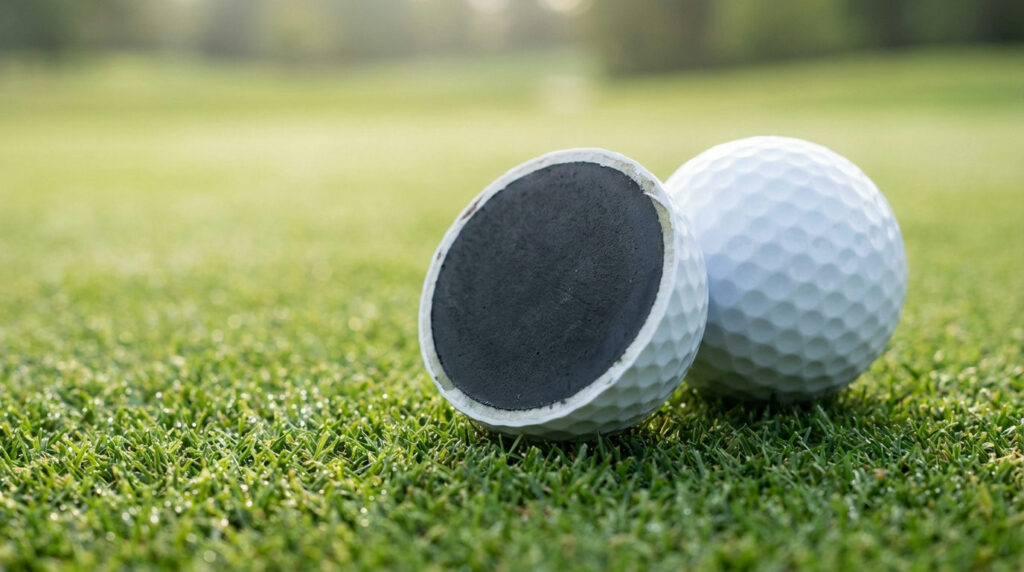
Golf ball construction explained simply comes down to layers: what sits at the center, what wraps around it, and what material forms the outside. Those layers shape how the ball spins, how it feels off the face, and how it behaves around the green. Once you understand them, the wall of ball boxes at the shop becomes far easier to read.
Disclosure: Best Golf Clubs may earn a commission from qualifying purchases made through links on this site, including as an Amazon Associate, at no extra cost to you.
Why Ball Construction Matters
The ball is the only piece of equipment you use on every shot. Even so, many golfers pick one based on habit or packaging. That is a shame, because construction affects driver spin, iron control, and wedge stopping power all at once.
If you have already read about ball compression, think of this guide as the other half of the picture. Compression describes how much a ball deforms under impact. Construction, on the other hand, describes how the ball is built to manage speed and spin through each layer. The two work together, but they are not the same thing.
The Three Main Parts of a Golf Ball
Nearly every modern ball uses some combination of three components. The number of layers and the materials used are what separate one design from another.
The Core
The core is the engine of the ball. It is usually made from a rubber compound, and it stores and releases most of the energy at impact. Generally, a larger, livelier core produces more ball speed and lower spin on full shots. Some cores are also built in stages, with a softer center and a firmer outer region, to fine-tune how the ball reacts to different swing speeds.
The Mantle
The mantle is a layer between the core and the cover. Not every ball has one. When it is present, it helps manage spin, often keeping driver spin lower while allowing more spin on shorter shots. Some balls use more than one mantle layer for extra control over how spin changes from club to club.
The Cover
The cover is what touches the clubface, and therefore it has a big influence on feel and greenside spin. The dimple pattern molded into the cover also controls how the ball moves through the air. Covers are usually made from one of two broad material families, which we cover below.
Two-Piece Golf Balls
A two-piece ball has a core and a cover, with no mantle. It is the simplest design, and it remains popular for good reasons.
- Lower spin overall. Two-piece balls tend to spin less on full shots, which can reduce the curve on a slice or hook.
- Durability. Most use a firm ionomer cover that resists scuffs and cuts.
- Straightforward distance. The large core often produces solid ball speed, especially off the driver.
However, there is a trade-off. Lower spin also means less bite on wedge shots. As a result, a two-piece ball may release and roll out more on the green, which makes it harder to stop the ball close to the hole on short shots.
Multilayer Golf Balls
Multilayer balls add one or more mantle layers, creating three-, four- or even five-piece designs. The goal is to separate how the ball behaves with different clubs.
In simple terms, the inner layers can keep spin lower on fast driver swings, while the outer layers and soft cover add spin on slower, shorter shots. Because of this, a well-designed multilayer ball can offer both distance off the tee and control around the green.
That said, more layers do not automatically mean a better ball for you. The benefits tend to show up most for golfers who make consistent contact and generate enough speed to activate the different layers. For many golfers, a good three-piece design is plenty.
Cover Materials: Ionomer vs Urethane
Cover material is one of the most important parts of golf ball construction. Here is how the two main options compare.
| Feature | Ionomer (often called Surlyn) | Urethane |
|---|---|---|
| Feel | Firmer, clicky | Softer, more muted |
| Greenside spin | Lower | Higher |
| Durability | Very scuff resistant | Scuffs more easily on wedges |
| Full-shot spin | Lower, often straighter | Depends on core and mantle design |
| Typical use | Two-piece and distance balls | Multilayer tour-style balls |
The key point is that urethane grips the grooves more on short shots. Consequently, chips and pitches tend to check up faster. Ionomer, by contrast, slides more on the face, which reduces spin but also makes the ball very durable.
How Construction Affects Spin and Feel
It helps to think about spin in three zones rather than one.
- Driver spin: Mostly controlled by the core and mantle. Lower spin here often means more distance and less curve.
- Iron spin: A blend of all layers. More spin helps the ball land softly and hold greens.
- Wedge and greenside spin: Dominated by the cover. This is where urethane usually stands out.
Feel follows a similar pattern. A soft core can make any ball feel gentle off the driver, whereas the cover shapes the sensation on putts and chips. Clubface design also plays a role, since grooves and face materials affect how the ball grabs. Our guide to modern clubface technology explains that side of the equation.
Matching Construction to Your Game
Choosing a ball is less about finding the best one and more about finding the right fit. Use this checklist as a starting point:
- You lose a lot of balls or want durability: A two-piece ionomer ball is a sensible choice.
- Your main miss is a big slice or hook: Lower-spinning designs may reduce curve on full shots.
- You want shots to stop quickly on the green: A multilayer ball with a urethane cover is worth trying.
- You have a moderate swing speed: Many three-piece balls are designed to perform without requiring tour-level speed.
- You value feel on putts and chips: Test softer covers and pay attention to sound and feedback.
Swing speed influences how a ball’s layers respond, so it is worth understanding your own numbers. Our guide on how to choose golf clubs by swing speed explains why speed matters throughout your equipment choices.
Common Myths About Ball Layers
A few ideas come up often enough that they are worth clearing up. With golf ball construction explained layer by layer, these myths are easier to spot.
- “More layers always means more distance.” Not necessarily. Extra layers are mainly about controlling spin across different clubs, not adding raw speed.
- “Soft balls are only for slow swingers.” Softness can come from the core, the cover or both. Plenty of faster players use soft-feeling multilayer balls.
- “A premium ball fixes a slice.” In fact, higher-spinning balls can exaggerate curve on full shots. A lower-spin design may help more.
- “Ball choice only matters for good players.” Every golfer chips and putts, so cover feel and greenside spin matter at every level.
A Simple Way to Test Golf Balls
The best testing starts at the green and works backward. Short shots reveal cover differences most clearly, and they are where most strokes are saved.
- Hit several chips and pitches with two different balls and watch how quickly each one stops.
- Next, compare a few full wedge and mid-iron shots for height and landing behavior.
- Finally, hit drivers and note any change in curve or carry.
- Repeat on another day before deciding, since one session can mislead.
Golf Ball Construction Explained: Common Questions
Are all golf balls the same size and weight?
Balls used under the Rules of Golf must meet limits on size, weight and performance. The USGA maintains these standards along with a list of conforming balls.
Does a urethane cover help high handicappers?
It can. Better greenside spin benefits anyone who chips and pitches regularly. However, durability and full-shot spin also matter, so test both types.
Where can I follow new ball designs?
Equipment coverage such as the GOLF.com gear section regularly discusses new constructions and materials.
Final Thoughts
With golf ball construction explained, the choice gets clearer. Two-piece balls generally offer durability and lower spin, while multilayer balls with urethane covers often add short-game control. Think about where you lose strokes, test from the green backward, and pick the construction that supports your game rather than the one with the most layers.
This guide is general information. For the best results, consider a professional club fitting or a lesson with a qualified golf professional.