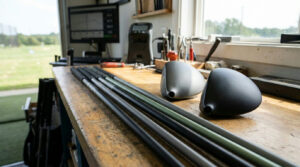

Walk past any golf bag and you will see a jumble of numbers and letters: 3, 5, 7, P, G, S. If you are new to the game, or simply never got a clear answer, this guide has golf club numbers explained in a practical way. You will learn what the numbers and letters mean, how they relate to loft and distance, and which job each club usually does on the course.
Disclosure: Best Golf Clubs may earn a commission from qualifying purchases made through links on this site, including as an Amazon Associate, at no extra cost to you.
The Basic Rule: Lower Number, Less Loft
The single most useful idea is this: within a category, a lower number means less loft and a longer shaft. As a result, lower-numbered clubs generally send the ball farther and lower, while higher-numbered clubs send it shorter and higher.
For example, a 5-iron has less loft than a 7-iron, so it usually flies farther with a flatter trajectory. Similarly, a 3-wood has less loft than a 5-wood. However, the number itself is not a universal measurement. Manufacturers set their own lofts, so a 7-iron from one set may have noticeably different loft than a 7-iron from another.
If you want to dig deeper into how loft works, our guide to golf club loft and lie covers it in detail.
Golf Club Numbers Explained by Category
Golf clubs fall into a handful of families. Each family has its own numbering, so it helps to take them one at a time.
Driver (Sometimes Called the 1-Wood)
The driver has the lowest loft of any club except the putter and the longest shaft. Its main job is the tee shot on longer holes, where distance off the tee sets up an easier approach. Most players only hit it from a tee.
Fairway Woods: 3-Wood, 5-Wood and 7-Wood
Fairway woods have smaller heads than a driver and more loft. A 3-wood is often used as a second option off the tee when accuracy matters, and it can be hit from the fairway on long par 5s. Meanwhile, a 5-wood or 7-wood is easier to launch from the grass and is popular with players who find long irons difficult.
Hybrids: 3-Hybrid, 4-Hybrid and Beyond
Hybrids blend the shape of a wood with the length of an iron. They are usually numbered to match the iron they replace, so a 4-hybrid is designed to cover a similar gap to a 4-iron. In other words, they offer a more forgiving way to hit long approach shots, especially from the rough.
Irons: 3-Iron Through 9-Iron
Irons are the core of most sets. They are often grouped this way:
- Long irons (3 to 5): longer approach shots and tee shots on tight holes. Many modern sets skip the 3-iron and sometimes the 4-iron.
- Mid irons (6 to 7): mid-length approach shots and a common choice for par 3s.
- Short irons (8 to 9): shorter approaches where accuracy and stopping power matter more than distance.
Wedges: PW, GW, SW and LW
Wedges switch from numbers to letters, which confuses many golfers. Here is what the letters mean:
- PW (pitching wedge): the next club after the 9-iron, used for full shots into greens and longer chips.
- GW (gap wedge): fills the distance gap between the pitching wedge and sand wedge. It may also be labeled AW (approach wedge) or UW (utility wedge).
- SW (sand wedge): designed for bunker play, with a wide sole that helps the club glide through sand. It is also a go-to club for pitches and chips.
- LW (lob wedge): the highest-lofted wedge, used for high, soft shots over hazards or to tight pins.
Some wedges are marked with their loft in degrees instead of letters, such as 52 or 56. Pitching wedges in modern sets are typically somewhere in the mid-40s of loft, while sand wedges are often in the mid-50s, but always check the specs for your own clubs.
Putter
The putter has no number. It is used on the green to roll the ball into the hole, and many players also use it from just off the green when the grass is short and smooth.
Golf Club Numbers Explained: Quick Reference Table
| Club | Typical job | Common lie |
|---|---|---|
| Driver | Maximum distance off the tee | Tee |
| 3-wood | Long tee shots, long second shots | Tee or fairway |
| 5-wood / 7-wood | High, long approaches | Fairway or light rough |
| Hybrid | Forgiving replacement for long irons | Fairway or rough |
| 4- to 6-iron | Longer approach shots | Fairway |
| 7- to 9-iron | Mid and short approaches | Fairway or tee on par 3s |
| PW / GW | Full and partial shots into greens | Fairway, rough |
| SW / LW | Bunkers, pitches, high soft shots | Sand, rough, around the green |
| Putter | Rolling the ball on the green | Green and fringe |
Why Your 7-Iron Might Not Match Your Friend’s
Many golfers compare distances with playing partners and feel confused. The reason is that the number on a club describes its position in a set, not a fixed loft. Over time, many game-improvement sets have used stronger lofts to help the ball travel farther. Consequently, one person’s 7-iron may play more like another person’s 6-iron.
This matters when you mix clubs from different sets. Instead of trusting the number, check the actual loft and how far you carry each club. That way, you avoid two clubs that go the same distance or a big gap where you have nothing.
How Many Clubs Can You Carry?
Under the Rules of Golf, published by the USGA and The R&A, you may carry no more than 14 clubs during a round. That means you need to choose which numbers earn a spot. For guidance on building a sensible lineup, see our article on how many golf clubs you need.
Beginners often do well with fewer clubs. A driver or 3-wood, a hybrid, a few irons, a pitching wedge, a sand wedge and a putter can cover most situations while you learn.
Practical Tips for Choosing the Right Club
- Learn your carry distances. Hit several balls with each club at a range or on a launch monitor and note the average carry.
- Plan for the shot, not the hero shot. Pick the club you can hit solidly most of the time, not the one you flush once a month.
- Consider the lie. From thick rough, a hybrid or higher-lofted club is often easier than a long iron.
- Account for conditions. Wind, elevation and firm or soft ground all change how far the ball travels.
- Ask for help. Coaches certified through organizations such as the PGA of America can show you how to match clubs to shots.
Frequently Asked Questions
Why don’t most sets include a 1-iron or 2-iron anymore?
Very low-lofted irons are hard for most golfers to launch. Hybrids and fairway woods usually do the same job with more forgiveness, so many manufacturers leave them out.
Is a gap wedge necessary?
Not always, but it is common. If there is a large distance gap between your pitching wedge and sand wedge, a gap wedge helps you avoid awkward half swings.
Do women’s and senior clubs use the same numbers?
Yes. The numbering system is the same, although lofts, shaft lengths and weights may differ to suit different swing speeds.
Final Thoughts
With golf club numbers explained, the bag becomes far less mysterious. Lower numbers mean less loft and more distance, letters mark the wedges, and each club has a typical job. Above all, learn your own distances so the numbers mean something for your game.
This guide is general information. For the best results, consider a professional club fitting or a lesson with a qualified golf professional.