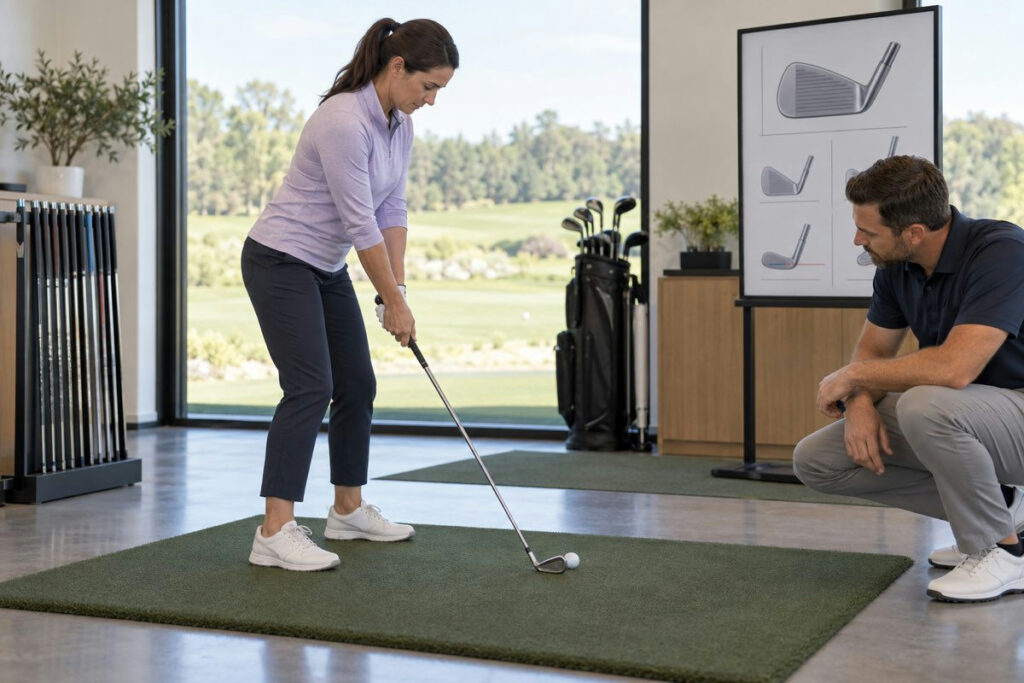
Shopping for golf clubs for shorter golfers often begins with a misleading rule: take a standard set and simply cut every shaft down. Height matters, but it does not tell a fitter where your hands fall, how you deliver the club, or whether a particular head and shaft combination feels controllable. Two golfers of the same height can have different arm lengths, postures, and swings. A sensible fitting starts with measurements, then checks real shots before any purchase or modification.
This adult golfer’s guide explains how length and lie angle interact, what to test, and when modifying existing clubs is worth the cost.
Start with height and wrist-to-floor measurement
A fitter may ask for your height and the distance from your wrist crease to the floor while you stand naturally. These measurements provide a starting point for club length and lie angle. PING’s iron fitting chart describes using both measurements for an initial color code and recommended length. The manufacturer also stresses that a fitter can refine that starting point from ball flight and feedback. The chart belongs to PING’s system, so do not treat one color or length as a universal prescription for every brand.
Measure in your usual golf shoes without reaching or bending artificially. Repeat a surprising measurement. Your fitter should also watch your address and impact because a static number cannot capture a swing.
The PGA’s account of a club fitting gives an example of a golfer whose height alone obscured the effect of relatively long arms and unsuitable club specifications. The useful lesson is to describe your body and your ball flight, rather than assume that “shorter person” means “shortest stock shaft.”
Why club length and lie angle belong together
Length changes where the handle sits when you set up. Lie angle describes the angle between the shaft and the ground when the club is in its designed position. A length change can alter how the sole meets the turf and how you position your hands. It can also alter strike location, timing, and distance. That is why a club that feels easier to reach while standing still still needs a test through impact.
For irons, the fitter can examine strike marks, launch direction, and the sole’s contact pattern with appropriate fitting tools. Ask to see the evidence rather than accepting a label such as “flat” without explanation. PING says that both iron lie angle and shaft length influence shot direction and consistency. A useful fitting compares several plausible combinations and keeps the one that works with your normal swing, not an exaggerated posture you can hold for only a few swings.
Do not assume that every club in the bag needs the same amount of shortening. A driver, a 7-iron, a wedge, and a putter serve different tasks. The best length for a driver may involve a control-versus-speed tradeoff; the best iron length must be evaluated with lie and strike; a putter is judged largely through setup and roll. Test each family separately before ordering a whole set to one blanket specification.
How to judge irons during a fitting
Begin with a familiar middle iron from your current set. Hit enough shots to show your normal pattern, not just a single best strike. Record where the ball contacts the face, how the club feels through turf, and where the ball starts. Then test an alternative length and lie combination with a comparable head and shaft. If the head, shaft weight, and flex all change at once, it becomes harder to attribute any improvement to length.
Ask the fitter to compare representative misses as well as the best shots. A candidate that produces one exciting launch-monitor number but widens your usual dispersion may be a poor match. You should be able to stand in a comfortable posture and reach the ball without crowding your hands into your body or stretching them away. The fitter can help distinguish an equipment problem from a setup habit.
Test a shorter iron or wedge too. If the fit works with a 7-iron but feels awkward with a wedge, ask whether the set’s length progression or lie specifications need adjustment.
What to test with driver, woods, and hybrids
A shorter player may find a long stock driver difficult to center consistently, but the shortest driver is not automatically the best. A shorter shaft can improve a golfer’s sense of control; it can also change head feel and club speed. PGA of America fitting guidance describes how a shorter driver shaft helped one player’s consistency. Treat that as a reason to test a shorter option, not as a guarantee that it will add distance for you.
Compare driver options with the same ball, similar loft, and a consistent swing effort. Watch strike location first. If a candidate helps you find the center more often, compare the resulting carry, total distance, and dispersion over several shots. A small gain in average distance is less valuable if more drives leave your intended corridor. Ask the fitter to check swing weight or head feel if shortening makes the club feel unusually light.
Assess fairway woods and hybrids from the lies where you actually use them. A perfect tee can hide a club that feels difficult from turf. Our club-selection guide by handicap can help you decide which clubs belong in your bag; fitting determines their specifications.
Grip size and shaft weight also affect comfort
Golf clubs for shorter golfers are sometimes marketed as lighter or smaller in every component. That package may suit some buyers but not all. Grip size relates more directly to hands and how you hold the club than to height alone. PING’s grip chart starts from hand measurements, then leaves room for a fitter to adjust based on ball flight and player feedback. If a short club has a grip that makes you squeeze too hard, the length alone will not solve the problem.
Shaft weight and flex should also be tested rather than inferred from stature. A strong, fast-moving golfer can be short; a taller golfer can swing slowly. Try a few combinations that keep the test controlled. Ask the fitter what changed and why. If a shorter club feels very different from your old one, part of that may come from weight distribution, not the half-inch difference you expected to notice.
Should you shorten clubs you already own?
Modification can be sensible when the heads and shafts otherwise fit and the grips need replacement anyway. It can also create new costs: regripping, checking lie angle, and possibly restoring preferred head feel. Before cutting a set, ask the shop for an itemized estimate and a test plan. If feasible, adjust one representative iron first. Play or practice with it long enough to know whether the change helps your ordinary shots.
A fitter or qualified repair shop should explain which specifications can be adjusted on your particular heads. Some irons permit lie changes more readily than others; do not assume every model can be bent safely. Shortening a driver may also require attention to balance. A purchase of properly fitted replacement clubs may be better value if several components of the current set are unsuitable.
A used set can be a good starting point if its specifications are known. Check actual playing length, lie if available, shaft model, grip size, and condition. “Women’s,” “petite,” and “junior” are retail labels, not fitting results. An adult golfer should evaluate whether the club’s length, head weight, shaft, and grip work together. Our new-versus-used club guide offers a broader condition checklist before you commit.
Golf clubs for shorter golfers: questions for the fitter
- What are my height and wrist-to-floor measurements, and what starting specifications do they suggest for this brand?
- What do my face impact pattern and typical start line show with my current clubs?
- Which length and lie combinations did we compare, with the same or similar head and shaft?
- Do the recommended changes work across a middle iron and a shorter scoring club?
- What happened to strike, dispersion, and distance control when the driver length changed?
- What will the finished clubs weigh and feel like, and what would each alteration cost?
Bring your current clubs, usual golf shoes, and the ball model you normally play if possible. Tell the fitter which shot you struggle with and which club you already trust. A good session should give you understandable reasons for a recommendation. If the evidence is mixed, it is reasonable to keep practicing or seek a second fitting before buying a full set.
Frequently asked questions
Can I just grip down instead of cutting a shaft?
Gripping down can be a useful, reversible test. It also changes where your hands meet the taper of the grip and may not feel the same as a properly built shorter club. Use it to identify a possible direction, then test the finished specification.
Choose from the evidence
The right golf clubs for shorter golfers are clubs fitted to the individual, not a fixed “short” set. Use height and wrist-to-floor measurements as a starting point, then check length, lie, strike, comfort, and ball flight by club category. Make a small reversible test before modifying a whole bag. If a shorter or flatter setup helps you make repeatable contact without forcing a new posture, you have a sound reason to buy or adjust. If it does not, keep looking at the whole fit instead of cutting shafts by rule of thumb.